

|
Getting your Trinity Audio player ready...
|
DURHAM, N.C. — At one point, snowflakes were falling so fast on the field inside the Carolina Panthers football stadium that it looked like a TV cutaway to Buffalo, New York — not glossy, uptown Charlotte, North Carolina. In the South Carolina Lowcountry, there was the unusual sight of snow tumbling across palm trees, adorning the crooked branches of Southern live oaks that dripped with Spanish moss.
And on Oak Island, North Carolina, ocean waves lapped against a whitened shoreline where footprints, typically marked by flip-flops, were now sparingly stamped by snow boots.
Carolinians from the mountains to the coastal islands were taking in a rare frigid world Sunday, as back-to-back weekends of Arctic blasts sunk temperatures into the single digits at times, halted travel on treacherous roads and dumped blizzard-like conditions across both states, as if they were encased in a snow globe.

“This has truly been a historic storm that will be talked about for decades to come,” said the National Weather Service in Wilmington, North Carolina, which was on the low end of the snowfall spectrum with about 5.8 inches.
Some parts of Pender County, north of Wilmington, received 18 inches. The general range along the coast was about 6 to 10 inches, an amount not seen in almost 40 years, said Rachel Zouzias, a meteorologist with the weather service in Wilmington.
“It’s a remarkable storm for us,” she said. “It takes decades, probably, to receive another one like this. For some people, it’s the storm of their life.”
Even as many people were seemingly enjoying the snow, the copious amounts of it were already posing a hazard.
Gov. Josh Stein of North Carolina said in a news conference Sunday that there had been more than 1,000 collisions over the weekend, leading to two deaths. There was also a major traffic jam Saturday afternoon on Interstate 85 after a collision involving a tractor-trailer and a Jeep. More than 100 vehicles were stranded or stuck on the road as snow piled up. The state highway patrol and the North Carolina National Guard cleared the jam in three hours Saturday night.
“Our message today is to stay off the roads,” Stein said Sunday.
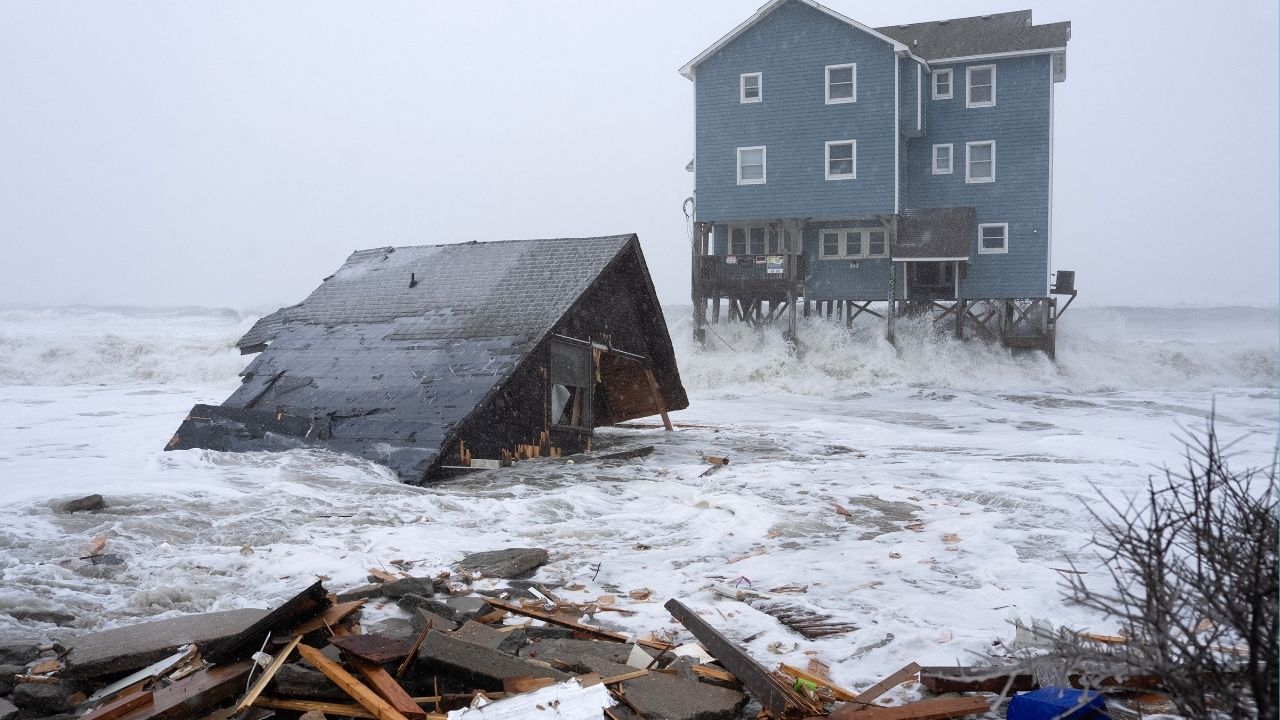
In the Outer Banks, road conditions rapidly deteriorated overnight. On Sunday, Highway 12, a roughly 150-mile-long byway that connects North Carolina’s islands and peninsulas, was closed as parts of it were washed over by the ocean.
Similar road hazards were also present in South Carolina over the weekend. In Greenville, authorities pleaded with residents to stay home, as officers responded to multiple traffic crashes, prompting the local police department to declare Saturday evening that it would not dispatch officers to single-vehicle collisions that did not involve injuries.
“Yesterday we warned everyone about how slick the roads were, and that danger hasn’t gone away,” Howie Thompson, chief of the Greenville Police Department, said in a statement Sunday. “Overnight, we saw wrecks caused by icy conditions, and as the day goes on, we’re concerned that more people will venture out to shop or attend activities. Every slide on the ice puts residents and our officers at risk.”
Stein echoed those concerns, saying that black ice on roads would remain an issue throughout the week. More than 2,500 employees of the state’s department of transportation were working overtime Sunday to clear roads, but officials warned that the operation could take days on the main roads, and possibly up to a week on secondary roads.
There were more than 10,000 customers in the Carolinas without power early Sunday afternoon. Air travel was also affected Sunday: About 56% of flights at Charlotte’s main airport were canceled, and so were roughly a quarter of the flights at the major airport that serves Raleigh and Durham, North Carolina. In the main airports that serve Wilmington and Myrtle Beach, South Carolina, more than 60% of flights were canceled.
Early Sunday morning, as heavy snow in the Carolinas was beginning to taper off, forecasters warned that strong winds were expected to spread north along the East Coast as the powerful storm moved out to sea.
“Even after the snow moves out of the Carolinas this morning, that storm is going to deepen off the coast, and that’s going to cause a lot of wind along the eastern seaboards,” said Brian Hurley, a meteorologist at the Weather Prediction Center. Most of the snowfall will stop around midday Sunday, he added.
Many Carolinians were hesitant to step outside Sunday. But there seemed to be at least some time for play.
The Riverbend Creamery in rural Lincolnton, North Carolina, shared a Facebook post about how to make “snow cream.” One cup of milk, some sugar, a splash of vanilla extract, salt and, most importantly, a bowl of fresh — and hopefully very clean — snow.
Many pastors postponed services to midweek and took the day off Sunday, including the Rev. Dr. Derrill Blue, who presides over the Little Rock AME Zion Church in Charlotte.
His family had spent seven years living in Rochester, New York, so there was not as much glee about the weather in the Blue household as in other parts of the state. But with no Sunday service to dress up for, the children were lounging around the house, playing video games.
“They’re like, ‘It’s nice, but we don’t want to go back out,’” Blue said, taking a break from making pancakes. “They said, ‘We’re going to look at it from the inside, because we are not going outside!’”
—
This article originally appeared in The New York Times.
By Eduardo Medina/Daniel Pullen
c. 2026 The New York Times Company