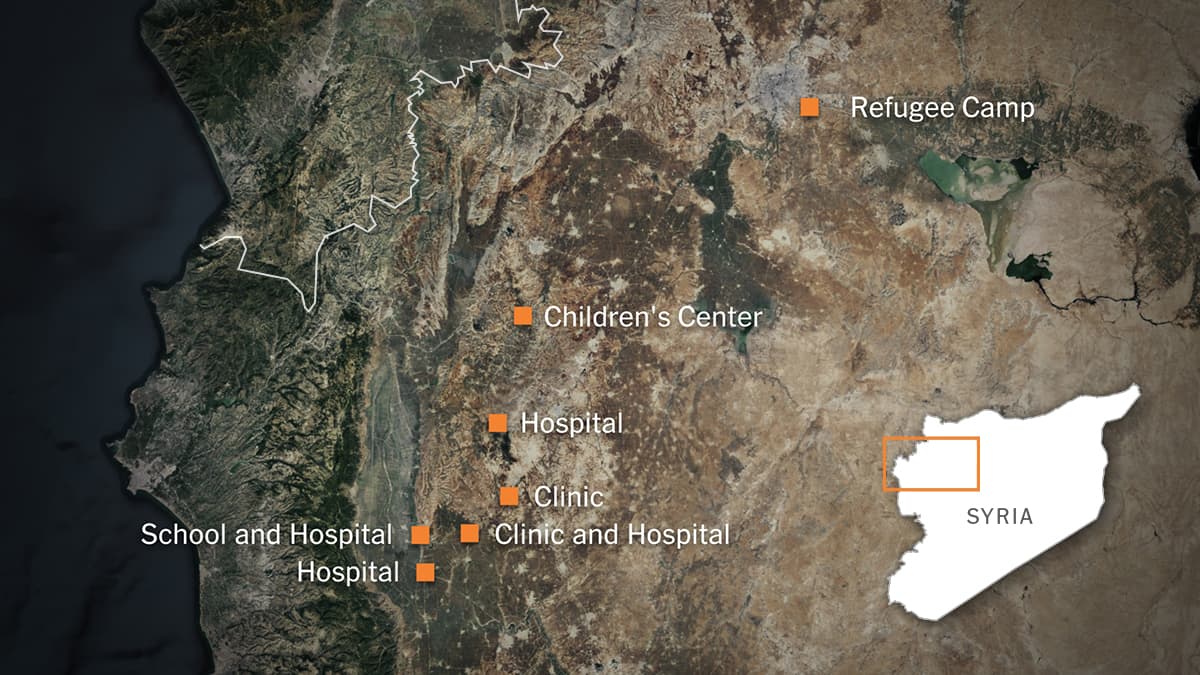
The bombs smashed into a child care center, a refugee camp and a school. They destroyed makeshift clinics and hospitals, disabling essential services for tens of thousands of people.
Over the past year, attacks on buildings in northwestern Syria, which are supposed to be off limits during wartime under international law, grew so frequent that the head of the United Nations launched an inquiry to document the violations.
Secretary General António Guterres’s establishment of the investigation is seen by many diplomats as a success at a United Nations largely stymied by division in the powerful Security Council. Russia, a Syrian government ally and a major perpetrator of these attacks, has cast 14 vetoes in the Security Council since the start of the war in Syria, blocking accountability efforts and hindering humanitarian aid deliveries into Syria.
Since April, at least 60 health facilities in northwestern Syria have been damaged in strikes, and at least 29 of them were on the off limits list. But the United Nations, at least so far, is looking at just seven incidents. A United Nations spokesman would not say how the inquiry’s sites were determined. Seven incidents on the United Nations list investigated by The Times. (Satellite image by Landsat and Copernicus, via Google Earth)Read More →
By Malachy Browne, Christiaan Triebert, Evan Hill, Whitney Hurst, Gabriel Gianordoli and Dmitriy Khavin | 31 Dec 2019
To provide the best experiences, we use technologies like cookies to store and/or access device information. Consenting to these technologies will allow us to process data such as browsing behavior or unique IDs on this site. Not consenting or withdrawing consent, may adversely affect certain features and functions.
Functional
Always active
The technical storage or access is strictly necessary for the legitimate purpose of enabling the use of a specific service explicitly requested by the subscriber or user, or for the sole purpose of carrying out the transmission of a communication over an electronic communications network.
Preferences
The technical storage or access is necessary for the legitimate purpose of storing preferences that are not requested by the subscriber or user.
Statistics
The technical storage or access that is used exclusively for statistical purposes.The technical storage or access that is used exclusively for anonymous statistical purposes. Without a subpoena, voluntary compliance on the part of your Internet Service Provider, or additional records from a third party, information stored or retrieved for this purpose alone cannot usually be used to identify you.
Marketing
The technical storage or access is required to create user profiles to send advertising, or to track the user on a website or across several websites for similar marketing purposes.



















![[hubspot type=form portal=8576119 id=f5235c74-daca-46b2-b841-0fec24b5a509]](https://gvwire.com/wp-content/uploads/2026/09/GVH_LaborDaySavings_300x250_static.jpg)
