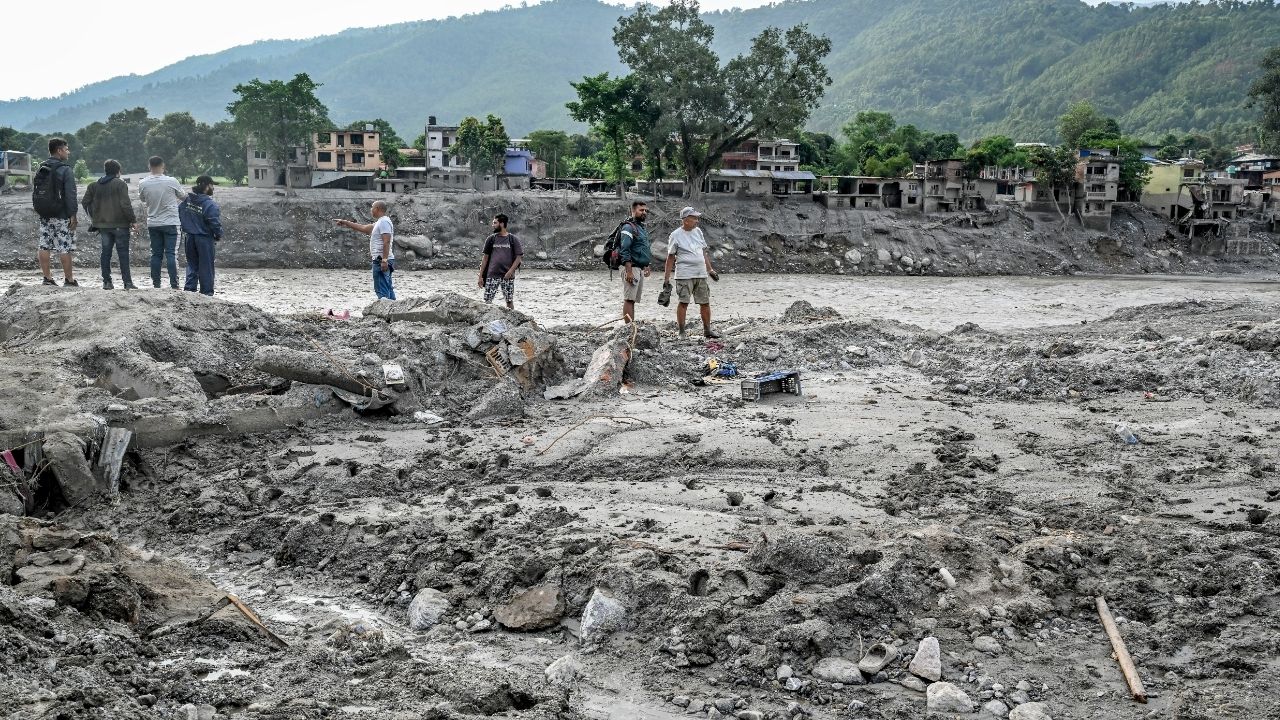

Putting the cost of recovery at $5 billion, a senior Nepali official said his country had requested urgent financial help from the United Nations’ special fund for climate-disaster recovery.
The official, Maheshwar Dhakal, the climate change chief in the Ministry of Agriculture, Forest and Environment, explicitly asserted that human-caused climate had been a factor in last week’s horrific glacial collapse and flooding. In an interview Monday he framed the event as an inequity in which decades of greenhouse-gas emissions from richer nations are harming vulnerable countries like his that can’t cope.
“Those who have contributed the least are suffering the most,” said Dhakal, who shared a letter his government sent to the fund’s board and that echoed that language.

It was a version of this argument, used for years at international climate conferences, that persuaded negotiators to agree to the special U.N. climate fund in 2023, after years of talks.
But the program has been held back by wealthy nations, including the United States, which have been reluctant to contribute. As a result, the fund is ill-equipped for a disaster of this scale, leaving stricken nations with few good options.
The fund has so far received $820 million in pledges. The United States, historically the largest emitter of greenhouse gases, pledged $17.5 million under President Joe Biden but then exited the fund under President Donald Trump. The fund, which is now preparing to disperse its first payments, had already received requests from at least 119 countries totaling $2.8 billion and has acknowledged a “significant financing gap.”
“There is no fund that is able to respond to this at the moment,” said Richard Sherman, a South African who is one of the fund’s board members. “The countries that have caused climate change are not the ones paying for it.”
Sherman, a former co-chair of the board, said that without the United States, “nobody is stepping up to fill the gap. So we’re stuck in the mud, unfortunately.”
He estimated that the U.N. loss-and-damage fund could conceivably allocate $20 million to Nepal, given the demands from other nations. “It’s nothing,” said Sherman, who said he had proposed that the board meet “as soon as possible” to help Nepal. Sherman also said that a country like Nepal could turn to the World Bank for loans.
A spokesperson for the U.N. fund did not immediately offer a comment.
The White House did not address questions about the climate disaster fund and about its approach to helping vulnerable countries. It referred questions to the State Department, which did not immediately respond.
The Trump administration has pulled the United States from the Paris Agreement, the main treaty for addressing climate change. This year it also withdrew from the Green Climate Fund, a separate program established in 2010 that is aimed at preventing climate damages and helping countries adapt to more extreme conditions.
“Our nation will no longer fund radical organizations like the GCF whose goals run contrary to the fact that affordable, reliable energy is fundamental to economic growth and poverty reduction,” Treasury Secretary Scott Bessent said at the time.
The flooding in Nepal last week was triggered after part of a glacier cascaded thousands of feet into a valley below. Scientists have noted that climate change was probably not the sole factor in the disaster, which has left thousands of people dead or missing.
However, the Himalayan region is rapidly warming, thawing the permafrost underneath glaciers. And Dhakal said he was “100%” certain that climate change had played a role.
The government’s letter to the U.N. climate fund described “escalating climate impacts” and asked for urgent funding help. “Early action in Nepal would send a signal that the Fund is capable of responding with humanity, speed, flexibility, and solidarity when climate-vulnerable countries face losses and damages beyond their capacity to address alone,” the letter said.
—
This article originally appeared in The New York Times.
By Chico Harlan/Atul Loke
c. 2026 The New York Times Company