


|
Getting your Trinity Audio player ready...
|
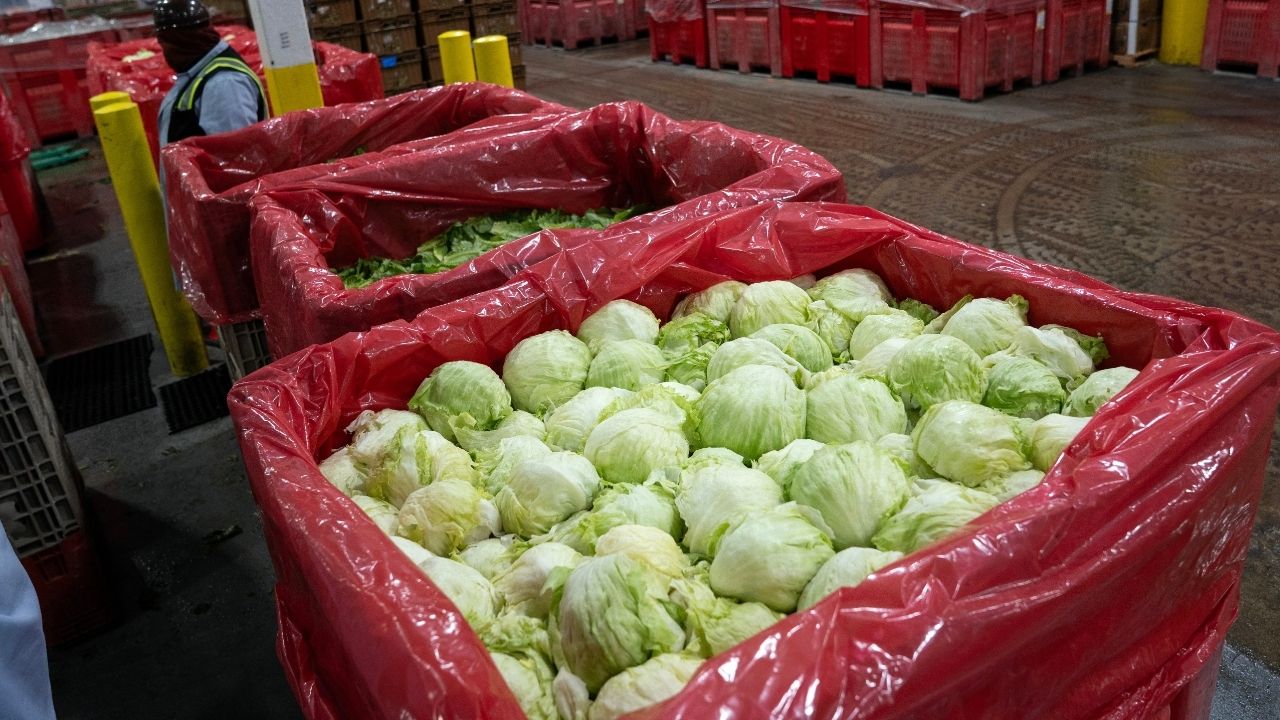
SALINAS, Calif. — At a Church Brothers Farms production facility, where conveyor belts rumble with giant heaps of chopped romaine and red cabbage, the company has slashed workers’ hours and laid off employees this summer. Some assembly lines in the plant in San Juan Bautista, California, near the agricultural heartland of the Salinas Valley, weren’t operating at all this past week.
Fresh produce sales fell nationwide after a major outbreak of cyclosporiasis, an illness that causes severe diarrhea. More than 17,000 people have been sickened so far, and two have died, according to federal health officials.
The largest cluster of cases was linked to iceberg lettuce grown in Mexico, and greens from the Salinas Valley haven’t been implicated by federal officials. Yet demand for the valley’s lettuce has plummeted all the same, said Raymond Gonzales, vice president of processing plant operations at Church Brothers.

“Even though all this product is from the U.S.,” Gonzales said, waving a gloved hand at pale green leaves churning through cold water, “the consumer just sees it as lettuce.”
Like many American farmers, Church Brothers made a tough decision in recent weeks to abandon healthy crops. If there isn’t a market for the produce, it often makes more financial sense to use the greens to re-fertilize the land than to shell out for the labor costs for harvesting.
Jeff Church, the company’s chief operating officer, said Church Brothers had lost hundreds of thousands of dollars in discarded greens. He estimated that the company had returned an extra 3.9 million heads of lettuce to the soil over the past six weeks as demand dropped.
“We just couldn’t use it,” said Church, 54.
The amount of romaine and iceberg lettuce produced for sale this summer in the United States has been the lowest in a quarter century, according to shipping data from the U.S. Department of Agriculture. And wholesale prices for lettuce remain at break-even costs, even though so little is available for sale, the data show.
Nowhere has the economic impact been felt more than in the Salinas Valley, an agricultural region about 100 miles south of San Francisco that marketers have long called the Salad Bowl of the World.
The area is perhaps best known nationally for the John Steinbeck novels set here, such as “Of Mice and Men” and “East of Eden.” But the Salinas Valley has also been prized for generations for its temperate weather and fertile soil, which allow it to grow strawberries, broccoli and, in the summer, 70% of the nation’s lettuce.
So produce scares are nothing new. It took years for spinach sales to recover after a deadly E. coli outbreak in 2006. But questions about the origins of the largest-ever U.S. outbreak of cyclospora, a parasite in human feces, seems to have made customers particularly cautious, avoiding berries and several types of fresh vegetables that were never linked to the outbreak.
The Centers for Disease Control and Prevention has confirmed only one source — iceberg grown in Mexico by produce behemoth Taylor Farms. But health officials say they’re investigating at least six other clusters for which sources have not yet been publicly identified.
“I even had one reporter tell me they were not going to have a Caesar salad,” said Norm Groot, executive director of the Monterey County Farm Bureau, who pointed out that romaine lettuce, the kind typically used in a Caesar, had never been connected to the parasite.
At Church Brothers, a large, family-owned business that has been growing produce in the Salinas Valley since 1999, lettuce sales began to drop in July, around the time the CDC announced a link between cyclospora and Taco Bell lettuce. It didn’t help that Taylor Farms, whose Mexican-grown lettuce was implicated, is based in Salinas, linking the outbreak to the valley in customers’ minds.
Sales have begun to pick up as the outbreak starts to subside, Church said. Yet he is now struggling to determine how much to plant in the coming months.
Church, wearing a vest in the Salinas morning fog this past week, contemplated the math as he watched workers harvesting iceberg lettuce strip off outer leaves with knives before wrapping the heads in plastic to sell to Walmart.
If local farmers plant too little, fearing more losses, there will be a lettuce shortage in the winter. But if Church plants a typical amount, he could be forced again to do what farmers call discing, in which they dispatch a tractor with steel blades, or discs, to chop up healthy produce and plow it back into the soil.
“It’s a really tough moment,” said Dave Puglia, president and CEO of Western Growers, an agricultural trade association representing produce farmers in California and other Western states. “There’s a lot of very good, fresh produce that’s being plowed back into the ground.”
Puglia said the drop in sales linked to this outbreak — close to 30% — had been higher than for other recent disease outbreaks.
And while America has a very safe food supply system, there are risks inherent to lettuce, he said, since it’s largely grown outside and is eaten raw. Leafy greens are among the leading sources of foodborne illness in the United States.
As far as eating lettuce, even customers in Salinas remain wary.
Melanie Waltrip, who co-owns Smalley’s Roundup Restaurant, a 50-year-old steakhouse with deep red booths, said her servers were still fielding questions about the safety of consuming their green salads, typically served as a side with ribs or pork chops.
But Jeff Birkemeier, 46, who co-owns Amapola Kitchen in downtown Salinas, said his most popular menu item, a Chinese chicken salad made with romaine, remains a bestseller. He said that employees of Taylor Farms, who work across the street from his cafe, often stop by for lunch.
“My customers in general are people that have grown up in this type of agricultural hotbed for their whole lives, and they just kind of take it all in stride,” he said.
—
This article originally appeared in The New York Times.
By Soumya Karlamangla/Minh Connors
c. 2026 The New York Times Company