


|
Getting your Trinity Audio player ready...
|
The Israeli military bombed a mosque in the Gaza Strip, accusing the Palestinian militant group Hamas on Wednesday of using it to store weapons.
The Hamas-run government media office in Gaza responded by saying Israel’s claims aimed “to justify its attacks on mosques” and were “entirely false.” There were no reports of deaths from the attack.
The Israeli military said advance warning was provided to civilians “to mitigate the risk of harm to them.”

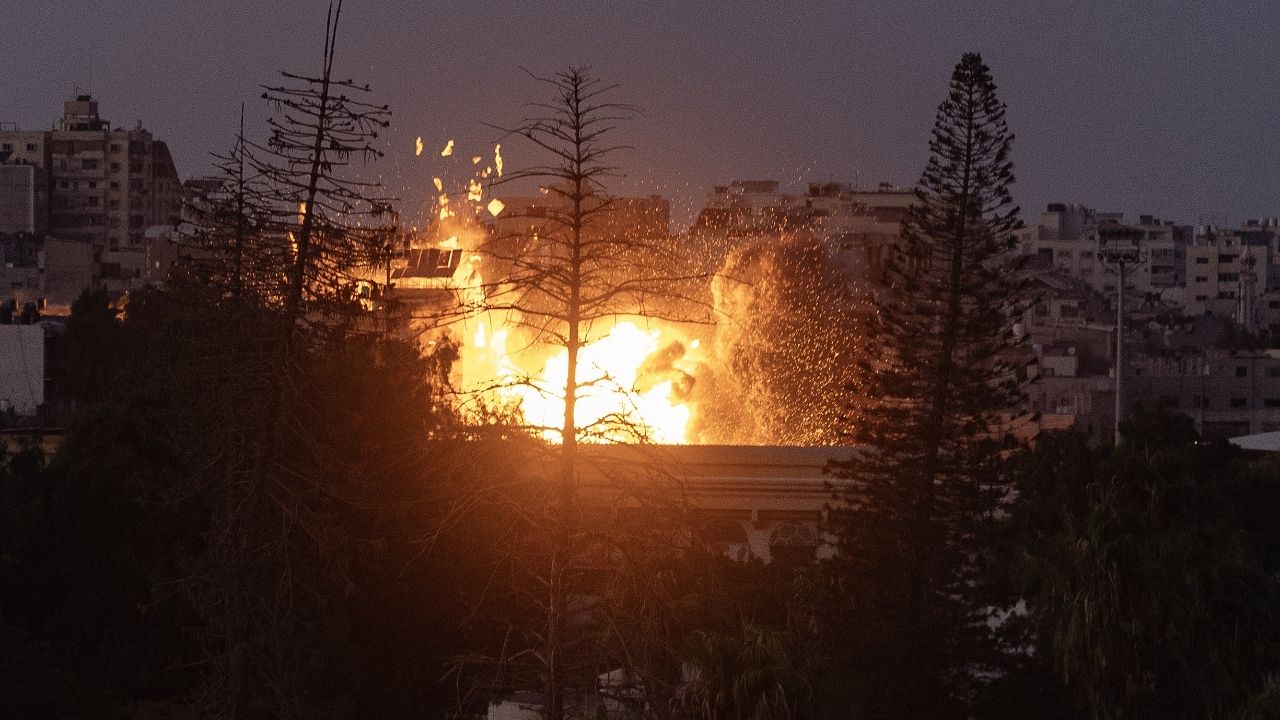
Footage reviewed by The New York Times shows people walking in Gaza City on Tuesday near clusters of tents for families displaced during the two-year war in Gaza. An Israeli bomb explodes on the mosque, sending clouds of dark smoke billowing into the evening skies.
Israel has intensified its strikes on Gaza in recent weeks, despite signing a U.S.-backed ceasefire deal with Hamas in October. Israeli officials say the military has been targeting Hamas and its weapons infrastructure.
Hamas says the ongoing strikes demonstrate that Israel was seeking to free itself of its commitments to the October ceasefire.
Zaher al-Waheidi, a statistician at the Gaza Health Ministry, said health officials did not record any deaths or injuries from the strike.
A photographer for The New York Times captured images of the strike’s aftermath — piles of dusty rubble and what appeared to be the remains of the mosque’s minaret.
“It was a terrifying sound,” said Riyad al-Masri, 31, who lives near the mosque. “It shook the ground.”
Hundreds of mosques in Gaza were destroyed during the war, according to the government media office in Gaza. Israel has repeatedly accused Hamas of embedding in civilian spaces, including in mosques, displacement camps and schools.
More than 1,200 people have been killed in Gaza since the October ceasefire, in addition to more than 73,000 killed during the war, according to the Gaza Health Ministry. Its toll does not distinguish between combatants and civilians.
The Hamas-led Oct. 7, 2023, attack on southern Israel killed some 1,200 people and ignited the war in Gaza. Palestinian militants took another 251 people back to Gaza as hostages.
While the Israeli military has issued many announcements saying its strikes in Gaza have killed Hamas militants, interviews with medical officials in Gaza and hospital records indicate that Israel has also killed civilians in the nine months since the ceasefire.
The U.S.-brokered ceasefire agreement led to the release of the remaining hostages in Gaza, and left Israeli forces in control of more than half of Gaza. The Israeli military has since expanded its area of control, hemming about 2 million Palestinian residents into a shrinking strip of land along the coast.
The war left Gaza in a deep humanitarian crisis with widespread food shortages and rampant hunger and most of the population displaced. Many people remain in displacement camps, and there has been no wide-scale reconstruction effort underway.
Humanitarian aid groups have said many essential goods are still difficult to attain, and the cost of food is often higher than before the war.
The Israeli military agency that oversees aid to Gaza said in a recent report that the humanitarian situation had improved significantly since the October ceasefire, pointing to the reduced price of food.
Under the Trump administration’s 20-point peace plan for Gaza, Hamas was required to lay down its weapons. Though the group has agreed to cede administrative control of the territory, it has so far refused to relinquish its arms.
This month, Maj. Gen. Tamir Yadai, the Israeli military’s deputy chief of staff, suggested Israel would press forward with its strikes in Gaza if Hamas does not disarm.
“At the end of the day, this place will be demilitarized and there will be no Hamas,” he said in remarks published by Channel 14, a right-wing Israeli TV station.
—
This article originally appeared in The New York Times.
By Adam Rasgon and Iyad Abuheweila/Saher Alghorra
c. 2026 The New York Times Company