
|
Getting your Trinity Audio player ready...
|
Barney Frank, the brassy, lightning-quick former Massachusetts representative who for decades was the most prominent gay politician in the country and who was an author of the most significant overhaul of the nation’s financial regulations since the Great Depression, died Tuesday at his home in Ogunquit, Maine. He was 86.
His friend James Segel confirmed the death. Frank said last month that he had entered hospice care with congestive heart failure.
Frank, a liberal Democrat who represented a diverse suburban Boston district for 32 years, starting in 1981, was the first gay member of the House to come out voluntarily; others had been outed in scandals. His public declaration of his sexual orientation in 1987 — spurred by a fear of being outed, by the death of a closeted colleague and by his own determination to show that homosexuality was nothing to be ashamed of — helped normalize being openly gay in public life.

“Prejudice is based on ignorance,” Frank told The Boston Globe in 2011, as he prepared to retire. “And the best way to counterbalance it is with a living example, with reality.”
A Harvard University-trained lawyer, Frank bristled with intellectual firepower, acidic turns of phrase and a zest for verbal combat.
His shivs were often cloaked in wit. Referring to Moral Majority, the conservative Christian organization that opposed abortion but also opposed child nutrition programs and daycare, Frank said in 1981: “From their perspective, life begins at conception and ends at birth.” Of the flawed intelligence behind the U.S.-led invasion of Iraq that led to nearly a decade of combat, he said the problem “is not so much the intelligence as the stupidity.”
In Washingtonian magazine’s annual poll of Capitol Hill staffers, he was frequently voted the “brainiest,” “funniest” and “most eloquent” member of the House.
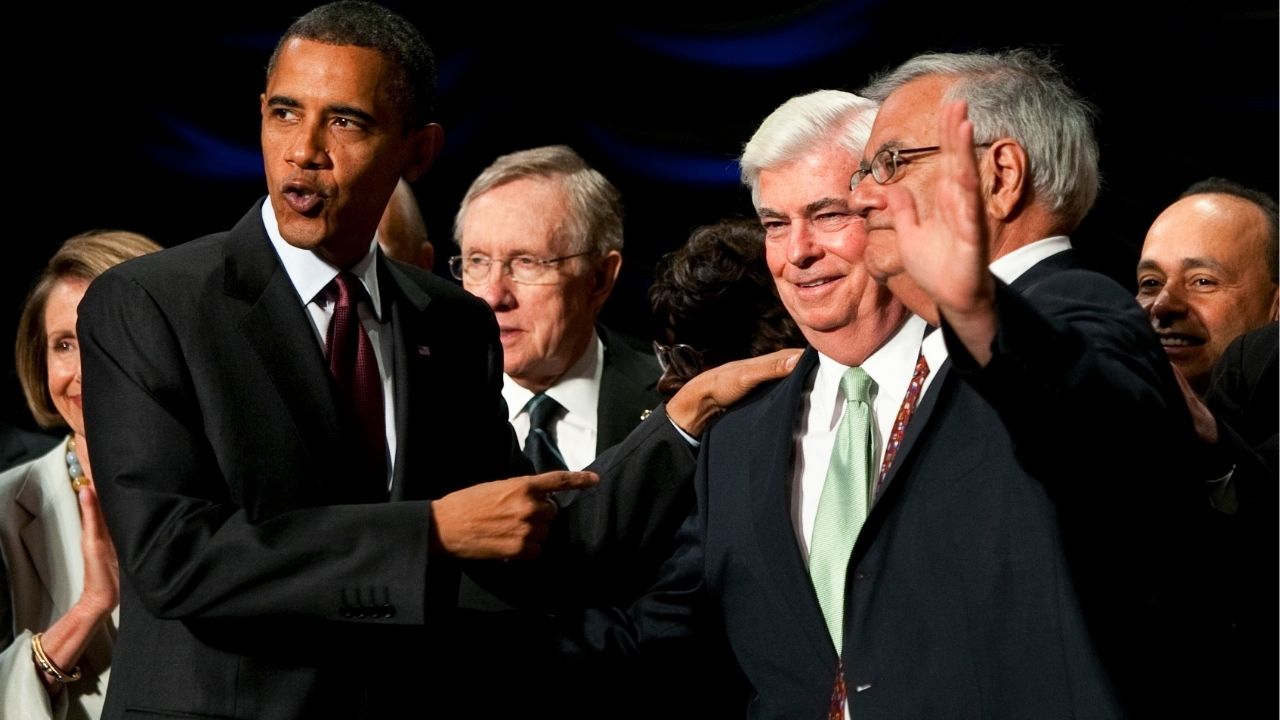
His most significant legislative achievement was in the realm of financial regulation. The Dodd-Frank Wall Street Reform and Consumer Protection Act, which he sponsored with Sen. Christopher Dodd, D-Conn., tightened rules on the financial industry as part of the government’s response to the housing crisis of 2007 and the global financial meltdown the next year.
Signed into law by President Barack Obama in 2010, the measure sought to prevent the nation’s biggest banks from engaging in excessively risky behavior and to protect consumers from unfair practices by banks and lenders. Congress watered it down in 2018, chiefly by exempting smaller and midsize banks from stricter oversight, but it remained largely intact.
Frank was also known for championing gay rights, civil rights and women’s rights. He did so by force of personality and by example. He insisted that his male partner be invited to all events to which the spouses of other representatives were invited. In 2012, at age 72, he married Jim Ready and became the first sitting member of Congress to wed someone of the same sex.
He also worked quietly behind the scenes to advance his causes. In one of many examples, according to his memoir, “Frank: A Life in Politics From the Great Society to Same-Sex Marriage” (2015), he helped persuade President Bill Clinton not to appoint Sen. Sam Nunn of Georgia as secretary of state because of his track record of homophobia.
Growing up in a working-class family in New Jersey, Frank was drawn from an early age to politics, stemming from his sense of himself as a minority and outsider.
“I’m a left-handed gay Jew,” he often said. “I’ve never felt, automatically, a member of any majority.”
But he was never shy. Even as a youth, he described himself as a “counterpuncher, happiest fighting on the defensive” on behalf of the vulnerable. At the time, that mostly meant racial minorities.
When he was introduced in 1950 to a scout for the New York Yankees, he challenged the man to explain why the team had no Black players. As a 15-year-old, he was profoundly moved by the lynching in Mississippi of Emmett Till, a Black teenager close to his own age; that led him to participate in Freedom Summer in 1964, registering Black voters in Mississippi.
In addition to Ready, Frank is survived by a brother, David, and two sisters, Doris Breay and Ann Lewis, a former communications director in the Clinton White House.
—
This article originally appeared in The New York Times.
By Katharine Q. Seelye/Doug Mills
c. 2026 The New York Times Company