

|
Getting your Trinity Audio player ready...
|
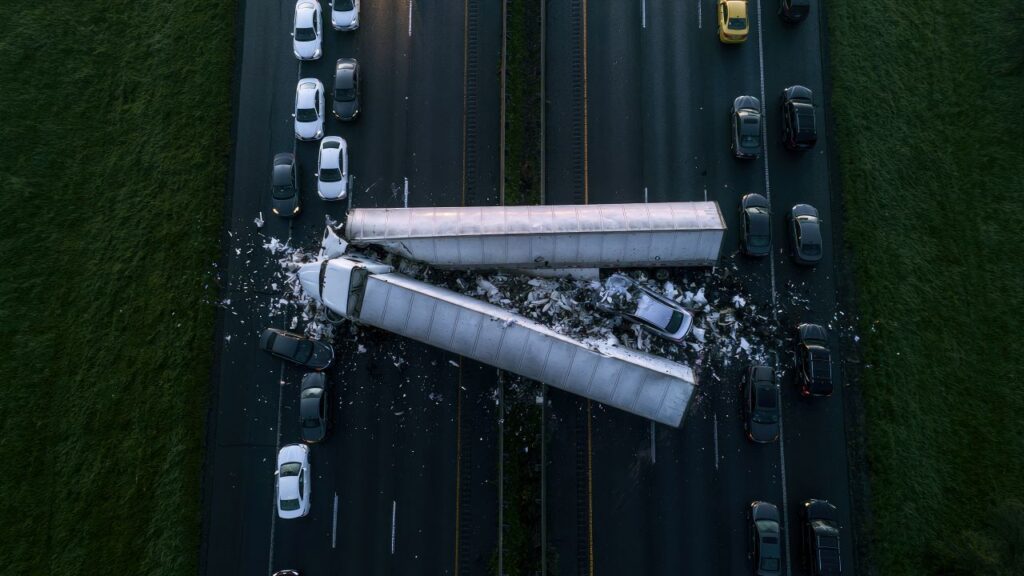
CalMatters’ “License to Kill” series found last month that in almost every DMV record it reviewed, truck drivers’ vehicular manslaughter convictions were listed at two points, the penalty for a regular driver, rather than the three that apply to a crash in a big rig.

By Michael Shemtoub
Opinion
In a written statement, the DMV said it relies on courts to tell it when a conviction involves a commercial vehicle. Tara Leal, Kern County Superior Court’s executive officer, told CalMatters last year, about the 22 vehicular manslaughter convictions her court had failed to report: “They were errors on our part.”
Vehicle Code section 1804 already requires the courts’ part. Every abstract of conviction a court sends the DMV “shall also indicate whether the vehicle involved in the offense is a commercial motor vehicle.” It is a required field on a form the DMV itself furnishes or approves. The department could reject abstracts that leave it blank and track which courts skip it. Nothing in the statute stops the department from doing either.

State Laws Are Stricter Than Federal Standards
On fatal crashes, California’s disqualification rule is also broader than the federal one.
Federal regulations bar a driver from commercial vehicles for a year after a conviction for causing a death only when the driver was in a commercial vehicle. California’s version, Vehicle Code section 15300, ties the one-year bar to a conviction for causing a fatality under the vehicular manslaughter statutes and doesn’t limit it to crashes in a truck.
A second such conviction means a lifetime ban under section 15302. The CalMatters sample included off-duty crashes in personal cars. Under the state’s text, a qualifying conviction should still keep those drivers out of a big rig for at least a year.
When a California-licensed commercial driver is convicted in California, the state has 10 days from the conviction date to make it available on the driver’s record in the national commercial license system. A state that fails to run its commercial licensing program to federal standards can lose up to 4% of certain federal highway funds the first year and up to 8% in later years.
That risk is no longer hypothetical. In January, federal regulators issued a final finding that California’s handling of non-domiciled commercial licenses, the kind issued to drivers from other countries, was out of compliance, and starting this fiscal year they are withholding about $158 million a year in highway funds. California is challenging the decision in federal court. If the noncompliance continues, the penalty can double.
Related Story: They Killed People With Their Big Rigs, and California Let Them Keep Driving
Trucking Companies Are Required to Review Driving Records
The other half of the story is the trucking companies, and that matters in the San Joaquin Valley, where Interstate 5 and Highway 99 carry big rigs every hour of the day.
A driver with a commercial license must tell the employer, in writing, within 30 days, about any traffic conviction other than parking, in any vehicle. Interstate carriers must pull every driver’s record at least once every 12 months, review it, and give “great weight” to violations such as speeding and reckless driving that show disregard for public safety. They have to keep a note of that review, with the reviewer’s name and date, in the driver’s qualification file. And an employer may not put a driver in a truck if it knows or should reasonably know the driver has been disqualified.
In a truck crash case, the qualification file is one of the first things I ask for. It shows what the company knew about its driver, and when. A carrier that kept a driver after a written notice of a manslaughter conviction, or after an annual review that should have caught one, will have a hard time blaming the DMV in front of a jury.
California adds its own employer rule. Under Vehicle Code section 1808.1, an employer whose drivers operate vehicles requiring a Class A or B license must enroll them in the DMV’s pull-notice program. The DMV then sends the company notice of new convictions, accidents, and suspensions added to the driver’s record, and the company must also get a periodic report at least every 12 months, then sign, date and keep it.
An employer that, after receiving one of those records, keeps employing a driver whose license has been hit with a disqualifying action faces up to six months in county jail, a fine of up to $1,000, or both. Once a court reports a conviction and the DMV posts it, the pull notice delivers it to the trucking company, whether or not anyone scored the points correctly.
Valley legislators should ask, at the next legislative oversight hearing on the DMV, how much more federal money is at risk and how many carriers received notice of a vehicular manslaughter conviction and kept the driver on the road.
Related Story: After His Crash Killed a Child, the DMV Renewed His License. Then It Hid His ...
About the Author
Michael Shemtoub is the founder and managing attorney of Beverly Law, a Los Angeles personal injury firm. He previously worked for a federal judge and practiced corporate and bankruptcy law. He represents people injured in accidents and victims of elder abuse and has a financial interest in personal injury litigation.
Make Your Voice Heard
GV Wire encourages vigorous debate from people and organizations on local, state, national, and international issues. Submit your op-ed or letter to bmcewen@gvwire.com for consideration.