

|
Getting your Trinity Audio player ready...
|
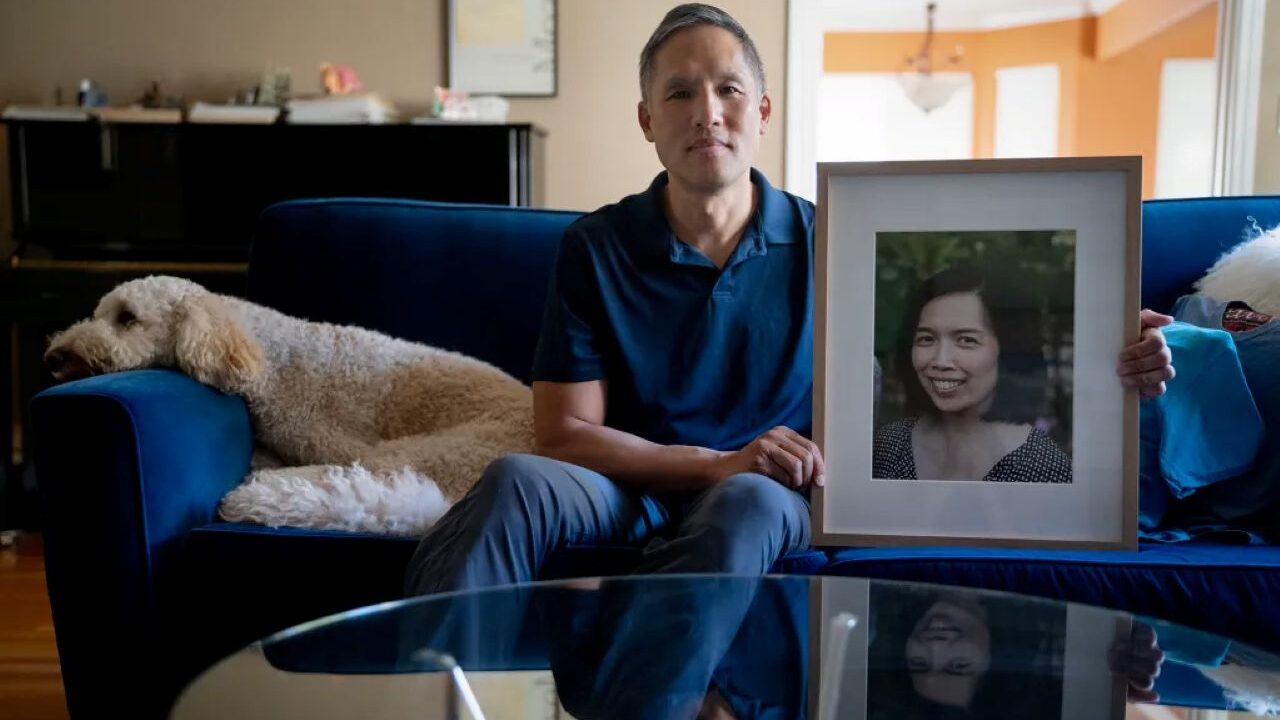
Loren Chow looked in the rearview mirror and had a terrifying realization.
We’re going to get hit.
There’s nothing I can do to get out of this.



Traffic outside Fresno had slowed. A semitruck loaded with fertilizer from Missouri, cruising at 65 miles per hour, hadn’t. By the time the driver, Baljit Singh, hit the brakes, it was too late. A fully loaded big rig traveling at that speed takes the length of nearly two football fields to stop.
Chow, his wife and their 17-year-old son were headed home from a college visit in June 2022. Singh’s red Freightliner smashed into the back of their SUV and flipped it. Jenny Chow died. Law enforcement said Singh caused the crash by driving too fast.
Loren Chow can’t talk about the details of the collision because of an active lawsuit against Singh, the trucking companies, and vehicle manufacturers. But court filings, police reports and driving records lead to a simple conclusion:
If the California Department of Motor Vehicles had done its job, Jenny Chow would still be alive.
This story was originally published by CalMatters. Sign up for their newsletters.
Big-Rig Driver Killed Someone a Year Earlier
That’s because in July 2021 — 11 months before he killed Chow — Singh let his semitruck drift over the median on Merle Haggard Drive in Kern County on his way to an Amazon distribution center, killing a 26-year-old man on a motorcycle.
The collision report from that crash shows police found pages from a log book, meant to keep track of Singh’s hours behind the wheel, “ripped into small pieces” in an overhead compartment. Investigators with the California Highway Patrol alleged that Singh was fatigued at the time of the crash after driving more than the 12-hour limit and recommended he be charged with vehicular manslaughter.
But while the DMV knew about the earlier fatal crash and had the authority to suspend Singh’s driving privileges, it let him continue to drive a big rig until he killed again.
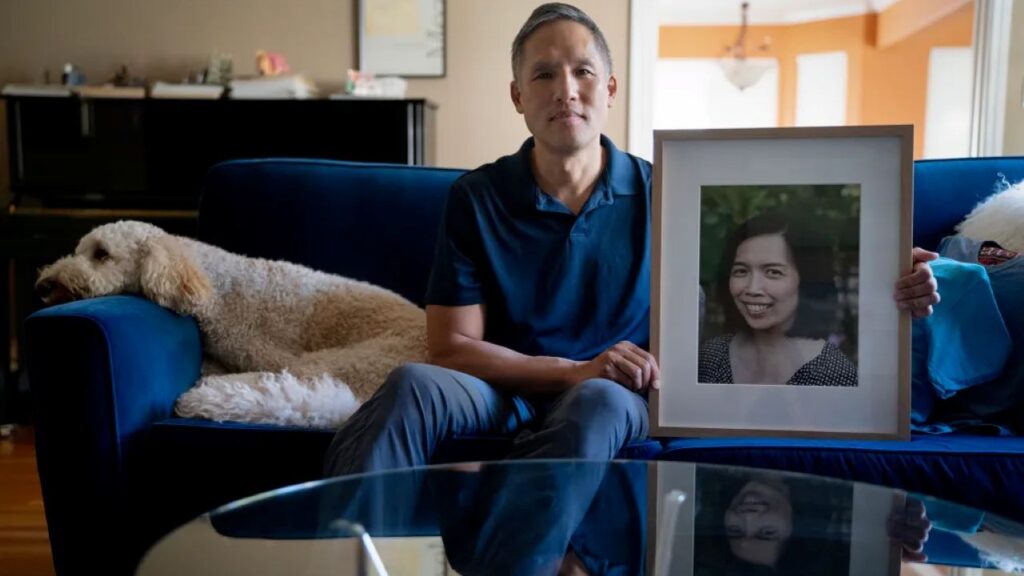
“The death was completely avoidable. That accident never should have happened,” Chow said, barely choking back grief during an interview in his Bay Area living room, which is blanketed in smiling photos of Jenny and their two boys.


“I would have had my partner still. We’d be a family of four. Jenny would have seen Dylan and Tyler graduate from high school,” Chow said. “She would have seen so much if only the DMV had done what any person in his right mind would have done, which is to suspend the license.”
What CalMatters’ Investigation Uncovers
A CalMatters investigation found that the DMV often lets professional drivers with a history of dangerous behavior behind the wheel stay on the road and command massive vehicles — buses filled with passengers, semis packed with goods, and tankers loaded with hazardous chemicals — even after a fatal crash.
Under California law, a truck driver convicted of manslaughter is disqualified from driving big rigs for 12 months. And any driver convicted of felony vehicular manslaughter is generally supposed to receive a three-year license revocation. But criminal cases can drag out, sometimes for years. Singh wasn’t convicted of manslaughter in Kern and Fresno counties until 2024. It was only then that the DMV took his license. Singh and his attorney did not respond to requests for comment.
State law empowers the agency to investigate drivers involved in fatal and serious-injury collisions and suspend their licenses — with or without a conviction. But the DMV routinely does nothing.
Even when the agency does act, records show it can take years to do so. We examined court filings and DMV records for more than 130 commercial licensees charged with vehicular manslaughter from 2019 to early 2024 following a fatal crash on the job or off-duty in a personal vehicle. Nearly half had a valid Class A or Class B license as of late May. That includes a dozen drivers who got a ticket for unsafe driving in a commercial vehicle after having already killed someone.
What’s more, vehicular manslaughter is supposed to be a three-point violation for a truck driver, but in almost every DMV record we reviewed, it was listed as two, the penalty for a regular driver. The agency in a written statement said it relies on the courts to notify it when a conviction involves a commercial vehicle so it can assess the appropriate number of points.
Despite such examples of bureaucratic indifference, we did find one area of enforcement in which the DMV is aggressive: making sure people pay fines.
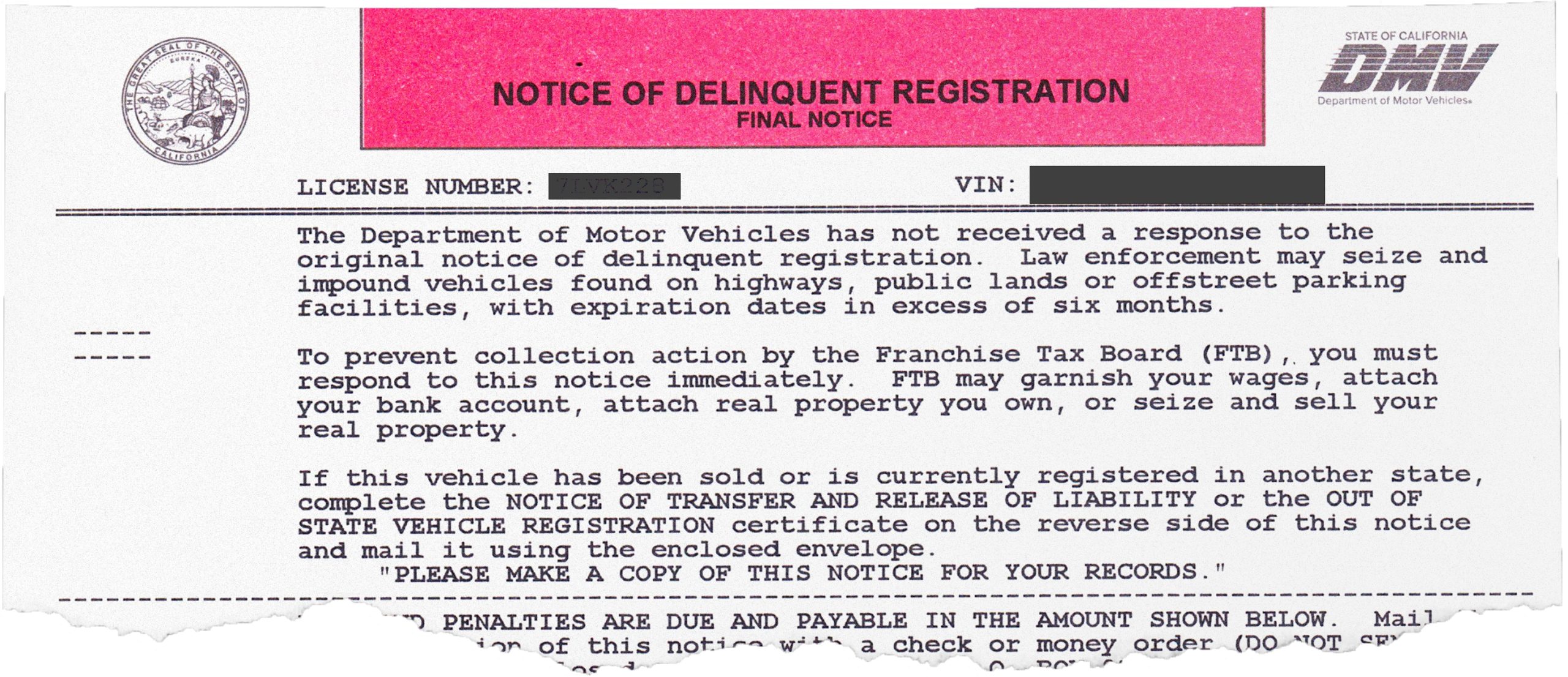
In 2023, months before the agency finally suspended Singh’s license, it started sending Loren Chow letters threatening to garnish his wages, seize his property and put a lien on his home.
The DMV said he was late paying his vehicle registration fee on the SUV that was totaled, by the truck driver it allowed to stay on the road.
‘You’re Gonna Kill Somebody’
The DMV’s inaction against commercial drivers is all the more consequential because of the clear risks they pose. Truck driving is a grueling job involving long hours over vast distances. A fully loaded semi can total 80,000 pounds — 20 times the weight of a car. A speeding semitruck doesn’t do fender-benders; it obliterates.
“One thing goes wrong, you’re gonna kill somebody,” said Joe Rajkovacz, a longtime owner-operator and advocate with the Western States Trucking Association.
About 4,000 people died in large-truck crashes in California from 2015 through 2024, the most recent decade for which federal data is available.
California’s licensing decisions have an impact beyond the state’s borders. Supersized trucks, long the backbone of our economy, haul billions of dollars of food from the state’s farms and online orders from teeming ports to destinations across the country.
Tami Friedrich, president of the Truck Safety Coalition, a national advocacy group, said that’s why regulators need to do more to flag truck drivers who shouldn’t be on the road. She got involved in road safety issues after her sister and brother-in-law and their two children — Kris, Alan, Anthony and Brandie — died in a crash with a big rig just after Christmas in 1989.
“There’s a certain level of responsibility above and beyond a regular car driver that they should adhere to,” Friedrich said.
The cases we examined suggest California is not holding them to that level.
DMV Fails to Take Dangerous Drivers Off the Road
A truck driver killed a 55-year-old man in Bakersfield in 2023, four years after court records show he allegedly injured a woman with his semi in a Sacramento crash. There’s nothing on his driving record to indicate that the DMV did anything in response. He got in yet another truck collision in 2025.
One driver was convicted of reckless driving and a hit-and-run, got in a collision in San Joaquin County in 2023, failed to show up to court in Sacramento on a traffic ticket and killed someone while driving in Amador County. Just this year he got a speeding ticket in Sacramento and in another collision in Amador. The DMV didn’t suspend his commercial driver’s license until September, after we asked about the case.
Another driver with five prior collisions — including one in 2021 in which he veered onto the shoulder in a semitruck and killed someone in Riverside County — was able to renew his license last year and almost immediately racked up two tickets for speeding in a commercial vehicle. He had a valid trucking license as of September.
While regular drivers can easily drive on a suspended license, a trucking company isn’t likely to turn over a loaded semi to a driver without a valid commercial license, experts said. That means DMV action would be all the more meaningful. But the agency often acts only when it’s legally required to and doesn’t use its immense discretionary power to ensure that unsafe drivers get off the road.
The DMV’s hands-off approach comes at a time of turmoil for the trucking industry. Experts say a proliferation of fly-by-night operators and training schools has undercut safety standards and fueled a race to the bottom for driving conditions. At the same time, the Trump administration has alleged California is improperly giving commercial licenses to people who don’t meet immigration or language standards. The court files and DMV records we reviewed do not include drivers’ immigration status.
DMV Says It Does Quicker Updates Now
We sent the DMV a list of commercial drivers along with questions for this story. The agency declined an interview request and wouldn’t comment on specific cases but, shortly after, took action against a dozen of the drivers, such as suspending licenses or stripping commercial driving privileges.
In an email, DMV spokesperson Jonathan Groveman wrote that the agency recently updated how it handles fatal crashes and manslaughter convictions.
“During this modernization process, the DMV identified some cases that had not been previously reviewed and have now been processed or are currently being processed,” according to Groveman’s email.
He also wrote that law enforcement and the courts need to report information to the agency in a timely manner in order for the DMV to act.
‘What the Hell?’
Jon Israel knew what kind of damage a fully loaded big rig could do. He used to drive one. And as a tow truck operator in California’s vast Inland Empire, he’d spent years towing away mangled wreckage from crashes on one of the state’s busiest trucking corridors.
So Israel would have been cautious one summer morning in 2018, when he pulled his overheating tow truck to the side of Interstate 10 and got out to check the radiator fluid, traffic whipping by.
But there’s not much you can do when a semi veers your way.
A police report shows that Marco Rodriguez let his tractor-trailer drift onto the shoulder. The massive side mirror struck Israel. He died on the roadway he’d long patrolled.
Rodriguez’s DMV record shows he kept driving commercial vehicles even after the fatal crash, for which he was ultimately convicted of manslaughter. Police caught him speeding in commercial vehicles three separate times from 2022 through last year, and ticketed him one more time for a lane violation.
Despite that record — a vehicular manslaughter conviction, plus four tickets for unsafe driving in commercial vehicles — the agency renewed Rodriguez’s trucking license in March, declining to use its discretion to keep him off the road.
“What the hell?” said Maxine Israel, Jon’s widow. “Are they waiting for him to kill somebody else?”
‘It’s Like They Don’t Care’
Rodriguez’s criminal defense attorney, Mukund Arun, called the fatal crash “a very unfortunate, tragic incident” and emphasized that his client was only charged with a misdemeanor. Prosecutors can charge vehicular manslaughter as a felony or a misdemeanor, with the more serious charge typically involving extreme behavior like drunk driving or excessive speeding.
Maxine Israel comes from a trucking family. She missed her high school graduation to go on a run in her dad’s semi. For years, she and Jon lived near a notoriously strict Riverside County checkpoint where the CHP weighed trucks and drivers could buy T-shirts that said, “I survived the Banning Scales.”
But over time, she and her husband noticed that truck drivers seemed to get younger and younger. They drove fast, and their eyes often drifted from the road ahead. The big thing she and Jon talked about was how, unlike in some other states, truck drivers here often failed to slow down and switch lanes to pass people on the shoulder.
“California used to be really, really strict on the big trucks,” Israel said. But now, it’s “like they don’t care.”
It’s been more than six years since Rodriguez was convicted of killing Jon Israel. In July, after CalMatters asked the DMV about the case, the agency finally disqualified Rodriguez from driving commercially.
DMV records show it’s a one-year ban; he should be eligible to go back to driving trucks next summer.
Court research by Robert Lewis, Lauren Hepler, Anat Rubin, Sergio Olmos, Cayla Mihalovich, Ese Olumhense, Ko Bragg, Andrew Donohue and Jenna Peterson.
Thank you to our partner KGET for contributing to this piece after producing its own video.
This article was originally published on CalMatters and was republished under the Creative Commons Attribution-NonCommercial-NoDerivatives license.