
|
Getting your Trinity Audio player ready...
|
Michigan’s tight race for an open US Senate seat will help determine control of the chamber while testing two broader questions: whether identity-based attacks on a Muslim candidate can succeed in a battleground state, and how willing Democratic voters are to embrace the party’s progressive wing.
Republican Mike Rogers has sought to portray Democrat Abdul El-Sayed, who would be the nation’s first Muslim senator if he wins the November 3 election, as sympathetic to Islamist extremism, which El-Sayed denies and supporters say is Islamophobic. Rogers has also argued that El-Sayed’s support for universal healthcare and other progressive policies places him outside the political mainstream.
El-Sayed, a former public health official, has focused his campaign on lowering costs for working-class Americans while seeking to tie Rogers to President Donald Trump, even as Rogers has broken with the president on some issues in the campaign’s closing weeks.

Trump has falsely accused El-Sayed of being a Muslim extremist, while Rogers has tried to tie him to the Muslim Brotherhood. Branches of the Brotherhood, one of the Arab world’s oldest and most influential Islamist movements, were designated as terrorist organizations by the Trump administration this year.
El-Sayed has disavowed the group and denied any connection with it. Pollsters and political strategists say the attacks are aimed at dissuading Jewish and Black voters in the Detroit area who backed his primary opponent, Representative Haley Stevens, from voting for him.
“He’s a Muslim-American and so Rogers is attempting to do his best to portray El-Sayed as an outsider who’s dangerous,” said Jonathan Hanson, a political scientist and public policy lecturer at the University of Michigan.
Michigan’s Senate seat is critical to both parties’ efforts to control the chamber. Republicans hold a 53-47 Senate majority heading into Tuesday’s election.
Independent analysts rate the race a toss-up. The RealClearPolling average shows El-Sayed ahead by 2.5 percentage points in a state Trump carried by 1.4 points in 2024.
El-Sayed campaign spokesperson Cole Wozniak accused Rogers of resorting to “desperate, bad faith attacks” and said the Democrat was focused on “his plans to bring down costs and stand up to the chaos and corruption in Washington.”
Abby Ronson, a spokesperson for the Rogers campaign, pointed to Rogers’ appearance on Sunday on NBC News’ “Meet the Press,” where he said he was not criticizing Islam but what he described as El-Sayed’s adherence to a “radical Islamic agenda.”
Identity Attacks
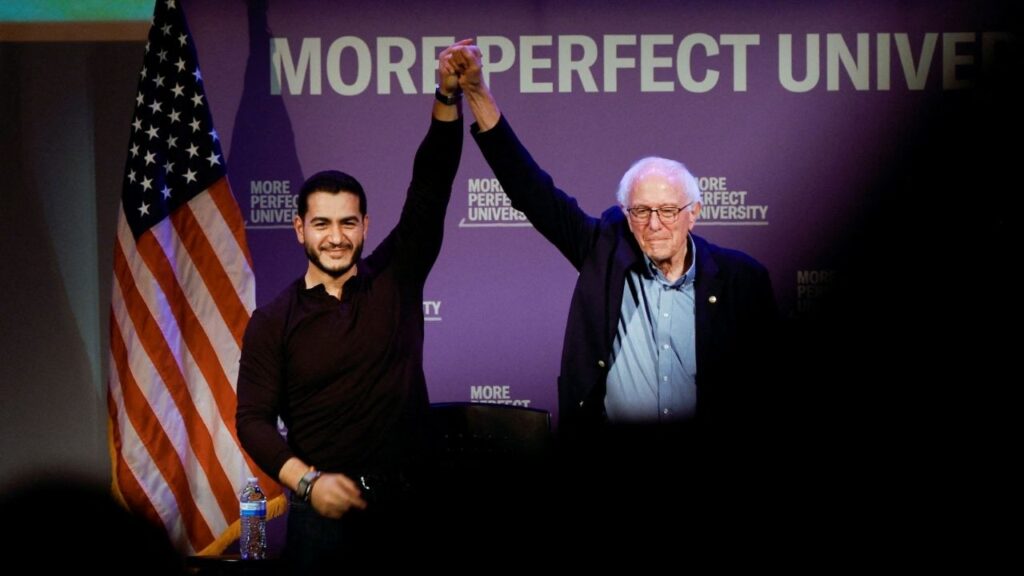
Advocating policies to curb corporate influence and expand the social safety net, El-Sayed, 41, has emerged as one of the Democratic Party’s most prominent progressives. He describes himself as a capitalist and rejects the socialist label, but a victory on Tuesday would likely be seen as a boost for the party’s left wing as it seeks greater influence ahead of the 2028 presidential election.
But the margin of any victory will matter, said Michigan State University political scientist Matt Grossmann.
“If El-Sayed wins by a couple of points but trails Democratic gubernatorial nominee Jocelyn Benson by a wide margin, that won’t be a very convincing argument,” Grossmann said. “And if El-Sayed were to lose, then it would be a mark against that faction of the party.”
Rogers, 63, has cast himself as a pragmatic conservative focused on lowering costs, boosting manufacturing and strengthening border security. With Trump’s popularity sagging, he recently called for an end to the war in Iran and the trade dispute with Canada, while avoiding direct criticism of the president.
But portraying El-Sayed as a national security threat has also become a central feature of Rogers’ closing message. Rogers has based that claim in part on a 2012 group letter signed by El-Sayed and other Egyptian Americans in support of then-newly elected Egyptian President Mohamed Morsi, who was backed by the Muslim Brotherhood. The letter called on Morsi to purge the media and security services of holdovers from the dictatorship toppled during the Arab Spring.
The El-Sayed campaign did not immediately respond to a query about the letter.
Earlier this month Rogers agreed with a social media post calling El-Sayed a terrorist. He also appeared with Trump at a rally on Sunday where the president likened El-Sayed to the September 11 attackers and said his goal was to keep a “jihadist” out of the Senate.
The rhetoric prompted a rare rebuke from the NAACP, the nonpartisan civil rights organization, which does not typically intervene in political races.
“The blatantly racist attacks surrounding the Michigan Senate race are unacceptable and disgusting,” NAACP President Derrick Johnson said in a statement. “It’s the same ugly, divisive tactics we’ve seen used during the darkest chapters of the South’s history.”
A poll by Michigan State University’s Institute for Public Policy and Social Research found that 38% of Michigan voters were less likely to support a Muslim candidate.
John Clark, a political science professor at Western Michigan University, said the attacks on El-Sayed were aimed in part at depressing Democratic turnout but could work against Rogers by angering and boosting turnout among Michigan’s sizable Arab American communities in Dearborn and elsewhere.
“Maybe this helps with some voters, but it has the potential of backfiring with others,” Clark said.
(reporting by Nathan Layne in Wilton, Connecticut; Editing by Ross Colvin and Deepa Babington)