
|
Getting your Trinity Audio player ready...
|
On the morning of March 25, a flood of posts that struck a remarkably similar tone began popping up on scattered social media sites.
Mayor Zohran Mamdani had just decided to cancel a $9 million contract that New York City had with consulting giant McKinsey, and gushing praise came pouring in from commentators, operatives on the left and even some comedians.
Alex Jacquez, who works at a progressive think tank, posted on social platform X: “Really exciting that NYC is generating operational efficiencies by insourcing needlessly outsourced public services and functions, building city capacity. More of this!”

Akilah Hughes, a comedian with more than 200,000 followers on X, reposted a comment suggesting that Mamdani was an improvement over his predecessor, Eric Adams, who “paid McKinsey $1.6 million to research trash cans.”
Matt Stoller, a political commentator with more than 160,000 followers on X, wrote effusively that the mayor “just cut a $9 million contract that McKinsey has with NYC. And then brags about it publicly. More please.”
Some of the online adulation, like Stoller’s post, was organic. But some of it was actually part of a campaign orchestrated by City Hall to use social media influencers to boost the image of the mayor and his young administration’s policies.
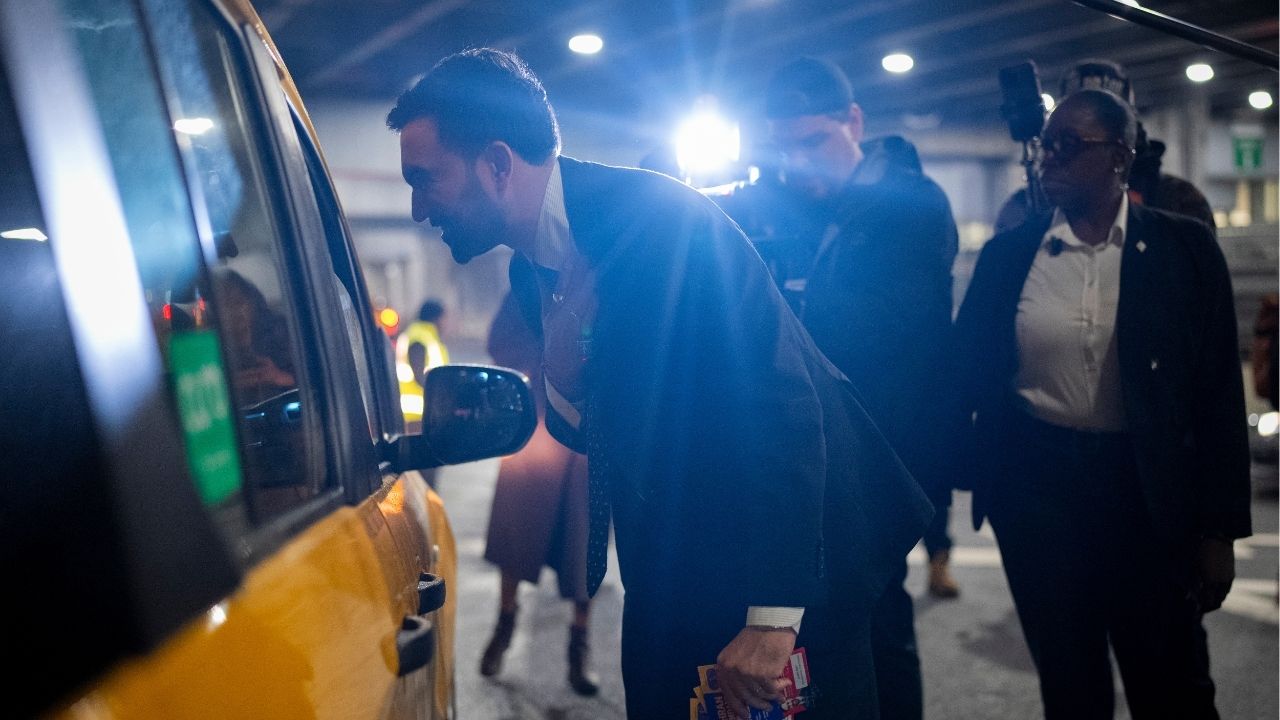
Mamdani is a master of new media, and his rise to power has been driven largely by his ease in front of a camera and his ability to harness the seeming informality of social media to connect with broad constituencies.
But as mayor, he has also been able to use taxpayer funds to create a sprawling network of hundreds of friendly influencers to boost his priorities, provide positive depictions of his administration and enhance his popularity.
The administration regularly sends the influencers memos on the mayor’s priorities and encourages them to trumpet his accomplishments, all outside public scrutiny. The missives are delivered in group chats on Signal, an encrypted messaging app designed to shield posts from public review.
The lack of transparency concerns watchdog groups. And the mayor’s office declined to provide The New York Times with details of City Hall’s social media operation, including the budget of the new media office, a list of the social media influencers used and the total spending by city government on influencer campaigns.
The influencer effort is led by Emilia Rowland, a new media expert who worked on Mamdani’s mayoral campaign and his transition team. Rowland, who earns $175,000 as the mayor’s director of new media and cultural communications, contended that working with influencers was a higher priority than interacting with traditional journalists.
“At a moment of profound distrust in politics, our job is not to preserve decades-old communications norms or protect the gatekeepers who once controlled access to public information,” Rowland said.
“The monopolization of the media has resulted in legacy press hemorrhaging readers and viewers, essential reporting often locked behind paywalls, and ownership increasingly concentrated in the hands of a small number of wealthy corporations and billionaires who exert their own editorial agendas over the news,” she added.
That view was clear in the administration’s strategy surrounding the announcement in March that the McKinsey contract was being canceled. Rowland’s team wrote to hundreds of social media influencers with instructions about how to enthusiastically describe the budget savings. (Jacquez and Hughes received the guidance; Stoller did not.)
“Share a short video or post explainer on the news that, in sharp contrast with the corruption and wasteful spending of your tax dollars that Eric Adams was infamous for, the Mamdani administration found $1.7B in savings,” they wrote.
The content creators and commentators soon responded in kind, and in kind fashion.
An artificial intelligence analysis of more than a dozen Instagram influencers who work with Mamdani’s team found that of 178 videos related to the administration, the overwhelming majority were positive.
Rowland, who used to work for the Democratic National Committee, created Mamdani’s influencer outreach model during his campaign. She began direct-messaging influencers and asking them to make content about Mamdani, offering coveted access with the aim of ensuring that the candidate’s goings-on were reaching millions of people who might not have already followed him.
When Rowland moved into City Hall, that operation came with her, but now its costs are publicly funded. She sends the influencers updates on the mayor’s priorities, from tenant hearings to outdoor dining and taxes.
The mayor’s office says that it does not pay the influencers. Still, their proximity and access to a figure as popular as Mamdani can help increase their own social media following and, by extension, potentially put them in a position to attract paid content sponsorships from commercial brands. Some influencers said that when they feature Mamdani, the videos get more likes, and viewers watch longer.
And some influencers have gotten paid through programs run by city agencies to promote policy agendas.
Others have defended their work as an important public service motivated by their belief in the mayor’s policies.
Diego León, a social media influencer known as dandyinthebronx, was paid by the Sanitation Department to post content. He was already a friendly presence in Mamdani’s orbit: During last year’s mayoral campaign, he interviewed him, introducing the video by asking if Mamdani was “gonna be the very best like no one ever was for the Bronx?”
When the mayor held a news conference in July on cutting red tape for small businesses, León wrote: “Thanks NYC for inviting me to check out this press conference.”
Brianna Dineen, 34, a parenting influencer with about 169,000 followers on Instagram, said: “I feel like we have kind of become the messengers and a way for them to get their information out in a digestible way. It’s kind of like our role is amplifying all the good things they’re doing.”
The influencers are also invited to events with the mayor where some traditional reporters are excluded, and some influencers are given one-on-one interviews with Mamdani.
The Times has interviewed more than a dozen influencers who have worked with Mamdani’s team and has reviewed dozens of videos and portions of influencer group chats showing how Rowland and her staff boost the mayor’s agenda.
To the mayor’s supporters, this communication is a forward-looking effort to reach constituents where they are, on their phones. To his critics, it raises questions about the authenticity of some narratives that New Yorkers are viewing about their mayor.
Previous mayoral administrations have used content creators in more limited fashion, as Bill de Blasio did to promote vaccines during the COVID-19 pandemic. And President Donald Trump has built a large, devoted and hyper-online following by using Truth Social as his primary communications tool.
But Mamdani has managed to weave these outside voices into his internal communications strategy, creating a new model of what it looks like to shape public opinion while in office.
City Hall has worked with more than 1,200 content creators since the mayor took office, according to Mamdani’s team. Rowland oversees a Signal group for creators with more than 250 influencers, as well as smaller thematic Signal groups, like one targeting parenting influencers. City Hall also uses Signal to send talking points to people with large followings on X.
Rowland, who reports to the mayor’s communications director, Anna Bahr, oversees three staff members. Dora Pekec, a senior spokesperson for the mayor, would not divulge the size of Rowland’s office’s budget, and it is not broken out in public documents.
Pekec declined to say how much city agencies have spent this year on social media influencers.
Anya Schiffrin, co-director of the Technology Policy and Innovation Concentration at Columbia’s School of International and Public Affairs, who recently published a report on the Mamdani administration’s relationship with new media, said that influencers deployed by City Hall “may also be earning money from a lot of different activities. They could be promoting a product, they could have a contract from a city agency.”
“With traditional journalism, journalists have one job and that job is to report the news,” she added. “With influencers, there’s a blurring of boundaries.”
Influencers have been invited to spend time with the mayor at events like a tour of a childcare center and an Eid celebration. Some of the invited guests said they have been asked to share their questions for the mayor with Rowland’s team in advance.
When asked whether the city has created a code of ethics for its engagement with influencers, Rowland suggested that traditional media might be in more need of tighter ethical guidelines.
“Is there a recommendation for disclosures from legacy media?” she said, adding that working only through “channels with diminishing reach” might mean failing to reach New Yorkers about important city services.
The city’s Campaign Finance Board used an outside firm to pay 18 influencers a total of $626,365 during the 2025 election cycle to help boost voter turnout, an agency representative said.
Shan Rizwan, a 27-year-old influencer, was surprised to get an email this spring from a city agency asking if he wanted to make a video. Rizwan received a contract brokered by his agent to make a video in April about “The People’s Money,” an initiative of the Civic Engagement Commission.
Rizwan, who also exchanged messages with Rowland during the campaign, said he tends to be choosy about when he does paid opportunities. “I’d lose a lot of creative freedom — usually that’s how it goes in creative partnerships,” he said. “How I’m able to support myself is usually partially through paid sponsorships; I do some paid partnerships.”
Since the release of the Columbia report this past week, government reform activists have increased their scrutiny of City Hall’s use of influencers and private communication channels like Signal, which allows users to set messages to automatically disappear.
“Use of Signal runs counter to the city’s document retention policy and its ability to comply with the Freedom of Information Law,” said Grace Rauh, who heads the organization Citizens Union. “Any discussion of official government business must occur in a manner that ensures records are preserved and accessible.”
Mamdani’s chief counsel, Ramzi Kassem, said that city policy did not prohibit Signal. And Mamdani, during a news conference Wednesday, promised transparency. “If there are any departures from what is legally required, my administration will look into it immediately and take corrective action,” he said.
But it is not clear that commitment to transparency was being followed. Until recently, at least one of the influencer channels run by Rowland was set to erase her messages after she sent them to the group. The day after inquiries from a Times reporter, the channel setting was abruptly changed to preserve the messages.
An organization that recently formed in opposition to Mamdani, NYC Common Sense, asked the city’s Department of Investigation to look into the mayor’s relationship with influencers and the administration’s use of Signal. The City Council is also preparing to hold a hearing on the matter.
–
This article originally appeared in The New York Times.
By Sally Goldenberg/Emma Goldberg/Vincent Alban
c.2026 The New York Times Company