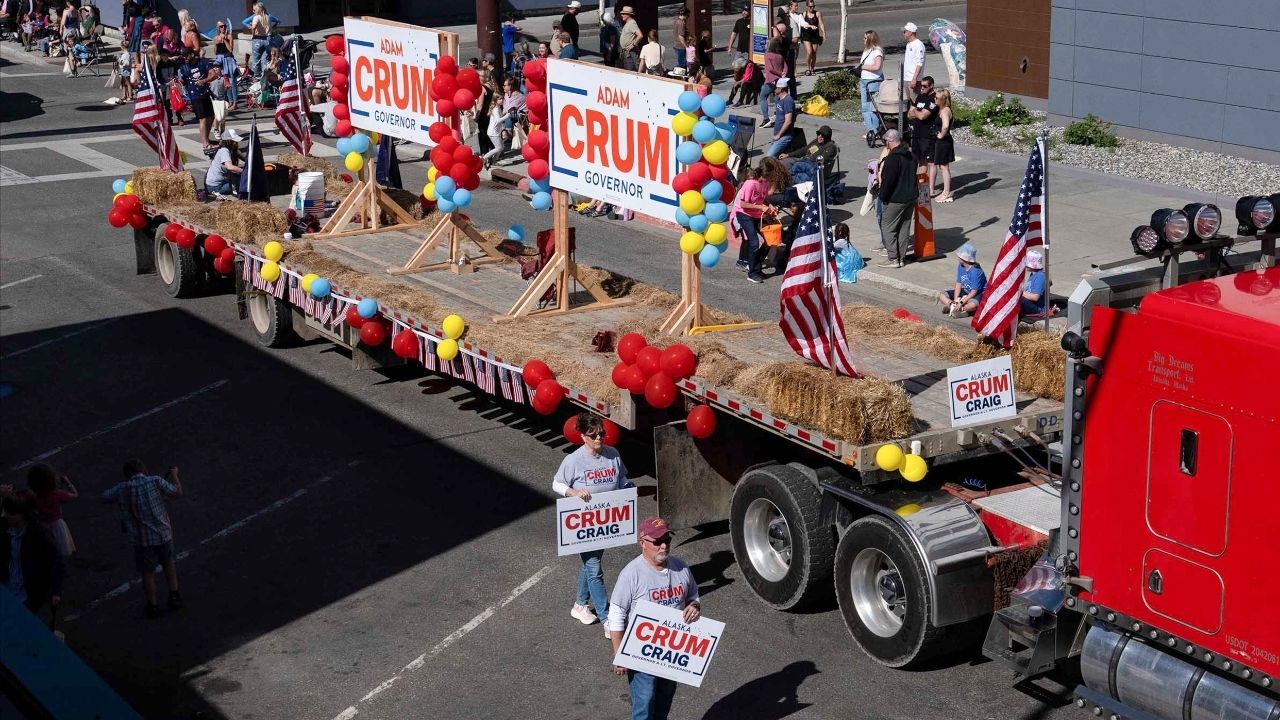

FAIRBANKS, Alaska — By the time the last candidate for governor rolled through the 74th annual Golden Days parade in Fairbanks, Alaska, late last month, even the master of ceremonies sounded exhausted.
Along with the antique cars, taekwondo students and saloon girls, he had introduced eight campaigns for governor — not even half the candidates on the Aug. 18 primary ballot. As the parade neared its end, marchers came by promoting a measure in November to repeal the state’s open primary and ranked choice voting system.
“Well,” the announcer quipped, “at least if that passes, our next parade will be shorter.”

On Tuesday, voters will pick four of 17 candidates to advance to the November general election for governor at a critical juncture for the oil-rich, cash-poor state. Several forces are coming together to make this a weird political moment: Alaska’s open primary system, which places Democrats, Republicans and independents on a single ballot; the first governor’s race in nearly a quarter century without an incumbent or an heir apparent; and a growing consensus that the state faces some of its biggest decisions since the Trans-Alaska Pipeline was built five decades ago.
With so many choices, “it’s like eating a salad — you have to really dig in and take your time to get to the good parts,” said Nick Stepovich, a former legislator, son of a former governor and owner of a downtown Fairbanks saloon. “And there’s always this risk that it’s a bad meal.”
The campaign is also unfolding in the shadow of one of the nation’s marquee Senate races, which pits the Republican incumbent, Dan Sullivan, against a former representative, Mary Peltola, the last Democrat to win statewide office in Alaska. That race is drawing tens of millions of dollars in outside spending, driving up advertising costs and consuming much of the state’s limited television and radio inventory.
The math has scrambled the usual assumptions about party politics in this Republican state. Political observers and even other candidates expect both Democrats, Tom Begich and Jonathan Kreiss-Tomkins, to advance to November.
“You’ve got 80,000 voters on the left, and 110,000 on the right or the middle-right,” said Art Hackney, a longtime Republican consultant. The two Democrats get to split those 80,000, he said, while a dozen or so Republicans fight for the slightly larger pot on the right.
With polls showing the top finisher may win less than 25% of the vote, the difference between advancing or going home could be a few hundred, or a few dozen, ballots.
Taking no vote taken for granted, Kreiss-Tomkins rode a skiff 450 miles down the Yukon River in July and had driven a snowmobile to the Arctic Ocean earlier in the year. Republican Adam Crum tried “guerrilla campaigning,” skipping traditional political events to serve hot chocolate in the spring to hundreds of snowmobilers in the woods.
“You go wherever there might be voters,” said Begich, a former Democratic legislator and singer-songwriter whose Democratic father, Nick Begich Sr., served in the House, whose Republican nephew, Nick Begich III, serves there now, and whose brother, Mark Begich, was a senator.
Nearly every candidate also agrees on something else: Alaska has reached an inflection point. Despite its vast oil wealth, the state’s unique fiscal model — no statewide income or sales tax and annual checks to each resident from Alaska’s oil fund — has left lawmakers scrambling to keep schools open, pave roads and stop population loss.
“We are the richest poor state you could possibly imagine,” said Crum, a former state revenue and health commissioner.
Kreiss-Tomkins, who started his political career at age 13 directing the state campaign of Vermont’s governor-turned-presidential hopeful Howard Dean, said the next governor and legislature “will be making decisions that will shape the state for the next half century.”
The state’s votes have favored President Donald Trump in three consecutive presidential elections, but the legislature has been governed for nearly a decade by a coalition of Democrats, Republicans and independents. They’ve largely sidestepped culture-war fights to focus on Alaska’s fiscal and environmental challenges.
Still, the state government is now frozen. The outgoing governor, Mike Dunleavy, a Republican who polls among the least popular governors in the country, has repeatedly vetoed efforts to increase education funding and restructure the budget. In turn, the legislature has rejected the governor’s efforts to cap state spending and increase dividend payments from the state oil fund.
“We all think the state needs change,” said Click Bishop, a candidate for governor and former Republican legislator who has been labeled a “Republican in name only” by others in the race because of his willingness to work with Democrats. “Nobody is exactly happy with how things are going; we just disagree on the solution.”
The field includes a former governor, Bill Walker, who shocked the political establishment with his surprise late entry; a podiatrist and political novice, Matt Heilala, who has already spent more than $1.4 million of his own money; and five Republicans aligned with Trump and trying to win the conservative base.
With just days to go, no one is sure what will happen, said University of Alaska Anchorage political scientist Forrest Nabors.
Planned Parenthood Alliance Advocates of Alaska, the health organization’s political arm, endorsed Begich in the primary because the crowded nature of the race gave its support more weight. The political arm of Alaska’s largest teachers union, the NEA-Alaska, endorsed three candidates — Begich, Kreiss-Tomkins and Bishop — to give options to education-minded voters.
After the primary, candidates who qualify for the general election have until Aug. 31 to decide whether to remain on the ballot. In November, voters will use ranked choice voting to pick the next governor from the final four.
—
This article originally appeared in The New York Times.
By Anna Griffin and Ruth Fremson/Ruth Fremson
c. 2026 The New York Times Company