




|
Getting your Trinity Audio player ready...
|
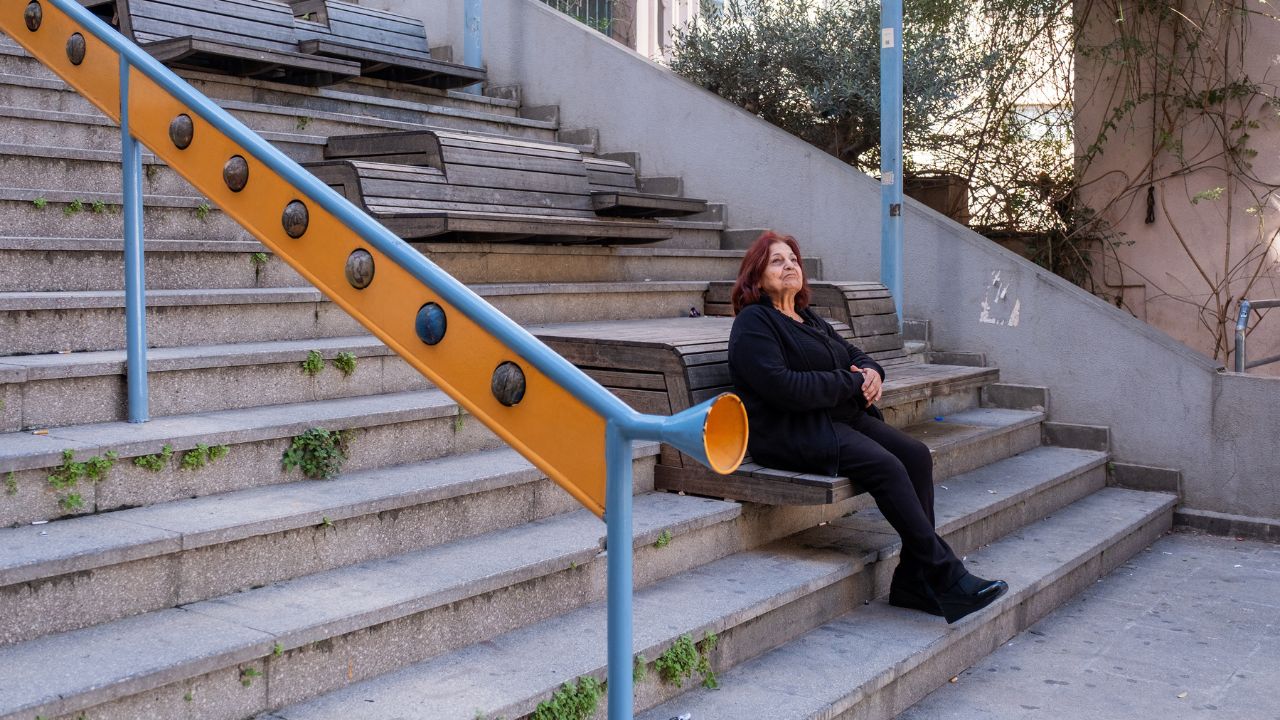
Like many children in Beirut, Georges Zahar grew up playing on the public stairs dotting the city. Then came the 2020 port explosion that killed 218 people and caused up to $4.6 billion in damages, including to the Vendome and St. Nicolas stairs near his home.
After the blast, “there was no life on the stairs, and it was quite trashy,” said Zahar, now an 18-year-old biology student. “It wasn’t livable anymore, and it was hard walking on them.”
When he was 14, Zahar participated in a workshop that used the video game Minecraft to engage children in urban design. Led by facilitators from the Block by Block Foundation and U.N.-Habitat, he and 45 other children redesigned three of the damaged stairways, dreaming up new features like a big slide, handrails made from speaking tubes and shaded seating areas, modeling everything out in the game to inform real blueprints.

Since the renovation, the 125 steps that make up the St. Nicolas stairs are buzzing with people hanging out and children playing with features first imagined in Minecraft. “I was really happy that they actually added the slide on the stairs that are near my home,” said Corine Abiramia, who participated in the workshop as a 14-year-old and now studies interior design.
Despite Israel’s conflict with Hezbollah and multiple strikes targeting the Lebanese capital this spring, “the stairs remain intact and continue to be used,” said Joana Dabaj, co-founder of CatalyticAction, the organization behind the Beirut project.
The Gameplay
In the blocky, 3D virtual world of Minecraft, one of the world’s most popular games, users can build and destroy structures as they like. In 2025, more than 200 million monthly players helped turn “A Minecraft Movie” into the highest-grossing video game movie ever made.
The game’s open-ended design and building tools allow players to reimagine real-life spaces like abandoned riverbanks, dark alleys and dump sites, making it one of the main tools used to involve citizens, especially youth, in redesigning urban areas.
Since 2012, the Block by Block Foundation and U.N.-Habitat have supported the building of over 150 urban structures in 55 different countries, with more than 30,000 citizens using Minecraft to participate in the design process.
Microsoft purchased Minecraft’s developer, Mojang, in 2014, which helped to set up the foundation alongside U.N.-Habitat. While Mojang and other partners continued to provide core funding for the initiative, it was cut off in 2025, forcing the foundation to close. Their work will now continue under a new U.N.-Habitat initiative called Games for Urban Futures, building on the Block by Block methodology and incorporating other games.
There’s no fixed approach to designing public spaces that really solve local issues. “But there’s a looseness to the Minecraft methodology that we can play with,” said James Delaney, who has led the foundation since 2020.
Including both children and adults in the workshops was part of the magic. “The power dynamic between the two is flipped because the younger person instantly knows Minecraft and can be quite quick at it,” Delaney said.
Re-design Process
Block by Block’s methodology works like this: Local organizations — mostly nonprofits working on engaging citizens in urban planning — submit their project proposals to U.N.-Habitat. Those selected are given funding and technical guidance to engage community members, run the Minecraft workshop and construct the final designs, with budgets of $10,000 to $200,000.
Once a site is chosen, community members go on a walk equipped with printed-out maps and markers. “We invite participants to look at the place with critical eyes,” said Eugenio Gastelum Pons, a gaming expert who has organized Minecraft workshops around the world since 2014. People may pass by a place every day without stopping to consider how it could be improved, he said.
After the site visit, participants attend a Minecraft workshop to learn how to build 3D models using the game. Gastelum preloaded each location into Minecraft, allowing participants to walk around the virtual space and add their designs.
The children are encouraged to think about the needs of vulnerable groups such as older residents and those with disabilities, said Bisma Setiyad, an architect with Kota Kita, a nonprofit that implemented a Block by Block project in Indonesia.
Once the Minecraft designs are ready, they take turns presenting their ideas before voting on which models should be built in real life. Professional architects and urban planners then translate the Minecraft models into sketches and drawings that could be used for construction.
Kota Kita operates in Solo, a city of about half a million on the Indonesian island of Java. In 2021, the nonprofit started scouting for a place to redesign with the Minecraft methodology, and chose a riverbank close to Rusunawa Mangkubumen, an affordable public housing block with 80 families.
The area was scattered with trash, provided no shade and had very little for the local children to play with. “There were a lot of children living in the housing block, but also many elderly residents who just stayed in their rooms because they didn’t feel safe to move around in their wheelchairs,” explained Setiyadi.
The Minecraft Effect
After the Minecraft project, the riverbank became a colorful space with plenty of shaded seating areas, and a playground with a badminton net and basketball field. Ramps, handrails and guiding blocks made the space more accessible for some 320 residents who live nearby.
“Minecraft is great because participants get a sense of the proportion of the components that they want to add — you can’t cram in an infinite amount of things and you have to prioritize,” said Giulia Galli, the architect who translated the Minecraft visions of Beirut’s children into technical sketches and models.
After the final design for the Beirut stairs was approved, Zahar passed by daily to see construction advance. After 14 months, the results were in. “The stairs were more colorful, there was more life, and many people started to use them because they now had places to sit,” Zahar said.
The redesign brought new restaurants and bars. Small tables and plants dotted the landings. More seating areas and handrails made the stairs more comfortable for older neighbors. “You can see elderly residents meeting again and doing dinners and lunches in front of their houses,” said Dabaj.
But participatory urban design also has an intangible impact: not only by making children feel heard and seen, but also by transforming their ideas into real structures in their city, explained Jose Cheng, coordinator of the Global Public Space Network at U.N.-Habitat.
“That’s why we only try to work on projects we can see through and finance the building of,” said Cheng. “I get the sense that young people are slightly sick of being asked what they think when there’s no tangible result.”
–
This article originally appeared in The New York Times.
By Natalie Donback/Natalie Naccache
c. 2026 The New York Times Company









![[hubspot type=form portal=8576119 id=f5235c74-daca-46b2-b841-0fec24b5a509]](https://gvwire.com/wp-content/uploads/2026/09/GVH_LaborDaySavings_300x250_static.jpg)
