


|
Getting your Trinity Audio player ready...
|
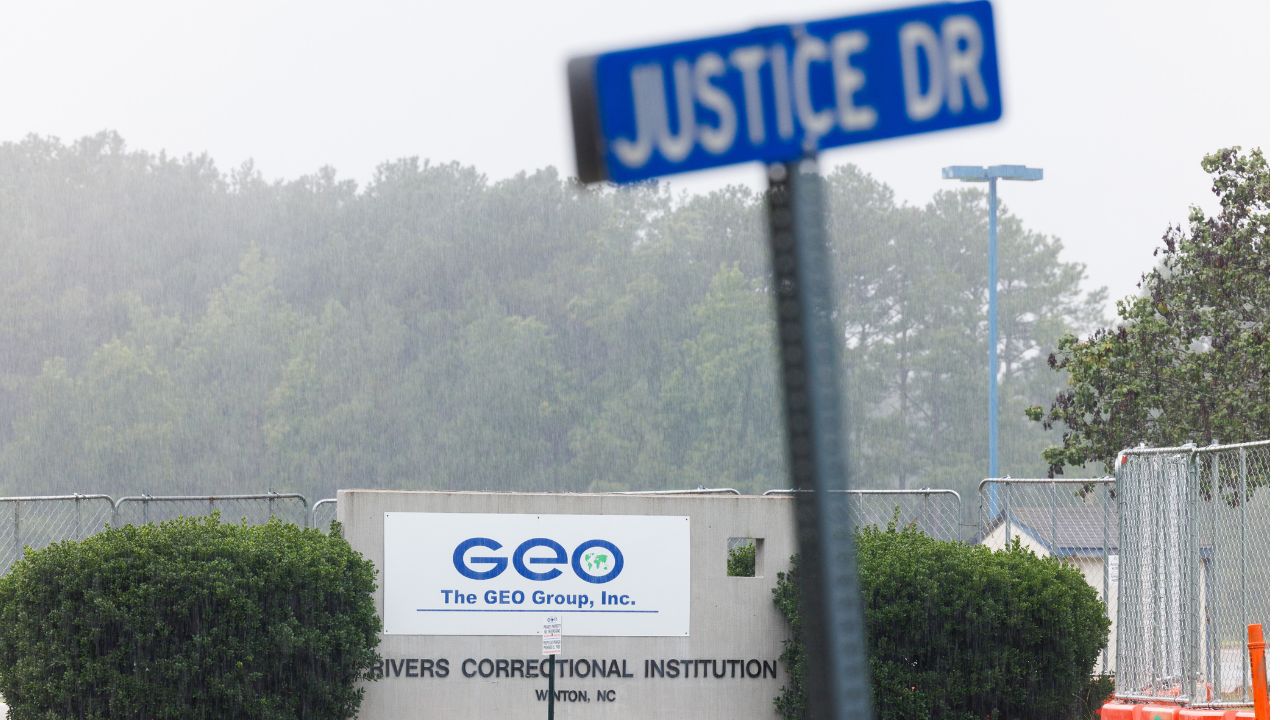
HERTFORD COUNTY, N.C. — For weeks, residents near the long-dormant Rivers Correctional Institution in Winton, North Carolina, have noticed trucks inside the prison’s gates, people walking around the entrance and fences being erected.
Internal documents obtained by The New York Times show that U.S. Immigration and Customs Enforcement plans to open a detention center at the complex in northeastern North Carolina by the end of the year. The facility is owned by GEO Group, one of the largest private prison operators in the country. Contract negotiations are ongoing, but the documents show that the facility will have about 1,400 beds, making it among the largest detention centers on the East Coast.
The opening of the facility — the first of its kind in North Carolina — signals that even as ICE has been retreating from its plan to buy up warehouses around the country, it remains determined to increase its capacity for detaining people as part of the Trump administration’s mass deportation campaign.

Documents obtained by the Times in June show that ICE plans to off-load seven warehouses that it bought for more than $700 million, scaling back a signature initiative under the previous homeland security secretary, Kristi Noem. The Department of Homeland Security sent a letter to Pennsylvania officials this month saying it no longer planned to use a warehouse in Berks County.
But it continues to partner with private companies like GEO Group to repurpose existing prison complexes in places like North Carolina, Colorado and Arizona, all of which have large immigrant populations.
The agency has to find bed space in places that are perceived as “more friendly” toward such facilities and do not prohibit them, said Claire Trickler-McNulty, a former ICE official who has served in Republican and Democratic administrations.
At the same time, North Carolina and its surrounding states are a so-called detention desert. Most detainees in the region are often taken to facilities farther south — as happened during the immigration crackdown in Charlotte last year — which costs more time, money and resources. Immigration lawyers and advocates say that a new detention center near the Virginia border could greatly increase agents’ capacity to detain more people across neighboring states.
North Carolina, which has a powerful Republican-controlled legislature, also recently passed laws that require sheriffs and state law enforcement agencies to cooperate with ICE, which is likely to increase the need for capacity.
The Winton facility is poised to make North Carolina a major hub for ICE detentions along the East Coast, said Stefanía Arteaga, a co-founder of Carolina Migrant Network, an immigrant rights group.
The internal documents show that the ICE field office in Washington plans to manage the detention center. A state official, who requested anonymity to discuss private planning, said the facility could be open as soon as late September.
The contract negotiations have not been made public by GEO Group, which did not respond to requests seeking comment. A spokesperson for ICE said in a statement that the agency had “no new detention centers to announce at this time.”
“It should not come as news that ICE will be making arrests in states across the U.S. and is actively working to expand detention space,” the statement said.
Since President Donald Trump took office in January 2025, federal immigration agents have arrested more than 6,300 people in North Carolina, which is double the number of arrests made during the previous two years combined, according to the Deportation Data Project, an academic group.
In Hertford County, whose county seat is Winton, some local officials have expressed concerns about being kept in the dark over the federal government’s plans, as they try to manage all the speculation. The county is heavily Democratic.
“This is the most divisive issue that we’ve had in this area,” said Mayor Weyling J. White of Ahoskie, about 10 miles from Winton, noting that he had major reservations about having an ICE-operated facility nearby. “What kind of quality of life do those jobs bring?”
The county, which has a population of less than 20,000, is predominantly Black with pockets of Haitian and Mexican communities. Its poverty rate is about 23%, nearly double the statewide rate.
It also sits in a competitive congressional district, currently held by Rep. Don Davis, a Democrat. The district was redrawn last year to favor the Republican candidate, Laurie Buckhout, a retired Army colonel. Neither candidate responded to requests for comment on Thursday. Gov. Josh Stein, a Democrat, also did not respond to a request for comment about the facility.
Well-paying jobs are scarce in the county, so some see the new ICE detention center as an economic lifeline. Others worry about becoming another flashpoint in the immigration crackdown and serving as an outpost for a deeply polarizing federal agency.
The former Rivers Correctional Institution, which closed in 2021 as the Biden administration moved to end federal contracts with for-profit prisons, also has a history of poor conditions.
Leroy Douglas, a Hertford County commissioner who politically identifies as an independent, said the two recent fatal shootings by ICE agents in Texas and Maine had made some residents more resistant to having an immigration detention facility in their backyard. But plenty of others, he added, approve of the plan, especially those who lost their jobs when the Rivers prison closed in 2021.
It is unclear how many locals would be employed there. In 2021, the prison employed about 300 people.
While he doesn’t agree with a lot of ICE’s aggressive tactics, Douglas said he did not believe that agents would be “running rampant around Hertford County, because that’s not what this is about.”
“If they open up, I really see no negative change in our actual community,” said Douglas, whose wife worked as a correctional officer at GEO Group decades ago before moving into administrative roles at the company. “I actually see a positive one because there would be a few more jobs.”
Douglas says he has had no communication with ICE or GEO Group leaders. Other county commissioners did not respond to requests for comment.
—
This article originally appeared in The New York Times.
By Eduardo Medina and Hamed Aleaziz / Cornell Watson
c. 2026 The New York Times Company