Growers who farm within two miles of the Friant-Kern Canal in southern Tulare County should be prepared for a pumping moratorium as early as April 2027, water managers learned Thursday.



|
Getting your Trinity Audio player ready...
|

By Lisa McEwen
SJV Water

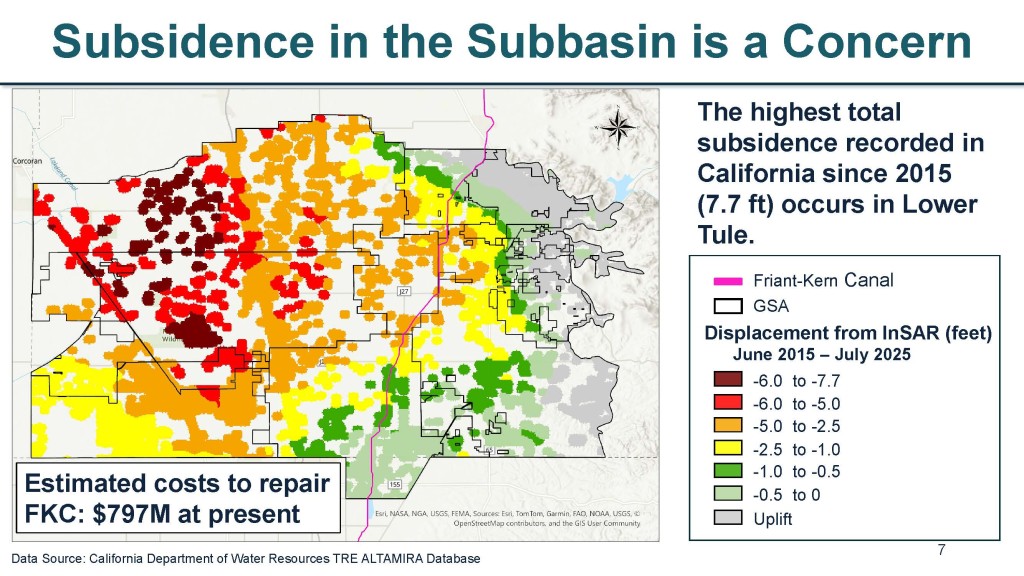
The move is part of Phase I of the state Water Resources Control Board’s proposed pumping plan, which zeroes in on damage to the canal caused by overpumping. The cost of that damage already tops $797 million, according to a slide presented Thursday.
The severity of the state’s plan did not surprise water managers, but the accelerated timeline did.
“It speaks to the urgency,” said Eric R. Quinley, general manager of Delano-Earlimart Irrigation District Groundwater Sustainability Agency (GSA).
It also clarifies the state’s laser focus on subsidence, or land sinking, which has been rampant in the Tule subbasin.
Since 2015, the greatest amount of subsidence recorded in California – 7.7 feet – has been in the Tule subbasin, specifically, the Lower Tule River GSA, according to one slide in the state’s presentation.
Even so, the possibility of a pumping moratorium was unthinkable to some just days before the state meeting.
“When anybody says no pumping within two or three miles of the canal, I’d say, ‘You guys are smoking crack.’ Because that’s never gonna happen,” Porterville GSA General Manager Sean Geivet said at the agency’s July 14 meeting.
Two of Geivet’s three irrigation districts, Saucelito and Porterville, have significant amounts of land along the canal.
Quinley said Thursday’s meeting reinforced the progression of the Sustainable Groundwater Management Act (SGMA), now more than 11 years old. He also referenced subsidence guidelines released last year by the Department of Water Resources.
“This is the last opportunity for the basin to produce a plan that allows control to remain in the hands of the locals,” he cautioned.
The subbasin failed twice to write a plan that met state requirements and was placed on probation in 2024. Probation requires farmers to meter and register their wells at $300 each, report their pumping to the state and pay the state $20 per acre foot.
Now, water managers have less than a year to cobble together a groundwater plan that could buy growers a little more time to adjust their operations and bring the aquifer into balance by 2040.
The Phase I plan will be released publicly in January 2027, six months sooner than managers were first told. Pumpers will receive notices in February and a final version of the plan will be released in March.
The plan would only go into effect after the Water Board approves it, likely at the board’s April 2027 meeting.
All of this could change, however, if Tule water managers produce an acceptable groundwater management plan before then.
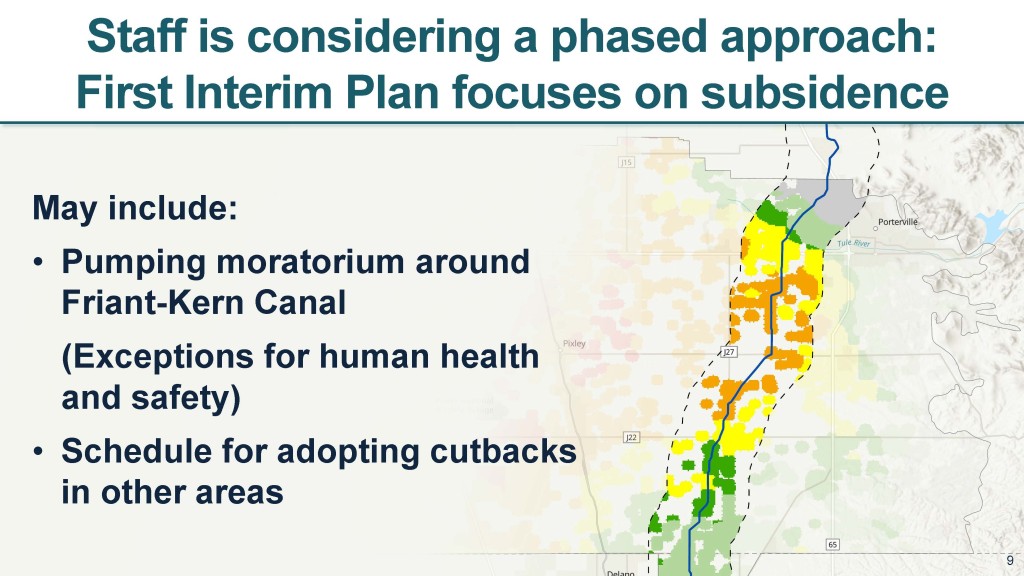
Alex Peltzer, general manager of Lower Tule River and Pixley GSA, hoped to move even faster as the area being targeted around the Friant-Kern Canal is heavily planted in citrus and pistachios, which will be headed into their growing season next spring.
“We’ve got six months to find something other than a strict moratorium,” he said
Phase II of the state’s plan would impose further pumping reductions throughout the subbasin to safeguard critical infrastructure and domestic wells. The state’s draft plan would also come with a fee increase from $20 to $35 per acre foot pumped to be paid by farmers.
One positive development from the meeting is an improved communication framework called a Collaboration Plan, Peltzer said. A lack of communication with state board staff has long been a complaint of managers, who said in meetings last week that state staff operate “in a silo.”
Peltzer said he pushed regulators to consider weaving their actions into existing GSA plans and working with managers and consultants, who are spending millions on writing a new groundwater plan with 11 of the 12 GSAs participating.
“It’s pointless to have plans that don’t integrate,” he said.
Subbasin manager Don Tucker is writing Tule’s Collaboration Plan and that will set a framework for getting a unified plan across the finish line with the state’s approval.
“There’s a lot of work to be done before they can combine their plan and our work,” Peltzer said. “I’m hopeful they will follow through with this and be inclusive of what we’ve already got working in our plans, especially from the landowner perspective. They are trying to understand what they need to comply with.”
About the Reporter
SJV Water Reporter Lisa McEwen grew up in Tulare County. She has reported on agriculture and other issues for a wide variety of publications, including, Ag Alert, Visalia Times-Delta, the Fresno Bee and the Tulare and Kings counties farm bureau publications.
About SJV Water
SJV Water is an independent, nonprofit news site covering water in the San Joaquin Valley, www.sjvwater.org. Email us at sjvwater@sjvwater.org.