
|
Getting your Trinity Audio player ready...
|
Leaders of NATO countries are meeting in Ankara, the capital of Turkey, for an annual summit starting on Tuesday that is set to be dominated by the response to the war in Ukraine and the alliance’s shifting relationship with the United States.
The group of Western European and North American states, formally known as the North Atlantic Treaty Organization, has supported Ukraine since Russia first invaded in 2022. Before the summit this week, NATO reiterated that the best way to end the conflict and secure lasting peace was “to ensure that Ukraine can participate in any negotiations from a position of strength.”
A fraying relationship between the United States and its allies in NATO looms over the two-day meeting. The United States is the largest contributing member, but President Donald Trump has threatened to reduce the country’s role and has lashed out at countries who he said are not spending enough on their militaries. He also has accused NATO allies of disloyalty for not supporting the U.S.-Israeli war on Iran.

Members of the alliance are expected to discuss increasing military spending, to 5% of their annual gross domestic product by 2035. NATO allies also will discuss bolstering their own defense industries.
New crises have transformed the alliance, not least Russia’s invasion of Ukraine. Here’s a quick guide.
What Is NATO?
The mutual defense alliance was established after World War II in 1949 by the United States, Canada and 10 European countries. The alliance also is known by its French and Spanish acronym, OTAN.
The treaty for which the alliance is named has 14 articles by which all members must abide. The most prominent is Article 5, which declares that an attack against one member state is an attack against them all.
That article placed Western Europe under U.S. protection at a time when the Soviet Union was cementing its domination over Central and Eastern Europe. NATO has invoked Article 5 only once, the day after the Sept. 11 attacks on the United States in 2001.
Also under focus is Article 4, which allows member countries to bring up their own security concerns for formal discussion. Estonia and Poland invoked the article after multiple incursions by Russian drones and jets into NATO countries’ airspace.
Which Countries Are Members?
In addition to the United States and Canada, the countries that became part of NATO in 1949 were Belgium, Britain, Denmark, France, Iceland, Italy, Luxembourg, the Netherlands, Norway and Portugal.
Since then, 19 more European states have joined: Albania, Bulgaria, Croatia, the Czech Republic, Estonia, Finland, Germany, Greece, Hungary, Latvia, Lithuania, Montenegro, North Macedonia, Poland, Romania, Slovakia, Slovenia, Spain, Sweden and Turkey.
When Finland joined in 2023, in part a response to Russia’s Ukraine invasion, it extended the alliance’s commitment to collective defense to a country that shares an 830-mile border with Russia. Ukraine, which shares a nearly 1,300-mile internationally recognized border with Russia, has long aspired to NATO membership.
Sweden is the most recent signatory to the treaty, joining in 2024. It brought an advanced high-tech defense industry and enhanced NATO’s deterrence capabilities in the Baltic and North Seas.
Who Is NATO’s Leader?
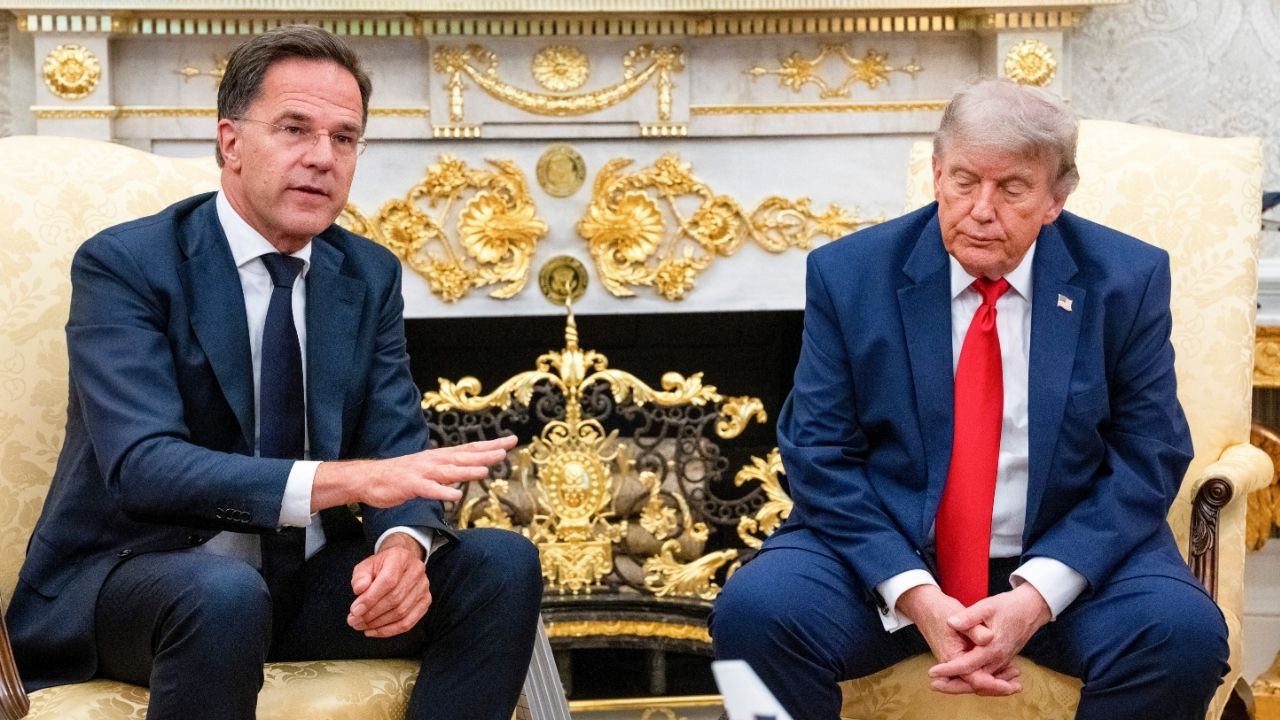
Mark Rutte, a former prime minister of the Netherlands, is secretary-general of NATO. Rutte took over in October 2024 from Jens Stoltenberg, a former Norwegian prime minister, who had held the job for a decade.
Rutte got the job partly because of his perceived ability to calm Trump, which has earned him the nickname the “Trump whisperer.” His objective was to heal a wounded alliance, but Trump has proved unpredictable even for Rutte. His relationship with the U.S. president also has sometimes angered the very European leaders who expect Rutte to placate Trump.
How Has the War in Ukraine Changed NATO?
In 2019, President Emmanuel Macron of France described NATO as brain-dead because of what he saw as a wavering commitment to collective defense and Trump’s antagonism toward the alliance. But since Russia’s full-scale invasion of Ukraine three years later, NATO’s relevance has increased.
The alliance has not only expanded by adding new members but it also is spending more money on defense, including increased production of tanks, artillery shells, drones and jet fighters. It also is deploying more troops on Russia’s borders and approving more serious military plans for any potential war.
Although the alliance does not directly provide military aid to Ukraine, NATO countries have sent tens of billions of dollars worth of equipment. All member states discuss military aid to Ukraine at monthly meetings at the Ramstein Air Base in Germany. The alliance also has helped to coordinate Ukraine’s requests for humanitarian aid.
Russia’s invasion has raised the stakes for Ukraine’s bid to join NATO. For years, joining the alliance has been a central goal of Ukraine’s foreign policy, as part of its plan to secure its future within the European Union. The government in Kyiv has applied to join NATO, but allies fear that membership would further antagonize Russia, which has demanded that NATO halt its expansion.
—
This article originally appeared in The New York Times.
By Lynsey Chutel/Alex Kent
c. 2026 The New York Times Company