
|
Getting your Trinity Audio player ready...
|
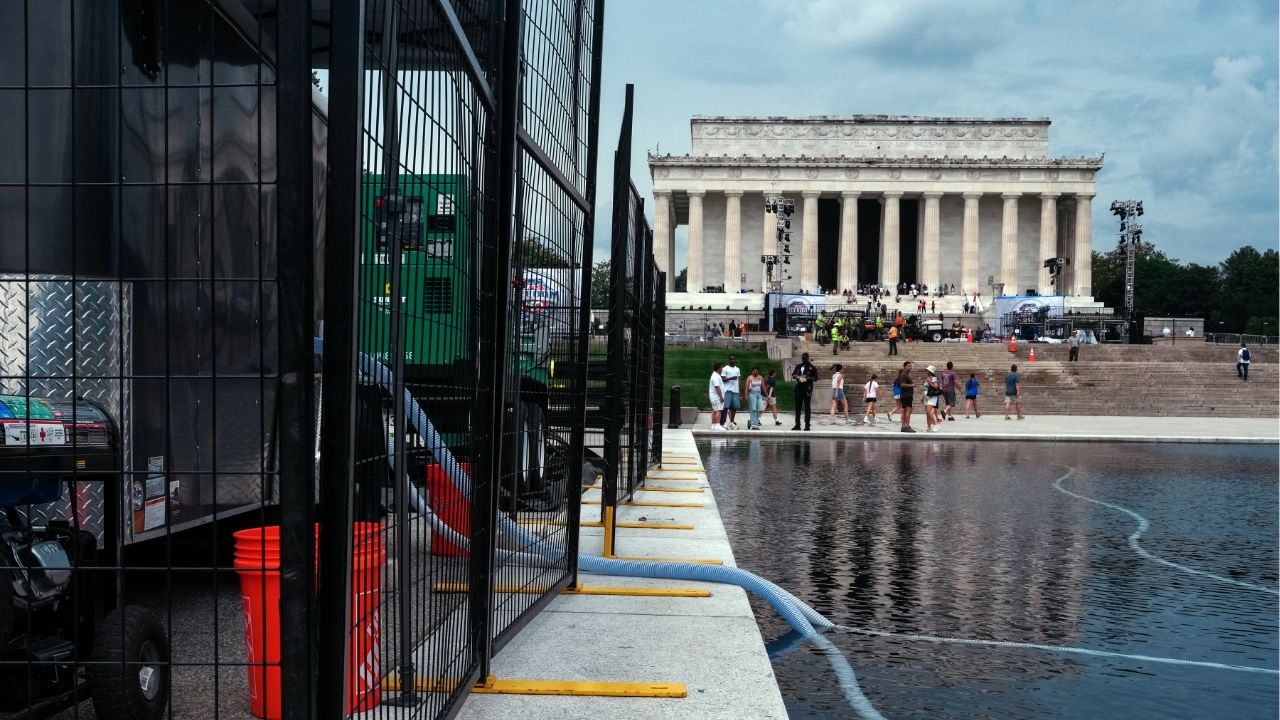
The Lincoln Memorial Reflecting Pool was supposed to be the centerpiece of President Donald Trump’s makeover of Washington. His administration spent $16.4 million on its renovation, giving out no-bid contracts to improve its filtration system and to spread blue waterproof coating across its large concrete floor.
But just days after the pool was largely refilled with water on June 5, problems appeared. The water turned bright green. The new blue coating peeled and floated to the surface.
In recent days, Trump has repeatedly blamed these problems on vandals and said six people had been arrested. But his administration has provided little evidence to back up some of his claims, and it appears no charges have been filed yet in court. Experts say other factors could have caused the major issues that have plagued the pool.

Here’s what to know.
What’s gone wrong with the reflecting pool?
At least three problems have surfaced since the pool was refilled.
The most visible one was algae, which has plagued the pool for decades. Days after the pool was refilled, algae returned and turned the water a bright shade of green. (That problem now seems to have abated: The water appears clearer, with new purification systems and Park Service employees vacuuming up algae.)
As the algae bloomed, another problem became apparent. Sections of the pool’s new blue coating began to peel off the bottom and float up to the surface.
The third problem was harder to spot, and its scope was unclear. The National Park Service said it had found cuts in the caulking used to seal joints around the pool’s edge. The government has given varying estimates of the length of the cuts, from 20 feet to more than 340 feet.
What has Trump said?
Trump has blamed all three problems on vandals.
He said that the algae bloom may have happened because people dumped fertilizer in the water. “Somebody said they might have put fertilizer. They did something to create the algae,” he said in an event with reporters Monday.
Trump said that the pool’s blue coating was peeling because vandals had cut it and pulled it apart. In a social media post, the president said the coating was “cut and powerfully lifted off the surface leaving very jagged, uneven edges.”
The president said that the cuts to the caulking around the pool’s edge were also done with malicious intent. “Somebody had to work very hard, probably in the dark of night, to create such a condition,” he wrote.
Trump said in a post Tuesday that six people had been arrested, and seven given citations, for damaging the pool.
Fencing that was set to go up around the pool ahead of the Fourth of July to allow for launching of fireworks was put in place early to guard against vandalism, the Interior Department said. In recent days, the area has also been patrolled by National Guard troops, police officers and the U.S. Marshals Service.
What evidence has the administration offered to back up the president’s claims?
The government has provided no evidence for Trump’s first claim that somebody poured fertilizer in the pool.
Experts said the algae probably did not need that kind of outside help, anyway. They said the algae blooms could have exploded because the Park Service refilled the pool with D.C. tap water, which contains phosphate compounds meant to prevent pipe corrosion. But those compounds can also serve as food for algae. Also, as the algae bloomed, government documents show that one or two of the four temporary water-treatment systems meant to clean the pool were often offline.
The government has also offered little evidence for Trump’s second claim: that vandals sliced and pulled up the blue coating.
Experts said the coating may be peeling because it was the wrong material for the job. The coating was a product called Rhino Pipeliner 5000, which is typically used inside of pipes, rather than on the bottom of pools or large basins. Interior Department employees had raised alarms earlier in the process after seeing small bubbles and holes in one layer of the coating, according to documents seen by The New York Times.
The contractor that applied the waterproofing, Atlantic Industrial Coatings, posted a statement on its website that said “a very small part” of the pool needed repairs, but did not identify a cause. The company did not respond to requests for comment Friday.
The administration has provided some details about the president’s third allegation: that someone cut the caulking at the pool’s edge.
Frank Lands, a top official with National Park Service, said in a court declaration last week that on June 9, the agency found damage to the pool that included “a caulk over the foam sealant that was cut with a sharp knife or razor and destruction of delaminating surface material.”
On Friday, an Interior Department spokesperson said that those cuts had “disturbed” nearby sections of the pool’s blue liner, although it is unclear whether those cuts could have dislodged all the pieces of blue coating spotted floating in the water.
Government documents obtained by the Times show that by June 16, the coating was peeling in multiple spots across the 2,000-foot- pool. The documents show that only a small amount of force was needed to peel the coating away.
Have people been charged?
Officials have declined to say how many people have been arrested or charged with crimes for vandalizing the pool.
Timothy Lauer, a spokesperson for the U.S. Attorney’s Office in Washington, said Friday that “we are aware of citations being issued” by the U.S. Park Police. But he did not say how many people had been cited, or describe what they were accused of doing. More details could be available later when the cases are heard in court.
So far, only one of those cited has been identified publicly: David Carter Hearn, 67, who represented the United States in three Olympics as a canoeist. His lawyer, Norman Eisen, said that Hearn was charged with a misdemeanor count of destruction of federal property after he reached into the pool’s water and touched a piece of blue coating that had already detached. He said Hearn was also charged with another misdemeanor for allegedly disobeying a government official’s command.
Eisen said that his client had not torn or removed any of the coating and that he did not disobey any commands. He said Hearn would fight the charges: “It is not a crime in America to touch water.”
(STORY CAN END HERE. OPTIONAL MATERIAL FOLLOWS.)
On Wednesday, the U.S. Park Police also released a video taken on June 19, which appeared to show a woman kneeling at the pool’s edge during a busy afternoon, sticking her hand into the water and pulling something out.
The police said they were seeking to identify the woman “in connection with a destruction of government property investigation.” The episode occurred days after the pool had turned green, the caulking had been cut and the blue coating had begun to detach.
Representatives for the Park Police did not respond to a request for comment about the incident.
–
This article originally appeared in The New York Times.
By David A. Fahrenthold/Maxine Joselow/Clarence Williams/Alex Kent
c.2026 The New York Times Company