
|
Getting your Trinity Audio player ready...
|
The blows just keep coming.
Venezuela’s economy began crumbling so badly more than a decade ago that hospitals were hollowed out, blackouts were everywhere and even the most basic goods disappeared from store shelves.
Soon, millions of Venezuelans fled the country, often on foot, scattering across the hemisphere and beyond. Faced with the nation’s steep decline, Venezuela’s repressive government clamped down even harder, stealing an election and people’s hopes for change.

Next came U.S. military strikes on boats off the nation’s coasts, a partial blockade of its oil and a stunning intervention: The Trump administration raided the capital, Caracas, seized Venezuela’s authoritarian leader and declared that the United States would run the country, effectively turning it into a vassal state.
After all the head-spinning crises, Venezuela finally appeared to be on the cusp of an economic rebirth this year. Oil was flowing again, its leaders were mending ties with global lenders and energy executives were flocking to Caracas to explore potential deals.
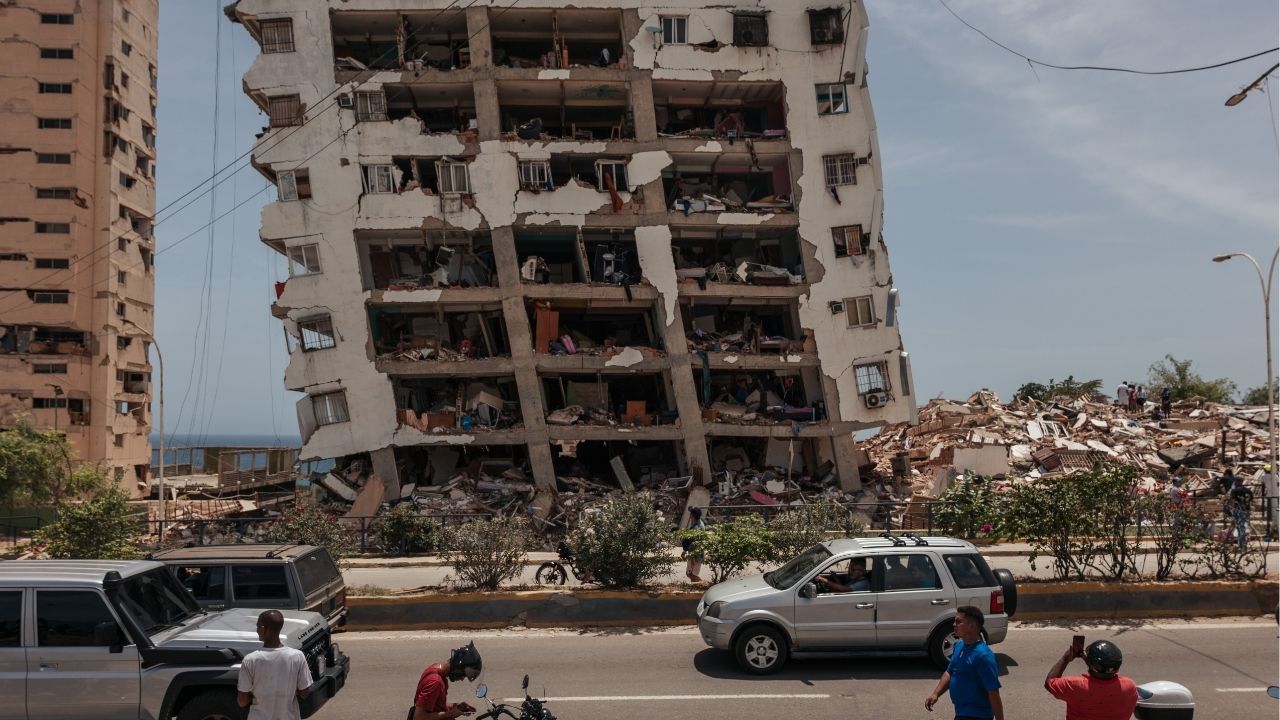
Then, the twin earthquakes this past week upended everything.
The cash-strapped Venezuelan government, already struggling to tame the world’s highest inflation rate, must now somehow muster an enormous disaster response: clearing vast amounts of rubble; finding and caring for countless, newly homeless survivors; and restoring basic services to a nation in crisis.
“This is a country that already had massive reconstruction needs,” said Francisco Rodríguez, a prominent Venezuelan economist. “Now, on top of that, they need to rebuild without having ready access to resources.”
The tragedy is likely to raise the expectations on the United States, especially since the Trump administration took control of Venezuela’s oil industry after seizing Venezuela’s leader, Nicolás Maduro, in January.
President Donald Trump has portrayed Venezuela’s transformation into a resource-rich client state led by Delcy Rodríguez, Maduro’s Washington-picked successor, as a tremendous success. But even before the earthquakes struck, frustration was mounting in the country over the lack of improvement in living conditions under the new U.S. regime.
Trump says that the United States is “ready, willing and able to help” the country in the wake of the quakes. But Venezuelans are already criticizing their government’s response to the disaster, noting that civilians have been leading many of the rescue efforts in hard-hit areas.
“This definitely increases the pressure on Delcy Rodríguez’s government and its sponsor, the United States government, to start delivering more results,” said Omar Zambrano, an economist at Andrés Bello Catholic University in Caracas.
As Venezuelans sift through the rubble, the shock from the earthquakes is staggering. The official death toll is near 1,000 and certain to climb. About 1,400 buildings have been damaged, including 13 hospitals, according to the Venezuelan government, and with hundreds of aftershocks rattling what is left of apartments, stores and offices, many people are sleeping outside. Economic losses could range from less than $10 billion to as much as $100 billion, according to estimates from the U.S. Geological Survey.
To put those estimates into context, if final losses settle around the $10 billion mark, they could amount to 10% of Venezuela’s total annual economic output.
If the losses somehow reach $100 billion, that is what Trump said international oil companies needed to spend to revive Venezuela’s oil industry over a multiyear span, potentially pitting the recovery effort against Trump’s goals for the nation’s oil sector.
On the ground, highways fractured after the earthquakes, making everything harder to accomplish. Even the international airport near Caracas is closed after sustaining damage, paralyzing travel, commerce and other logistics.
Many people in zones hit by the earthquakes have stopped working and are simply picking up the pieces or participating in civilian-led searches for survivors.
Antonieta Martínez, the owner of a small grocery shop in the coastal town of Morón, said she had no option but to temporarily shut down.
“We don’t have any electricity or water, and on top of that, two employees had their homes severely damaged, walls and floors completely cracked,” said Martínez, 48. “It’s incredibly difficult to work under these conditions.”
Small neighborhood businesses, like Martínez’s, account for about 70% of the supply chain in the areas affected by the earthquakes, making them a vital part of any economic recovery, according to José Gregorio Rodríguez, the president of Consecomercio, one of Venezuela’s leading business organizations.
“This tragedy is going to generate enormous public spending needs for reconstruction that the Venezuelan state is simply not in a position to undertake or handle,” Zambrano said.
So far, the Trump administration has offered Venezuela a fraction of the post-earthquake aid the country needs: $150 million in combined assistance channeled through aid groups and the United Nations.
Venezuela’s past clashes with multilateral organizations such as the International Monetary Fund are also limiting the fast-tracked responses that global lenders can offer right after a catastrophe, as they did for Ecuador after an earthquake in 2016 left hundreds there dead.
The disaster, and its aftermath, showcase an epic decline decades in the making.
Chafing at U.S. influence, Hugo Chávez, Venezuela’s former leftist leader, forged ties with Iran, Russia and Cuba after rising to power in 1998. Timing was on his side: His oil-rich nation profited from booming commodities prices, allowing Chávez to plow proceeds into anti-poverty projects and international alliances aimed at blunting U.S. sway in Latin America.
But Chávez also shredded the checks and balances in Venezuela’s once-democratic political system, consolidating his grip on power. He purged opponents from the civil service and eviscerated judicial independence. By the time he died in 2013, Venezuela was exceptionally polarized.
Maduro, his chosen successor, did not have Chávez’s luck when it came to timing.
Shortly after Maduro took office, a sharp decline in oil prices devastated the economy. But instead of embracing reforms to ease the crisis, Maduro doubled down, embarking on more expropriations of private companies. He grew even more authoritarian than Chávez, imprisoning political opponents and refusing to accept election results.
Stifling opposition while mismanaging the economy, Maduro oversaw one of the largest peacetime economic contractions in recent history, leading to the exodus of millions. By the time U.S. forces seized Maduro in January, many in the now-impoverished country were simply exhausted by one crisis after another.
Maduro clashed with the IMF, viewing it as a tool of U.S. influence. Venezuela formally reengaged with the IMF only a few weeks ago, after Maduro was ousted, and so far the country is initially drawing $200 million from the IMF for reconstruction efforts.
Venezuela’s ability to secure additional funds now, from the IMF and other lenders, faces greater hurdles because it is only at the start of one of the largest and most complex sovereign debt restructurings in modern economic history.
Before the earthquakes, Venezuela’s total liabilities were thought to be in the range of $240 billion. This debt pile, which includes defaulted bonds and legal awards to U.S. companies that had assets nationalized, makes it harder for Venezuela to obtain even emergency loans.
Still, there are a few bright spots amid the destruction and disarray. A huge refining hub on the Paraguaná Peninsula, not far from the tremors’ epicenters, appears to be operating normally, despite the quakes. This could allow Venezuela to continue exporting oil, the lifeblood of its economy.
U.S. oil giant Chevron also said that its business in Venezuela remained operational. Chevron accounts for about a quarter of the country’s oil production, making it the most important private company by far for Venezuela’s economy.
Oil production and exports had been climbing in the months before the disaster. That led to predictions that Venezuela could register double-digit growth this year, potentially placing the economy on more solid footing.
–
This article originally appeared in The New York Times.
By Simon Romero/Emma Bubola/Adriana Loureiro Fernandez
c.2026 The New York Times Company