

|
Getting your Trinity Audio player ready...
|
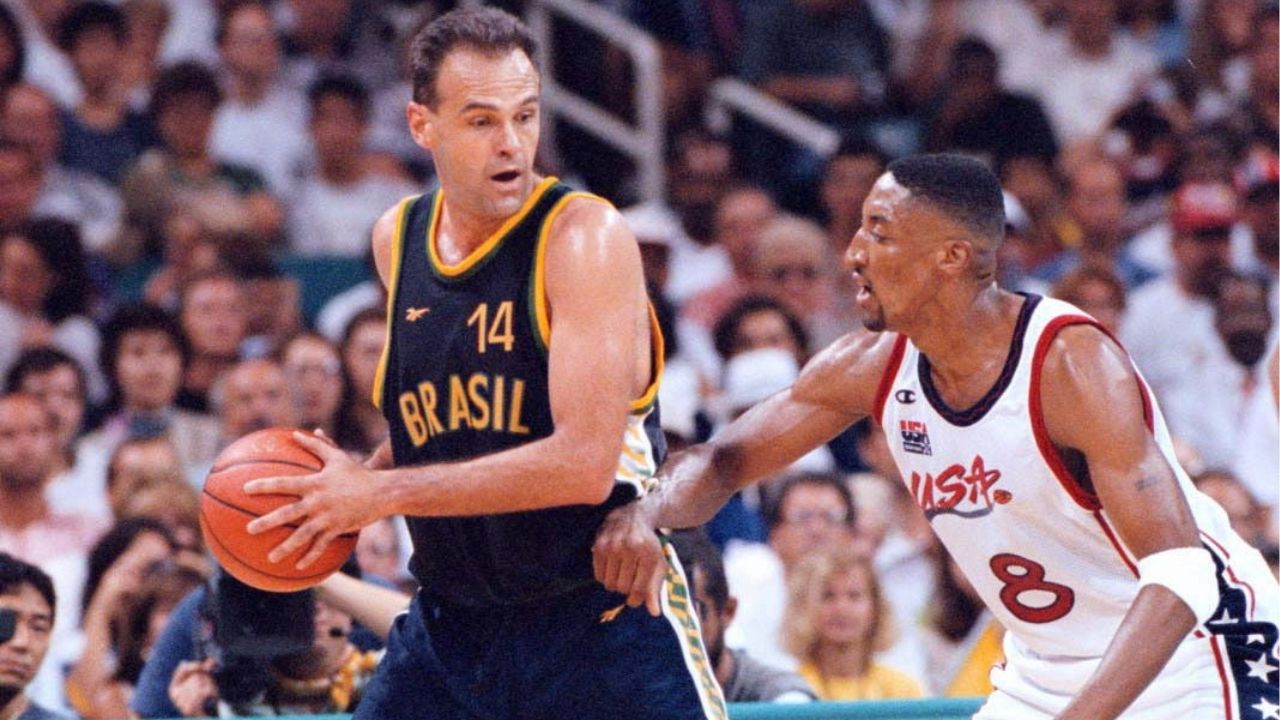
Oscar Schmidt, a brash Brazilian basketball superstar who was nicknamed the Holy Hand for shooting prowess that got him into the Hall of Fame, and who was often referred to as the best player never to play in the NBA, died on Friday in Santana de Parnaiba, outside Sao Paulo. He was 68.
In a statement, his family confirmed his death, in a hospital, but did not specify a cause. After being diagnosed with brain cancer in 2011, he underwent surgery in 2013. In 2022, he said he had been cured.
Schmidt, a 6-foot-8-inch forward, was one of the world’s greatest scorers — and an elite gunner.

“There was not a shot I didn’t like,” he said in a documentary profile that NBC Sports broadcast during the 2016 Summer Olympics in Rio de Janeiro. “I like them all because I practiced them all. I do more than 1,000 shots a day. So give me the ball. If you don’t want me to shoot, don’t pass me the ball.”
Steve Kerr, the Golden State Warriors coach, who played against him in international competition, told reporters after Schmidt’s death that Schmidt was “one of the greatest shooters I’ve ever seen in my life.”
“Just no conscience,” he added, “a bit of the Steph Curry mentality. Never, ever thought twice about letting it fly.”
Schmidt amassed 49,973 points over 29 years with Brazil’s national and Olympic teams and clubs in the Brazilian, Italian and Spanish leagues — almost as many as LeBron James’ record total of more than 51,000 in NBA regular-season play and playoffs over 23 seasons. Schmidt’s records include 1,093 points in Olympic competition, achieved in five Summer Games, from 1980 to 1996.
During the 1988 Games in Seoul, South Korea, he set a single-game Olympic scoring mark: 55 points in a loss to Spain.
In arguably his most electrifying performance, Schmidt scored 46 points to lead Brazil to a 120-115 upset victory over the United States in the final of the 1987 Pan American Games in Indianapolis. He called it “the greatest thing I did in basketball.”
At a time when loosely applied international rules prohibited NBA players from participating in the Olympics, the Pan Am Games and other amateur events (while other countries’ professionals were allowed to play), the U.S. team was stocked with star college players, like the future Hall of Famer David Robinson, and was considered unbeatable; it had won 34 consecutive games in Pan Am competitions.
Schmidt, who had scored 53 points in Brazil’s semifinal win over Mexico, had only 11 in the first half against the Americans, who led 68-54. But in the second half, Schmidt exploded, scoring 35 points on shots from all over the Market Square Arena court.
“It’s hard to be prepared for something like that,” Robinson told NBC.
Schmidt, who scored seven 3-pointers in the game, was an early master of the long-range shot long before it became a ubiquitous offensive tool in the NBA. After winning the final, he was asked how he had become so proficient.
“My wife goes with me in practice and passes me the ball 500 to 1,000 times,” he said. “That’s why I married her.”
Oscar Daniel Bezerra Schmidt was born on Feb. 16, 1958, in the city of Natal, on Brazil’s northeast coast, to Oswaldo and Janira (Bezerra) Schmidt. Oscar played soccer at first as a youth, but as he grew taller, his parents encouraged him to play basketball.
When he was 13 he attended a youth basketball camp, where a coach, Laurindo Miura, gave him a bit of critical, if obvious, shooting advice. In a story he often told, Schmidt said he had been holding the ball in front of his face before shooting it.
“Can you see the basket?” Miura asked.
“No,” Schmidt said. When the coach said, “Put the ball up” — above his head — Schmidt replied, “Now I see.”
He was only in his teens when he quickly built his reputation as a stellar player with Palmeiras, a Sao Paulo club, and with the Brazilian national team. In the late 1970s, Michigan State University tried to recruit him to join a Spartans team that had Magic Johnson on its roster, but he turned down the offer, preferring to remain with his national team. And in 1984, the New Jersey Nets (now the Brooklyn Nets) chose Schmidt in the sixth round of the NBA draft.
By then, he was a star in the Italian league, averaging 27 points a game. As he had with Michigan State, he turned the Nets down, in part because he did not want to comply with an NBA rule at the time that prevented its players from competing for national teams.
“They came to offer me a no-cut contract,” he said when he was inducted into the Naismith Basketball Hall of Fame in 2013. “I said thank you very much, but if I play one game here, I will never play for my national team.”
Schmidt nevertheless earned the respect of many NBA players, including the Hall of Famers Larry Bird, Charles Barkley and Kobe Bryant.
“If they were big, he’d go around him,” Bird told NBC, describing Schmidt’s ability to shoot against virtually anyone. “If they were small, he’d post them up.”
The Geneva-based International Basketball Federation, known by its French acronym FIBA, inducted Schmidt into its Hall of Fame in 2010, and he entered the Italian Basketball Hall of Fame in 2017. He was the top scorer in three Olympics: in Seoul, where he averaged 42.3 points a game; in Barcelona, in 1992 (24.8 points); and in Atlanta, in 1996 (27.4 points).
Schmidt’s survivors include his wife, Maria Cristina (Victorino) Schmidt; and two children, Stephanie and Felipe.
—
This article originally appeared in The New York Times.
By Richard Sandomir/Jose R. Lopez
c. 2026 The New York Times Company