
|
Getting your Trinity Audio player ready...
|
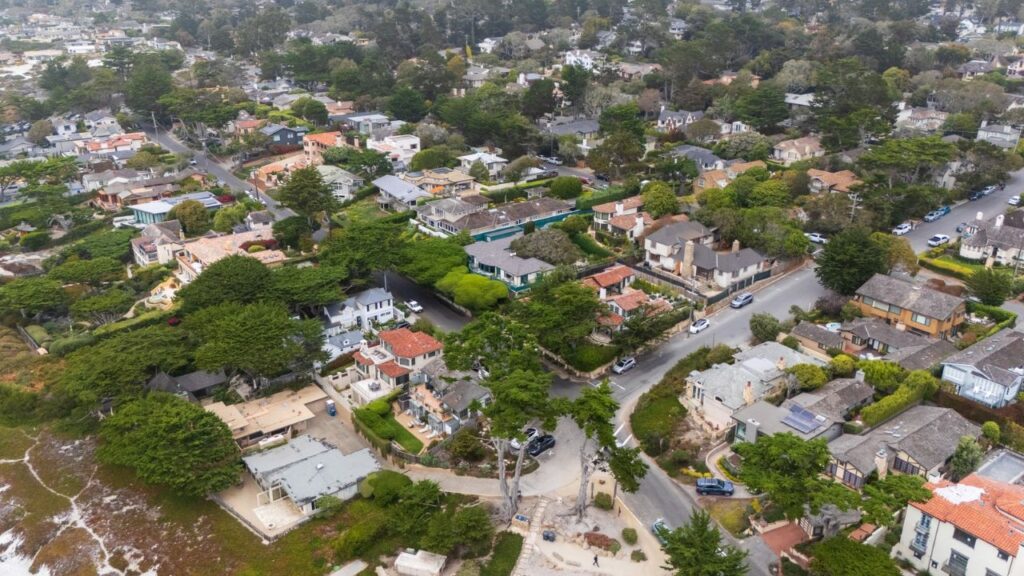
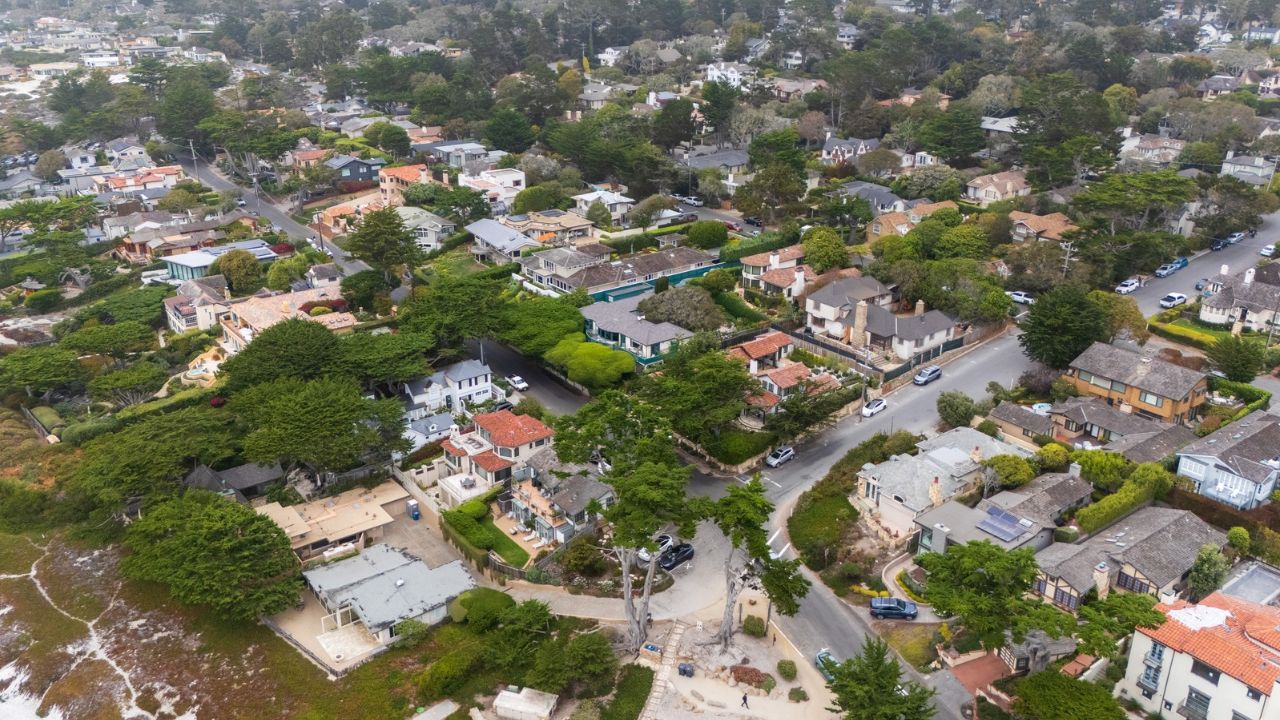
Carmel-by-the-Sea, California, has long guarded its eccentricities.
Incorporated in 1916, the charming coastal village along the southern bend of the Monterey Peninsula drew writers and artists who made it a bohemian enclave. And when it came to property, it insisted that a home was something you described, not something to slap a number on.
In the 1920s, Perry Newberry ran a successful mayoral campaign on the platform “Keep Carmel Off the Map,” according to a document from the National Register of Historic Places. And for nearly a century, the town more or less obliged, doing without address numbers. To locate City Hall was to know that it was on the east side of Monte Verde, between Ocean and Seventh avenues. The Hasenyager House, a quaint French Tudor home, was southwest of 13th Avenue on the west side of Carmelo Street.

Last month, after repeated tries and lengthy debates, Carmel’s buildings and its 3,000 residents got mailing addresses for the first time. This change was driven by the need for ambulances to find the right door and an aging population increasingly relying on deliveries of packages and prescriptions, officials said. While the change was widely seen as practical, some residents said it was is the latest in a series of factors eroding Carmel’s small-town character.
“I don’t like to see these traditions and uniqueness dissipate,” said Frankie Laney, a longtime resident. “Some change is inevitable, and you just have to suck it up.”
Laney learned of her new street address this summer from her post office box. It was a fitting place to find it. For decades, mail has rarely been delivered to homes in Carmel-by-the-Sea, a 1-square-mile city. Instead, every resident received a free P.O. box at the downtown post office, where many came to collect their mail and lingered to chat with neighbors.
Getting a package delivered in Carmel was more complicated, with parcels sometimes ending up at neighboring properties.
After years of failed attempts, the City Council voted unanimously to approve the street address map in June. The city started rolling out the change in early September, with announcements in city newsletters, ads and postcards mailed to residents. Some houses had their address numbers added this week.
Carmel Mayor Dale Byrne called the issue a matter of public safety. In an interview, he recalled an episode from July when he was visiting a friend’s home and the man suddenly turned pale, losing consciousness.
Byrne called 911 and tried to describe the location where the ambulance should arrive, but the dispatcher did not understand how to find the home without an address. He was transferred to another dispatcher, then another.
“He could have had a heart attack, and you’re asking me to explain how my street address works,” Byrne recalled.
An ambulance did arrive, he said, guided by a dispatcher based on the scraps of information Byrne managed to convey. (His friend is OK, he said.) Afterward, Byrne asked city emergency medical workers whether this had happened before. It had.
Justin Cooper, a division chief with the Monterey Fire Department, which covers Carmel and several cities in the region, said that such episodes have typically involved emergencies reported by part-time residents or visitors. In moments of panic, they haven’t been able to tell dispatchers precisely where they were.
He recalled one time when emergency medical workers got only a street name when responding to a report of someone having a heart attack. He said they had to go door to door until they found the patient.
Based on his own experience and what he learned, Carmel’s tradition of being an address-free city had to end, Cooper said.
Byrne agreed.
“This is 2026, not 1906,” he said. “Things are going to be different over time, and there are some things you can protect, some things you can’t and shouldn’t protect.”
Laney’s house, which has been in her family since the 1930s and which she inherited in 1984, is called Cielo e Mar, Italian for “sky and sea.” Until this summer, its location was described as Santa Rita 3 SW of 4th, or, more commonly to visitors, the third house southwest of Fourth Avenue, on the northeast side of town.
Laney, 90, said that while she understood the need for the numbers, noting that some of her neighbors rely on prescription delivery, all the ways Carmel has changed in recent years have been hard to accept.
Those changes are partly a reflection of shifts in California’s real estate market. On any given night, about 60% of the houses in Carmel-by-the-Sea sit empty, having become the vacation homes of owners living elsewhere. The hardware store and pharmacies that long served residents have given way to other businesses like restaurants and bike rental shops that are attractive to visitors and part-time residents, according to city officials.
The median list price for a house for sale in Carmel hovers around $3.2 million, according to real estate website Realtor.com.
Jeff Baron, a City Council member who supported the adoption of addresses, said he had not expected the backlash that followed. He has since come to see it as part of a deeper problem: a steady decline in the number of people who live in Carmel year-round and a doubling — to 60% from about 30% of the share of properties used as vacation homes.
“We have lots of neighbors that come down like two or three times a year,” he said. “I question whether our community will be able to survive because of that.”
The shift is visible downtown. For its 3,000 residents, Carmel has nine coffee shops, Baron said. The hardware store folded six years ago and is now a vacation rental management office, he said.
“That’s the perfect example of what’s going on here,” Baron said.
“We’re going to be a community of houses,” he added, “not a community of people.”
—
This article originally appeared in The New York Times.
By Mark Walker/Nic Coury
c. 2026 The New York Times Company