



|
Getting your Trinity Audio player ready...
|
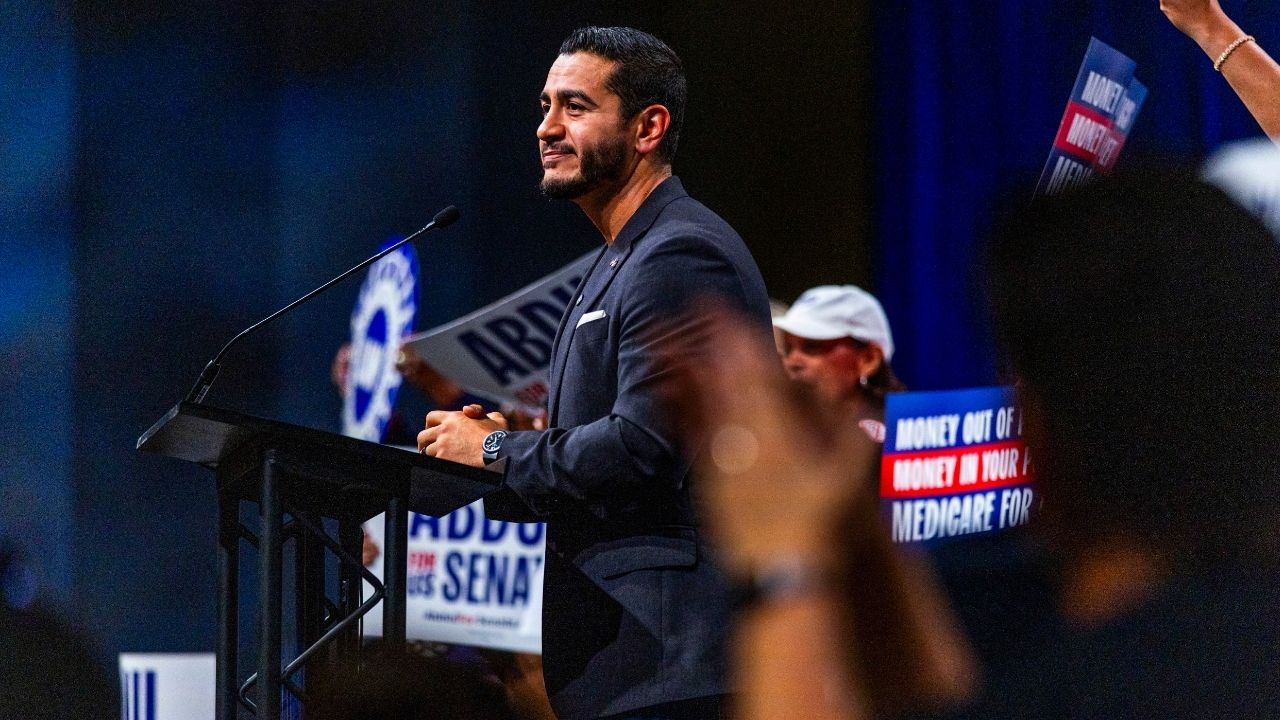
Dr. Abdul El-Sayed, the Democratic Senate nominee in Michigan, recently spent two days trying to mend fences with Jewish Democrats after an acrimonious primary against a pro-Israel opponent.
For some of them, it wasn’t enough.
Specifically, El-Sayed sought to address remarks he had made shortly after an attack on a synagogue in the Detroit area in March that some interpreted as too sympathetic to the assailant. But his apologies last weekend fell short with some Jewish Democrats in part because he seemed to be seeking forgiveness for the timing of his remark rather than its substance.

El-Sayed’s criticism of Israel has concerned many Jewish Democrats. And some are angered by his association with Hasan Piker, a provocative streamer whose comments about Israel have drawn blowback from Democrats and Republicans.
The frictions revealed the still-fresh wounds from a bitter primary struggle between El-Sayed and his pro-Israel opponent, Rep. Haley Stevens. Their race became a proxy war over the Democratic Party’s divisions on Israel, which propelled numerous progressive candidates, including El-Sayed, to victory.
The lingering tension is a hurdle for El-Sayed as he seeks to turn to his general-election opponent, former Rep. Mike Rogers, a Republican. Uniting Democrats is proving difficult for El-Sayed, who won his primary by fewer than 18,000 votes. And he is battling on two fronts, as Rogers and other Republicans, including Vice President JD Vance, have begun to assail him over his position on Israel in an effort to peel off Jewish support.
With just over two months left before the general election, the dissonance could threaten El-Sayed’s efforts to assemble a winning coalition in a key Senate battleground race that will help determine control of the upper chamber.
El-Sayed is “under a microscope in the Jewish community,” said Yifat Clein, 41, an Israeli-American from Detroit who is supporting him. She said she was concerned about the number of Jewish Democrats in her community who have said they would vote for Rogers, because of his support for Israel.
Zach Nessel, the secretary of the Michigan Jewish Democratic Caucus, the organization that El-Sayed addressed twice over the weekend, said that El-Sayed’s “apology didn’t go far enough.” Nessel, who is the son of state Attorney General Dana Nessel, added, “I don’t think Abdul has done enough at this point in time to gain our full support with an endorsement.”
El-Sayed has been meeting with Jewish leaders in Michigan and expanding his outreach, including hiring a Jewish liaison, his campaign said. He will “continue to be actively engaged with those communities to build the coalition that will defeat Rogers,” Cole Wozniak, a spokesperson for El-Sayed’s campaign, said in a statement.
Back in March, El-Sayed angered many Jewish Michiganders when he described how the assailant at a synagogue in West Bloomfield Township, a U.S. citizen of Lebanese descent, had lost his family in an Israeli airstrike in Lebanon a week earlier.
“Hurt people hurt people,” El-Sayed said then, while also denouncing antisemitism and condemning the actions of the perpetrator, who drove a vehicle into a building full of preschoolers, injuring a guard before he was killed in a firefight.
On Saturday, El-Sayed apologized for those remarks during an appearance before the Jewish Democratic Caucus at a party convention in Lansing. He did so again at the caucus’s private fundraising gathering on Sunday.
“There’s opportunity for context later on, but when you give the wrong — the right medicine at the wrong time, it’s the wrong medicine,” El-Sayed said at the fundraiser Sunday, according to audio provided by his campaign. “And I gave it at the wrong time, and folks didn’t need to hear it, didn’t want to hear it. It was not the right thing to say.”
As Nessel saw it, El-Sayed had “apologized for when he said what he said, but not what he said.”
Decky Alexander, the chair of the Michigan Jewish Democratic Caucus, a subgroup of the state party, said the meetings had helped ease tensions for some, and gave voice to “the differing perspectives of those who are Jews and Democrats in Michigan.” She did not say whether the group would endorse El-Sayed.
Jewish voters have overwhelmingly supported Democratic candidates in recent elections. But some Jewish leaders said that El-Sayed’s views could mean that he might underperform. He has been a vocal critic of Israel, calling the country’s government “evil” and its actions in the Gaza Strip a “genocide.” He also sharply criticized a major pro-Israel super political action committee that spent millions in the primary trying to boost Stevens.
Some say they are breaking ranks with their party to back Rogers, who has wasted no time courting some of the state’s roughly 130,000 Jewish residents. He campaigned with a prominent rabbi from Ann Arbor last week and has circulated a list of 344 Jewish residents in Michigan, some of them Democrats, who have pledged to support his campaign.
El-Sayed’s posture toward Piker, who campaigned with him in the primary and has faced criticism for recent comments suggesting Jewish Americans could face threats over their positions on Israel, has also drawn scrutiny. Rogers has sought to make his opponent’s ties to Piker a liability, calling him El-Sayed’s “running mate.”
El-Sayed distanced himself from Piker’s remarks, saying that “Americans deserve the right to advocate for what they believe without fear of violence,” and that he does not have any intention to campaign with Piker in the general election. But he has stopped short of denouncing Piker directly, as some Jewish Democrats have demanded.
“This is not a campaign that is about a Twitch streamer in California. This is about affordability in Michigan,” El-Sayed told reporters Saturday.
In an interview last week, Piker called the GOP efforts a “smear campaign” and said it was El-Sayed’s opposition to U.S. aid for Israel, not his association with Piker, that had put a target on his back.
Stacie Chaiken of Detroit, a Jewish voter who supports El-Sayed, said he may face bias because of his Arab heritage and Muslim faith. His comments after the synagogue attack were “misinterpreted” by some as justification for the incident, she argued, and “maligned” by those already “inclined to distrust him.”
“There are some people, when your name is Abdulrahman El-Sayed, it will never help,” she said, adding, “It’s a shame that the Jewish community is so torn apart by things that are happening abroad, and that there is so much deep fear.”
Rabbi Asher Lopatin, who campaigned for Rogers last week, says he has voted for Democrats his entire life. While Rogers still “has a lot of work to do also to reach out to the Jewish community and to address concerns,” he said, he feels he is the best option.
“There are many things that he’ll probably vote for that I would disagree with, but I think for the long term of the Democratic Party and for the country, we need to defeat El-Sayed,” Lopatin said.
Clein said she felt El-Sayed’s “questioning” of the Israeli government was warranted and “necessary.” She is concerned that pro-Israel Democrats backing Rogers would help elevate a candidate who does not reflect their values on other issues.
“You’re not necessarily in love with the person that you’re voting for, right?” Clein said. “You have to be more strategic.”
—
This article originally appeared in The New York Times.
By Bayliss Wagner and Steve Friess/Emily Elconin
c. 2026 The New York Times Company










![[hubspot type=form portal=8576119 id=f5235c74-daca-46b2-b841-0fec24b5a509]](https://gvwire.com/wp-content/uploads/2026/09/GVH_LaborDaySavings_300x250_static.jpg)
