

|
Getting your Trinity Audio player ready...
|
For the first time since 1972, NASA is sending astronauts to the moon. (But not to land there.)
The mission, Artemis II, was scheduled to launch Wednesday at 6:24 p.m. Eastern time. A giant rocket will lift off from Kennedy Space Center in Florida, and the crew of four astronauts — three Americans and one Canadian — will embark on a 10-day journey around the moon and back to Earth.
While the astronauts will not touch the moon — at their closest, they will be thousands of miles away — a successful Artemis II mission is a necessary step toward returning to the moon’s surface. The mission will test life support and other systems of Orion, a space capsule that is to be America’s vehicle for lunar journeys.

Once there, future NASA crews will use other spacecraft, built by SpaceX or Blue Origin, to land on the moon. NASA aims to do that as soon as 2028.
Apollo 17 in December 1972 was the last time astronauts walked on the moon. After the United States beat the Soviet Union to the moon in 1969, interest in lunar exploration plummeted and NASA’s budget was cut. Instead of venturing outward, the agency’s astronauts have remained close to Earth since then, on the space shuttles and then the International Space Station.
During his first term, President Donald Trump set the moon as the destination for the Artemis program. The Biden administration continued Trump’s approach. The Artemis I mission, without astronauts aboard, flew successfully to the moon and back in 2022.
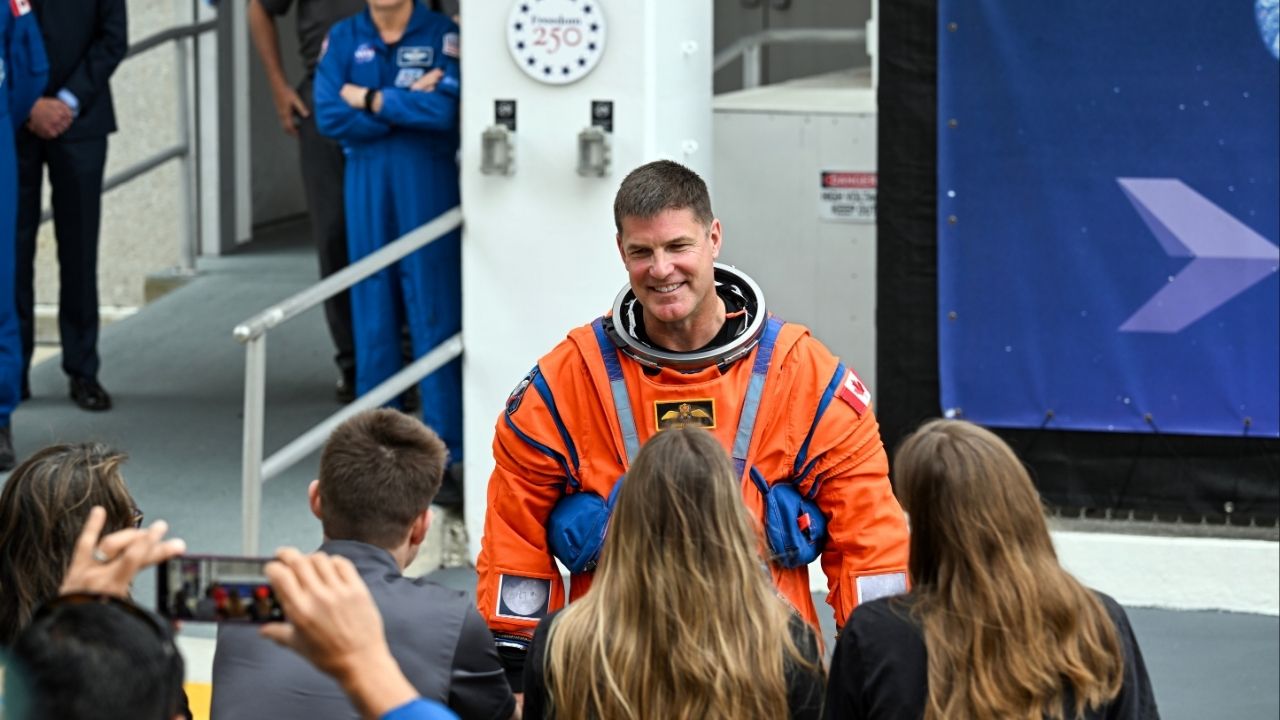
Four astronauts were preparing for launch: Reid Wiseman, the mission’s commander; Victor Glover, its pilot; and Christina Koch and Jeremy Hansen, the mission specialists.
Here’s What Else You Need to Know About Artemis II:
— All Aboard: The rocket is filled with propellants and the hatch has been closed to the spacecraft in which the astronauts will travel to the moon. Weather forecasters improved their prediction of favorable conditions during the two-hour launch window that starts at 6:24 p.m. Eastern time. It went from 80% to 90%. The window allows wiggle room to resolve last-minute glitches or wait for a threatening cloud to pass by. If the launch is postponed, NASA has additional opportunities through Monday to try again. After that, it would have to wait until at least April 30.
— Technical Hiccups: Problems that have snarled scheduled launch attempts in the past, like hydrogen leaks and helium leaks, have not recurred. But there have been other issues. First, NASA engineers resolved a problem with the rocket’s flight termination system, which destroys the rocket in the event that the crew capsule is ejected during flight. Then, around 5:30 p.m. Eastern, NASA said it was working on a problem with a battery in that crew capsule ejection system.
— How to Watch: NASA is streaming the mission on YouTube, X, its website and other digital platforms. The agency provided updates about the filling of the rocket with propellants, offering views from the launchpad. Some people in Florida and southern Georgia may even be able to see the rocket from their backyards.
— Firsts in Flight: The Artemis II crew includes several firsts. Glover, the pilot, is to be the first Black man to travel around the moon. Koch is to be the first woman, and Hansen would be the first Canadian to make the journey. While Wiseman, Glover and Koch have spent time on the space station, this will be Hansen’s first time off the planet.
— Rocket and Capsule: The astronauts will get to space aboard the Space Launch System. The rocket is the equivalent of the Saturn V that NASA used during the Apollo moon landings. The SLS is 322 feet tall and weighs 5.75 million pounds when filled with propellants. Once in space, the crew will separate from the rocket and travel toward the moon in the Orion capsule. It has the interior volume of about two minivans.
— 10 Days to the Moon and Back: The path of Artemis II is unlike any moon mission in the past and probably unlike any moon mission in the future. During the crew’s first few hours in space, they will test Orion’s systems while swinging out to about 43,000 miles above the Earth. That will set them up to begin their journey around the moon. If they launch Wednesday, Thursday or Friday, the astronauts will set a record for the farthest anyone has ever been from Earth, surpassing the distance reached by Apollo 13 when the astronauts had to abort their mission and return back to Earth.
—
This article originally appeared in The New York Times.
By Kenneth Chang and Katrina Miller/Kenny Holston
c. 2026 The New York Times Company