


|
Getting your Trinity Audio player ready...
|
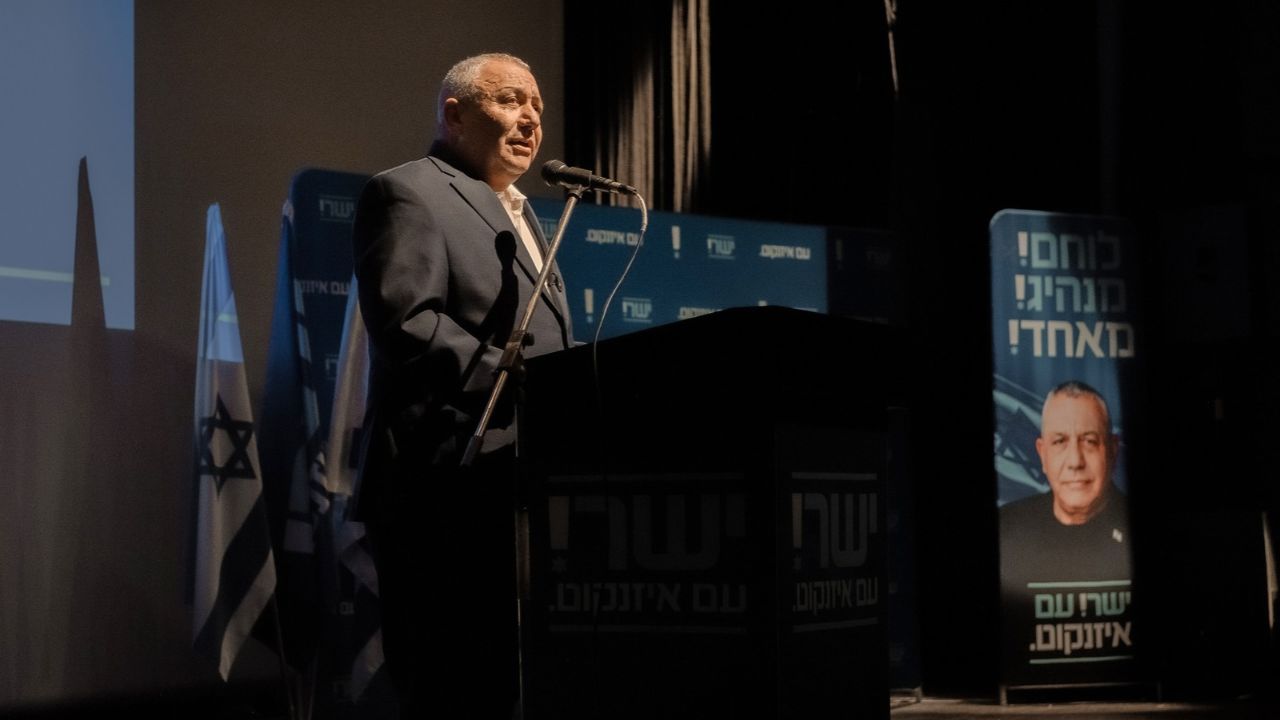
Israel’s president on Saturday selected Gadi Eisenkot, the leading rival of Prime Minister Benjamin Netanyahu, to try to form a new government, handing him the daunting task of forging a parliamentary coalition after an indecisive national election last month.
Israeli President Isaac Herzog said he had held “in-depth talks” with Netanyahu and Eisenkot before making his decision. He ultimately tapped Eisenkot, a center-right former Israeli military chief, after more members of parliament supported Eisenkot than Netanyahu during consultations over the past week.
The announcement gives Eisenkot a long-awaited chance to fulfill his pledge to unseat Netanyahu, but he will have to navigate significant obstacles to form a government. He has up to six weeks to build a coalition before the president passes the opportunity to another candidate, most likely Netanyahu.

Israel’s pivotal election Oct. 27 left all sides short of an outright 61-seat majority in parliament. Netanyahu’s coalition won 53 seats; Eisenkot and his Zionist allies secured 48; and two Arab parties took a record 19.
Now that Eisenkot has received a mandate to form a government, he faces a series of difficult choices. He could join forces with the two Arab-led parties, but some of the right-wing Jewish parties in his bloc have said they would not enter a government that relied on their support. Eisenkot has also stipulated conditions that the Arab parties have yet to meet, such as publicly labeling Hamas as a terrorist organization.
On Friday, Eisenkot said he would work to establish a “national emergency government” to eject Netanyahu as soon as possible. That would probably mean a minority government that would at least rely on the Arab parties’ support to prevent a no-confidence vote against it.
“We must urgently establish stable, responsible leadership, prevent another round of elections and put an end to outgoing Prime Minister Benjamin Netanyahu’s determination to cling to office,” Eisenkot said, adding that parties that did not join immediately could do so later.
Netanyahu has dominated Israel’s political life for the past three decades, leading for almost 19 years in all. His opponents consider him an existential threat to Israeli democracy and revile his failure to prevent the Hamas-led Oct. 7, 2023, attacks. But supporters see him as a strong leader willing to defy global opinion in the name of Israeli security.
On Saturday, Netanyahu attacked a prospective government led by Eisenkot that would rely on the Arab parties. He claimed it would unleash “fires and flames we will see in the streets,” comparing it to “national suicide,” and said Israel’s Zionist parties should unite under his leadership.
“This is a matter of our very existence. Israel simply will not survive under such a government,” Netanyahu said.
If Eisenkot fails to form a government, Herzog can select another candidate, who will then have four weeks to do so. If neither succeeds, parliament could ask Herzog to grant the mandate to a third lawmaker, who would have 14 days to make a last-ditch attempt.
If the candidates failed, parliament would be dissolved, and new elections would be held. While Herzog and Eisenkot have said they hope to stave off that prospect, Netanyahu may welcome it.
Under Israeli law, Netanyahu will serve as the caretaker prime minister until a new government is formed. Political analysts say remaining in power by forcing a new round of elections would be a victory for him, even if he is not able to form a government this time around.
Netanyahu and his hard-line allies have also attacked the results, asserting with little evidence that the election was “stolen by Arab parties.” Israeli election officials have repeatedly said there is no proof of widespread fraud.
The selection of Eisenkot had been expected for several days, after Herzog consulted with leaders and officials of the 11 parties that won seats in parliament. Eisenkot received a clear majority, with most parties backing him; he got the support of 67 lawmakers, compared with 46 for Netanyahu.
Eisenkot, a soft-spoken former general, campaigned on the promise of keeping Israel secure while leading it away from policies that have brought it to the brink of becoming a pariah on the world stage. But not everything would change: Like Netanyahu, Eisenkot says he does not support a Palestinian state.
He has also paid a painful personal price to which many Israelis can relate: His son and two nephews died in the war in the Gaza Strip that followed the Oct. 7 attacks.
Many in Eisenkot’s camp had hoped the election last month would be a reckoning over Netanyahu’s leadership, which included a contentious effort to weaken the Israeli judiciary and also brought Israel mounting diplomatic isolation over the devastating and deadly war in Gaza.
But Netanyahu, a consummate political survivor, overcame widespread criticism in Israel and fury abroad to outperform many of the polls. His Likud party secured 27 seats, down from 30 in the last election in 2022 but still more than any other political party.
Eisenkot has articulated four principles he said parties must meet to be included in his governing coalition: recognizing Israel as a Jewish and democratic state; supporting the Israeli Declaration of Independence; backing universal national service; and labeling Hamas as a terrorist organization that must be dismantled.
Neither of the two Arab-led parties — Raam and the Joint List — have met those conditions, Eisenkot has said. Raam has accepted most and has condemned the Oct. 7 attacks but has not called Hamas a terrorist group. The Joint List includes leftists and Palestinian nationalists who reject Israel’s founding ideal of a “Jewish democracy.”
Eisenkot could also try to woo away some of Netanyahu’s ultra-Orthodox allies. But many of the former general’s supporters could view that as a betrayal if he had to compromise on a push to force ultra-Orthodox religious students to serve in the military, given that he campaigned on ending their long-standing exemption from conscription.
—
This article originally appeared in The New York Times.
By Ephrat Livni and Aaron Boxerman/Amit Elkayam
c. 2026 The New York Times Company