


|
Getting your Trinity Audio player ready...
|
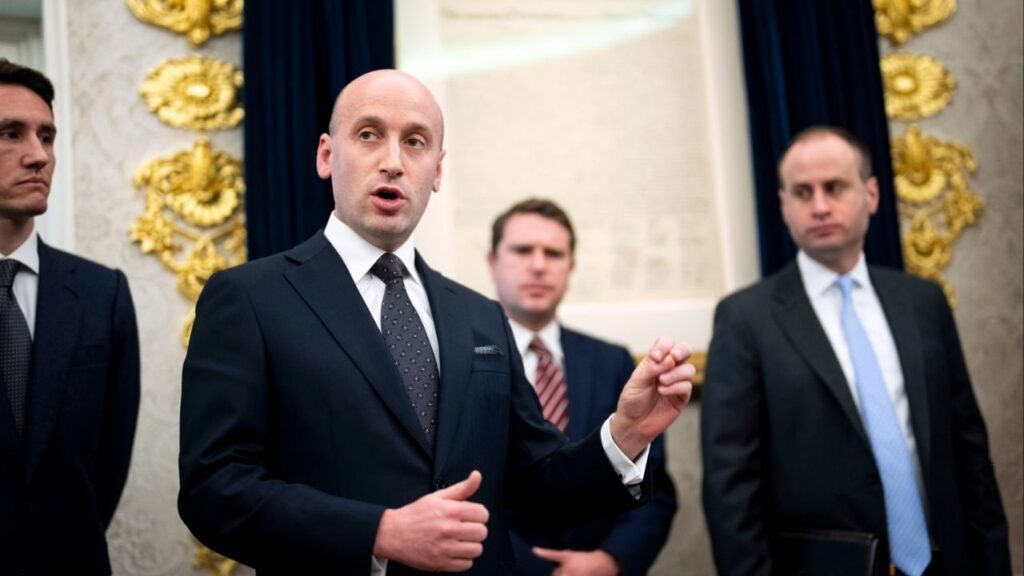
WASHINGTON — Stephen Miller is one of President Donald Trump’s longest-serving and most influential aides, and the architect of many of the president’s most aggressive border and immigration policies. His rise to White House chief of staff, a role he officially begins Monday, elevates a hard-line policy adviser to a position of preeminent power and influence in Trump’s inner circle.
An unabashed champion of Trump and his agenda in high-profile media appearances, Miller is a perennial target of critics of the president, who have highlighted his right-wing views. The policies he has driven are expected to be a top focus of congressional Democrats as they take power next year.
People close to Miller said he had little interest in compromising with Democrats and was prepared for a fight over congressional subpoenas and investigations, as The New York Times reported last week.

The new chief of staff plans to focus on trying to rebuild the fractured MAGA coalition and pursuing policies that will energize the voters who elected Trump in 2024, they said. He has also privately indicated the need to resolve the Iran war and mitigate the high prices that drove deep voter dissatisfaction in last week’s midterm elections.
Trump has not offered an explanation for his decision to fire Susie Wiles, his former chief of staff, and replace her with Miller, noting only that “Stephen’s been with me from the beginning” and was one of his most trusted advisers.
Miller, 41, has advised Trump for nearly a decade, and he has either authored or significantly contributed to many of the president’s most high-profile moves. Those include separation of migrant families at the border; the 2017 Muslim travel ban; directing the government to stifle critics of Trump; the ending of nearly all U.S. refugee programs; the widespread pressure campaign against American universities; extrajudicial boat strikes that have killed hundreds; and purges of officials deemed insufficiently loyal to Trump.
But perhaps Miller’s most wide-reaching influence can be seen in Trump’s mass deportation campaign, which Miller has overseen. Miller helped set in motion militarized operations on the streets of American cities, pitting masked, heavily armed immigration agents against residents of cities such as Minneapolis and Chicago.
Many of those raids have targeted immigrant communities that Trump has denigrated, including Somalis. Miller has also fixated on accusations that Somali Americans have committed fraud and are spending public money on luxury cars, mansions and first-class travel.
Miller has earned Trump’s trust by validating the president’s impulses and his worldview, particularly on immigration. Miller, once an aide to Sen. Jeff Sessions, an immigration hard-liner, was drawn to Trump by his anti-immigrant rhetoric that dominated his 2016 presidential campaign. Trump, in turn, was impressed by his ideas on immigration policy and the fervor with which Miller would rile up crowds during campaign rallies and defend Trump in media appearances.
“I love watching him on television,” Trump said of Miller last year.
Republicans in Washington have said that they consider Miller to be channeling the president when he speaks. The two spent the four years that Trump was out of power speaking on nearly a daily basis, “talking about what a second term agenda might look like before many of us even dreamed that there would be a second term,” said Sen. Jim Banks, R-Ind.
Miller, who has now amassed considerable power in the second Trump administration, has continued to serve as a fiery surrogate for the president’s most divisive moves.
This year, as Trump publicly toyed with the idea of invading Greenland, Miller laid out a vision of American imperialism in which the United States could freely overthrow national governments and take foreign territory and resources so long as it was deemed in the national interest.
“We live in a world in which you can talk all you want about international niceties and everything else,” Miller told Jake Tapper of CNN. “But we live in a world, in the real world, Jake, that is governed by strength, that is governed by force, that is governed by power. These are the iron laws of the world since the beginning of time.”
Miller has also echoed Trump’s efforts to undermine the legitimacy of the federal judiciary. When judges blocked the president’s tariffs last year, Miller attacked the decision as a “judicial coup” on social media. He has also blasted other judges scrutinizing Trump administration policies as Marxists and “crazy” communists.
—
This article originally appeared in The New York Times.
By Chris Cameron
c. 2026 The New York Times Company