
|
Getting your Trinity Audio player ready...
|
Taking advantage of a recent Supreme Court decision, the Republican National Committee is sending tens of millions of dollars to help the party’s midterm candidates. The long-awaited move adds to the GOP’s considerable financial advantages, especially in Senate races, despite a tough political environment.
The RNC, which entered September with an enormous $126 million on hand, told The New York Times that it was finishing moving more than $50 million to the groups overseeing the party’s efforts to elect House and Senate candidates. The cash infusion, significantly larger than what Republicans have done in the past, is something that the troubled and financially struggling Democratic National Committee is incapable of doing.
The RNC told the Times that it had transferred more than $44 million between mid-August and mid-October to the party’s main House and Senate committees. Many of those transfers will be disclosed for the first time in a campaign-finance filing Tuesday evening. The cash was about evenly split between the National Republican Congressional Committee, which works to elect House Republicans, and its Senate counterpart, the National Republican Senatorial Committee. At least $6 million more is set to be sent to those two committees by Election Day, the committee said.

The spending comes as Republicans play defense across the midterm map, devoting resources to states and districts that were once thought to be safely red as President Donald Trump’s low approval ratings weigh on the party’s candidates.
The RNC has amassed its huge war chest in part thanks to an aggressive fundraising effort by Trump and Vice President JD Vance, who has led the party’s finance operation. The party said it raised $18.5 million in September. By Oct. 14, RNC officials said, its $126 million coffers had been drawn down to $76 million, a campaign-finance filing Thursday will show.
Transfers are not new. In the four most recent election cycles, the RNC has transferred between $8 million and roughly $31 million to these party committees.
But the shift of money goes much further this time. In June, the Supreme Court struck down limits on the amount of coordinated spending that party committees could do with candidates. That was a major change, probably the largest in campaign finance since the 2010 Citizens United decision, which lifted limits on corporate spending in elections. And this year’s ruling from the conservative-controlled Supreme Court stood to immediately benefit Republicans, because they have much more money in their party committees.
The Republican House and Senate party committees have been able to channel their money into advertising that is more coordinated with candidates than what their Democratic counterparts are doing.
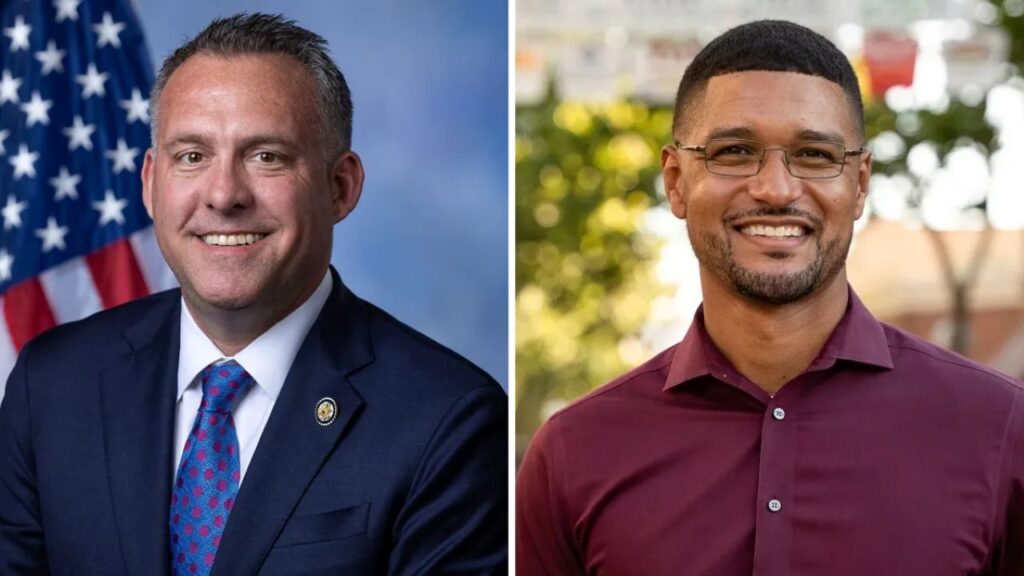
Those two Capitol Hill committees have aired or booked about $152 million worth of ads through coordinated purchases, according to data from the media-tracking firm AdImpact, the largest being for Sen. Jon Husted in Ohio. The RNC itself is airing another $5 million worth of ads that it coordinated with Rep. Ashley Hinson’s campaign for Senate in Iowa, a move it doesn’t expect to repeat with other candidates.
All told, Democratic committees have aired or booked only about $102 million worth of such ads, the largest being for Husted’s opponent, former Sen. Sherrod Brown in Ohio.
The Times reported in July that the DNC could not afford to make planned transfers to Democrats’ congressional committees. The DNC has reported holding negative cash on hand, inclusive of its debt, for almost the entire 2025-26 election cycle. Mia Ehrenberg, a DNC spokesperson, said the committee had made “historic, early and aggressive investments in critical party infrastructure,” sending over $1 million to state parties each month.
The two parties’ House and Senate committees had relative parity in fundraising through Aug. 30. That is why RNC officials say their transfers are responsible for the current Republican advertising advantage in coordinated spending, most of which was booked since that date.
Mike Ambrosini, the RNC’s chief of staff, said the strategy of coordinated spending had been part of his pitch to donors. “We’re moving all this money directly into these campaigns,” he said, “so we felt it was important that folks understood that investing with us meant that your dollar could cover all of those different use cases.”
The RNC is sticking to its traditional work of funding ground game and data work for candidates. Party officials said that through early October, they had spent about $56 million on canvassing and voter-turnout operations, $27 million on “election integrity” work, $18 million on the party’s data operation and about $11 million on digital work.
Party officials were careful to note that the RNC will not spend all of its money on hand in the midterms, and that tens of millions of dollars are likely to be left over. That is because some of the cash is held in special accounts designated for uses like legal fights and building renovations, and are not legally allowed to be used on campaigns themselves.
Still, Ambrosini said, “there’s no saving money for a rainy day.” He added, “Whatever we can get that can be deployed is going to be deployed.”
—
This article originally appeared in The New York Times.
By Theodore Schleifer
c. 2026 The New York Times Company