

|
Getting your Trinity Audio player ready...
|
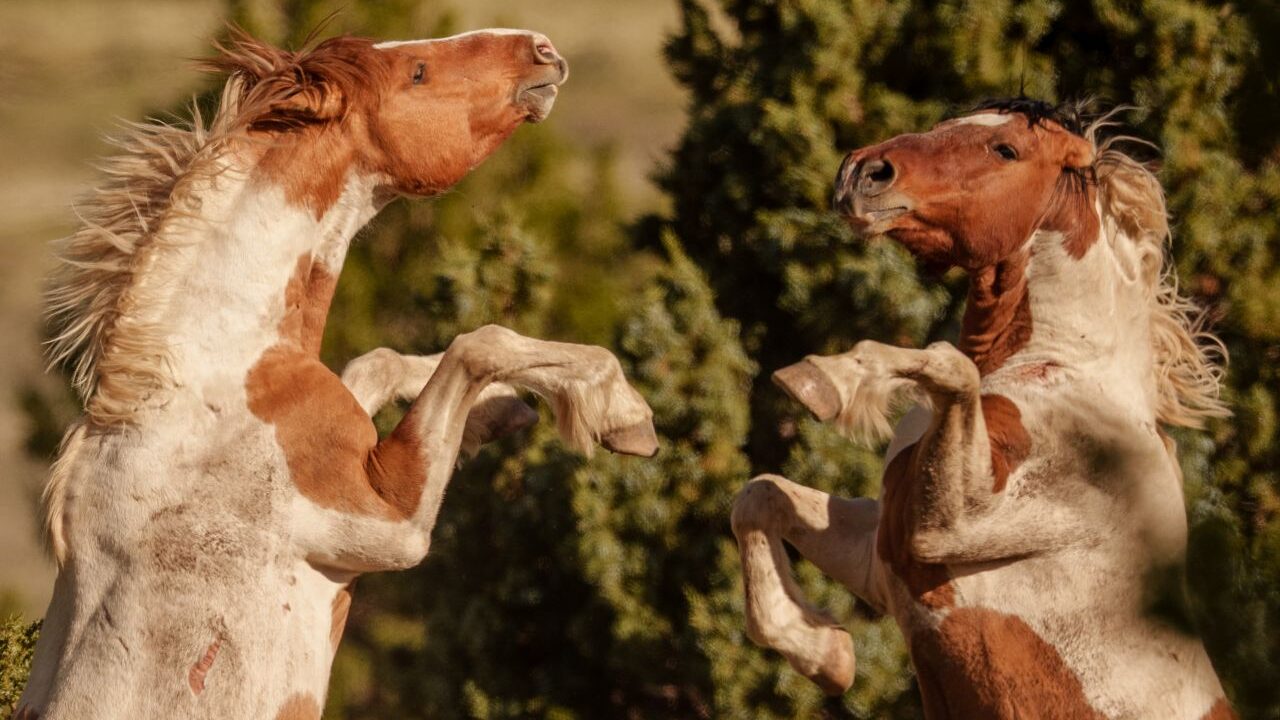
They once had run free through the desert mountains of the West, a multicolored band of 68 wild mustangs that had never been saddled or corralled.
Then the federal government rounded them up with helicopters in an attempt to control wild populations on public lands. The horses were held for years in a feed lot in Idaho while the government tried to find them what it called “loving homes.”
Abruptly this March, the government found a home. Whether it was loving didn’t seem to matter.

The horses were packed into metal trailers and trucked 1,800 miles east to the pens of a livestock trader in Ohio named Brandon Jones, who bought them for $25 each.
A day later, two double-decker cattle trucks pulled up at midnight, loaded the mustangs and quickly drove off into the night.
From there, the mustangs disappeared. The trader won’t say where they went. Wild horse advocates suspect the horses were shipped to slaughter.
How the Government Quietly Sells Wild Horses
But that’s not the government’s concern. It got what it wanted: two more trucks of wild horses off its books.
An examination of government records by The New York Times found that all over the country, the Bureau of Land Management, the agency in charge of protecting wild horses, is quietly selling thousands of horses to buyers like the one in Ohio. Slaughtering wild horses is illegal, but the bureau’s actions create a loophole that enables people to get mustangs on the cheap and then quickly resell them to be exported alive, processed into cuts of meat and sold abroad.
Livestock inspection records show mustangs sold by the government soon ended up on trucks bound for slaughter plants in Canada.
The U.S. government’s sales of wild horses were once rare but started to rise after President Donald Trump took office. In 2025, they more than doubled to 3,700 horses, according to bureau records.
In that time, the bureau has sent about 500 horses to Jones.
In an interview, Jones said he was able to resell the horses quickly, though he didn’t advertise online or even post a FOR SALE sign at his corral. He would not say where the horses went and denied selling any to slaughter.
The government can spend more than $3,000 to capture a mustang and bring it to market but sells each for as little as $25. A horse can fetch up to $750 at a slaughter plant. The potential for profit keeps buyers coming.
About 73,000 Wild Horses in the West
By selling mustangs at a huge loss, animal welfare organizations say, the agency in charge of protecting wild horses is, instead, subsidizing their destruction.
“The BLM is saying to the public that slaughter is off the table, but they’re doing it in plain sight using a third party,” said Clare Staples, who runs a wild horse sanctuary in Oregon called Skydog Ranch.
The bureau did not respond to questions about its sales or make leaders available for comment. An unattributed statement from the agency said it “remains dedicated to placing animals into good homes, protecting their welfare and upholding its statutory responsibilities on behalf of the American public.”
About 73,000 wild horses roam federal public lands in the West, where they are protected from hunting or capture. For decades, in an attempt to keep the population sustainable, the bureau has rounded up 9,500 on average each year and offered them for adoption. But it finds adopters for only about half.
The rest go into a labyrinth of feedlots and pastures that the bureau calls “the holding system.” The system now stores 58,000 wild horses at an annual cost of $100 million. Caring for them eats up most of the bureau’s $142 million wild horse budget.
Over the years, bureau leaders have floated various lethal proposals for reducing the herds. But Congress — aware that the public wants mustangs protected — has barred the bureau from spending any money to kill healthy wild horses.
There are alternatives to the roundups that have left so many horses in storage. For 20 years, the bureau has had access to inexpensive fertility-control drugs delivered by dart gun. They have been used effectively to control a few wild herds, and the government’s own experts have repeatedly urged the bureau to use them more widely.
But because the bureau is spending so much on storage, it has little left to make the changes that would save it from storing more.
Maneuvering to Use a Loophole Resulting in Slaughter
And because the bureau has been unable to stop horses from coming into the storage system, it is now focused on getting them out.
While the bureau can’t kill wild horses, it can use a series of bureaucratic maneuvers and financial transactions to transform them on paper into domestic livestock, stripping their legal protections.
First, the bureau has to show a wild horse can’t be adopted. It does this by posting hundreds of horses at a time on its online adoption site. After a horse has three one-week listings with no takers, the law permits the government to designate it as unadoptable.
Then it can be put up for sale.
That’s an important legal distinction because a wild horse that is adopted retains its federal protections. One that is sold loses those protections immediately.
A sold horse still can’t be legally killed — at least not yet — because the buyer is required to sign a contract promising not to slaughter the horse or “knowingly” sell it to anyone who intends to resell it for slaughter.
But if the buyer resells to a middleman without asking questions, the buyer is safe from prosecution.
The middleman has not signed a contract with the bureau and is free to legally sell the mustang to slaughter.
A Look at the Bureau’s Biggest Buyer
Jones, 35, appeared out of nowhere in the wild horse world last spring and quickly became the bureau’s biggest buyer, bureau records show.
He said he sold horses only two or three at a time to good owners. “I’m not dealing with traders,” he said. “I’m dealing with a farmer, come up the road, who wants to buy a horse.”
Shown photos and video of the trucks of horses that left his property at midnight — taken by a local wild horse lover and shared with the Times — he questioned whether it had happened.
“Could have been cattle,” he said.
To buy large numbers of mustangs, Jones had to get approval from top officials in the bureau. His application stood out.
Nearly all of the other buyers who have qualified over the years have well-established mustang sanctuaries. Not Jones.
He had no ties to the wild horse world and no history of working with mustangs. The application asked what veterinarian would care for the horses. He listed an office an hour away from his land with a website that says it treats only small animals.
On Facebook, he was friends with a number of livestock dealers but no wild horse rescues.
For a year, his application sat at the bureau with no action. Then, in March 2025, a federal court ordered an end to one of the bureau’s leading ways of off-loading horses — the program that paid adopters $1,000 per horse.
A few weeks later, Jones’ application was approved.
He denied selling mustangs to the traders. He said it was wrong to see him as a bad guy. By reselling mustangs, he said, he had saved the government millions.
Clues to How Jones Operates
There are small clues to what may have happened to the wild horses sold to Jones.
Four showed up late last fall at an auction in Tennessee frequented by slaughter buyers.
Jones said the horses in Tennessee were the result of just one bad sale to an irresponsible buyer.
Another clue emerged at the Canadian border.
The United States has no horse slaughter plants. The industry here was shut down in 2007, so horses are now exported to Canada.
Jones lives about an hour from the main Canadian horse export crossing.
Last summer, a few weeks after Jones received a load of 97 mares, export records show that one of the largest exporters of slaughter horses to Canada, an Ohio man named Fred Bauer, shipped two trucks of horses to Canada. Grainy photos of the trailers’ interiors taken by border inspectors show some of the horses had distinctive serial numbers on their necks — government wild horse brands.
Jones denied that his horses went to Canada through the exporter, saying, “I’d never deal with Freddy Bauer. Me and Freddy Bauer don’t get along.”
Reached by phone, Bauer declined to say whether he had bought mustangs from Jones. When asked where Jones’ horses were going, Bauer said it would be simple for authorities to track the horses.
“The government put Brandon Jones in charge of this whole wild horse situation,” he said. “There’s all kinds of records. So they ought to be able to find out what he’s doing if they want to.”
This article originally appeared in The New York Times.
By Dave Philipps/Erin Schaff
c.2026 The New York Times Company