
|
Getting your Trinity Audio player ready...
|
U.S. host cities for the 2026 World Cup are chasing FIFA for millions of dollars that they believe they were promised by soccer’s governing body, which have so far gone unpaid.
Before the Club World Cup in 2025, held in the United States, FIFA President Gianni Infantino announced that FIFA would make a contribution of $1 million to each of the 11 cities across the country that were hosting matches during the club tournament. This was described as a “legacy contribution,” and he said the funds would be used to build mini-fields and support “social projects.”
Where’s the $1 Million Promised to Host Cities?
After Infantino’s announcement, the U.S. cities scheduled to host games in 2026 asked if they would receive the same $1 million contribution for the more substantial and costly role of hosting multiple games across 39 days during the World Cup.

According to four executives at U.S. host city committees, all of whom asked to remain anonymous to protect relationships, FIFA management repeatedly assured the cities that they would receive the same $1 million contribution toward legacy, despite no public statement ever being made by the organization.
The World Cup host cities in the United States were Seattle; the San Francisco Bay Area; Los Angeles; Dallas; Houston; the Kansas City, Mo., area; Atlanta; Philadelphia; New York-New Jersey; Miami; and Boston.
The four executives said this promise was made verbally by members of FIFA’s senior management, and reiterated to cities in meetings, but the money has not been paid, meaning several cities are now asking FIFA staff for updates on the payments.
FIFA Isn’t Talking
FIFA declined to comment when contacted by The Athletic.
The challenge is exacerbated for the cities as some of the host committees are now winding down operations after the tournament, meaning it is not easy to work out the vehicle that would be best placed to benefit from the payments. Others are seeking to draw up financial reports to their jurisdictions and authorities but do not have certainty over whether to include the payments.
Two host city executives told The Athletic they found it difficult to understand how FIFA, an organization that celebrated revenues in excess of $15 billion for the revenue cycle 2023 to 2026, would be stalling or being noncommittal on these relatively minor payments to cities that subsidized its tournament and helped FIFA maximize returns. FIFA’s operating budget for the tournament was around $2.7 billion.
FIFA Leader Under Siege
It is now just one of the mounting issues on the desk of Infantino, who is under siege from the European soccer confederation, UEFA, and some of its global counterparts after the downfall of his plot to sell a stake in FIFA’s competitions and events to private investors.
The U.S. taxpayer contributed hugely to the direct and indirect costs of the 2026 tournament, with the expenses easily into the billions, as costs spread across security, transportation, logistics and operations.
FIFA took the vast majority of the revenue from World Cup ticketing, media rights, sponsorship, concessions and parking, while cities were responsible for the bulk of the costs related to transportation, safety and security, extending beyond the stadium to FIFA Fan Fest locations, airports and even vehicles used in the competition.
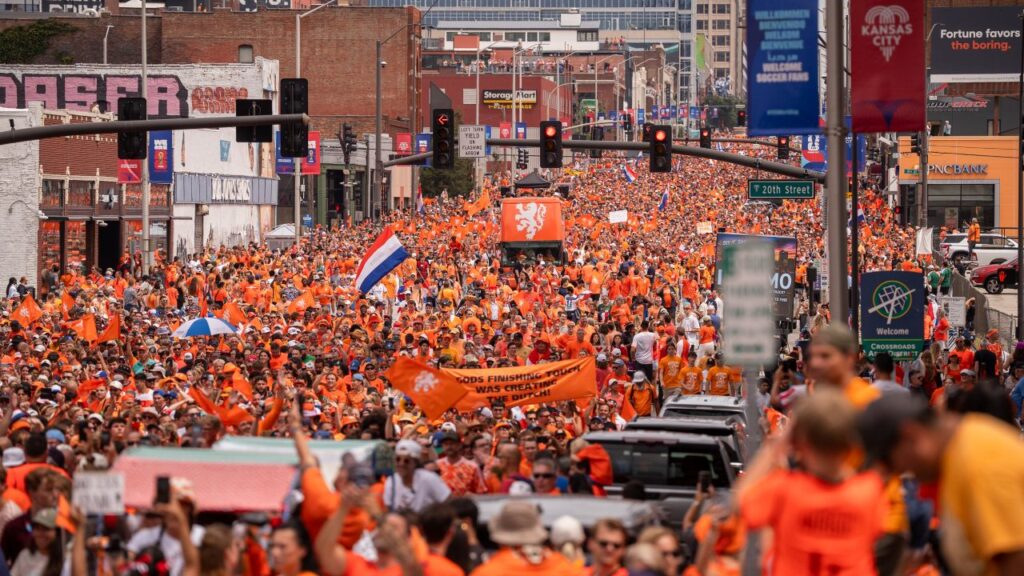
As a case study, the Kansas City host committee for the World Cup said it has received $42.5 million from the state of Missouri, $28 million from the state of Kansas, $14.8 million from Kansas City, Missouri, and a further $1.5 million from other public sources, totaling $86.8 million of public investment. Then there was $59.52 million in federal security assistance, as well as $13.3 million in federal grants for transportation.
Missouri Waived State, Local Taxes on Tickets
There are also private donations, which the host committee, a nonprofit overseeing transportation, logistics and the Fan Fest during the World Cup, would not disclose. The state of Missouri, in seeking to entice FIFA to choose Kansas City as a host venue, also opted to waive state and local sales taxes on World Cup tickets. According to a pretournament analysis by The Athletic, this means a further $15.6 million was left on the table, a figure that was probably higher, as it did not factor in hospitality pricing.
The host city obligations also included special access traffic line and police escorts for FIFA-designated VIPs, six-figure costs of making “clean stadiums” and wiping any signs of non-FIFA branding, as well as the additional $13 million injection to ensure MetLife Stadium had a field worthy of hosting the World Cup final July 19.
The lead-up to the tournament was often a story of mounting costs and mounting frustration at just who was footing the bill for the biggest sports event on the planet, but FIFA and host cities argued that there would be a huge return for the United States via the economic impact of tourism and events across the country, with FIFA often championing a report that claimed $30.5 billion would be injected into the U.S. economy.
This article originally appeared in The New York Times.
By Adam Crafton / The Athletic/Christopher Smith / The New York Times
c.2026 The New York Times Company