
|
Getting your Trinity Audio player ready...
|
WASHINGTON — Republicans in Congress have quietly blocked a proposal to expand military health coverage of in vitro fertilization treatment for service members and their families, heeding the calls of anti-abortion groups to limit access to a fertility option that President Donald Trump vowed to make more widely available.
The move is a shift from previous years, when there was enough bipartisan support for the idea of broadening the availability of IVF for members of the military that it was included in the annual defense bill that passed both the House and Senate. Speaker Mike Johnson later stripped it out in final negotiations before the legislation became law, but the provision’s initial inclusion indicated that the vast majority of Republicans had been willing to accept it.
This year, Republican senators banded together to bar the measure from being added to the defense bill in the first place. It illustrated how, while many GOP members of Congress have said they are in favor of IVF access, they have managed behind the scenes to thwart legislative efforts to ensure it.

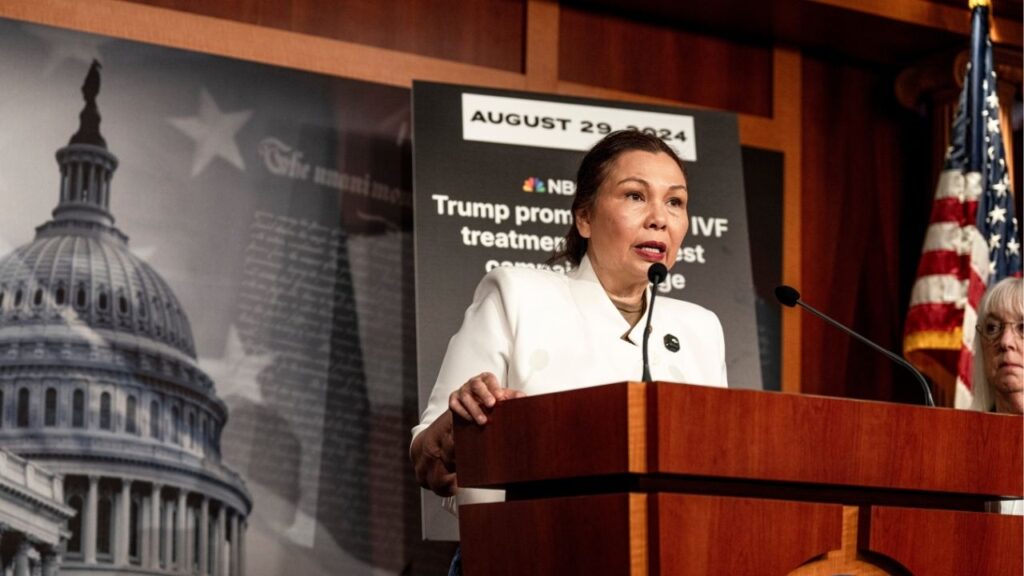
During a closed-door meeting of the Senate Armed Services Committee last month to draft the defense bill, all 14 Republican senators voted against adding the IVF coverage provision, offered by Sen. Tammy Duckworth, D-Ill.
The military currently covers the treatments only for active-duty service members whose infertility was caused by an injury or illness sustained in the line of duty. Duckworth’s proposal would make it available to other service members and their families.
Its outright defeat was a stark turnabout from last year, when the Republican-led panel allowed Duckworth’s proposal to be added by a voice vote, in which senators do not go on the record with a position but unanimous support is assumed. The defense bill then passed both the Senate and the House with the language included, though Johnson later intervened to remove it, the second year in a row he had done so.
Democrats and women’s rights groups were alarmed at how things went last month, regarding the committee vote as a signal of how emboldened foes of abortion rights have become in opposition to in vitro fertilization.
Trump promised during his campaign for a second term that he would deliver free IVF treatment for all, and access to it remains broadly popular with voters, including large majorities of Republicans. Many GOP lawmakers have said they, too, believe in allowing access to IVF.
But some religious conservatives are deeply opposed to the method — which can involve creating multiple embryos and implanting only those that are considered viable — believing that it leads to the destruction of life. For that reason, leading anti-abortion groups generally oppose legislation that seeks to increase access to IVF.
The closed-door vote afforded Republican senators a chance to privately signal to those groups and the conservative voters who vehemently oppose IVF that they are aligned.
Before calling for a roll-call vote on the proposal, according to people familiar with the confidential meeting who spoke about it on the condition of anonymity, Sen. Roger Wicker, R-Miss., chair of the Armed Services Committee, asked that the official position of SBA Pro-Life America, an anti-abortion organization that opposed the measure, be recited out loud.
“I can surmise they wanted to demonstrate to anti-abortion groups that they were against IVF,” Dana Singiser, co-founder of the nonprofit group Contraceptive Access Initiative, said of the vote. “It shows how beholden Republicans are to the anti-abortion groups, that they would take a position that’s so at odds with their own constituents.”
Wicker’s office did not respond to a request for comment.
For years, Republicans have been in a political bind on the issue of IVF. Many of them say they support it while also backing legislation that declares that life begins at conception, which could severely restrict aspects of the treatment.
The disconnect underscores the lasting influence of groups like SBA Pro-Life America.
The group did not respond to multiple requests for comment.
The recent vote also raised questions about the president’s commitment to expanding IVF coverage, suggesting that Republicans in Congress fear worse consequences for breaking with anti-abortion organizations on the issue than they do for straying from Trump’s stated position.
During last year’s committee drafting session, when the issue came up for debate in the Armed Services Committee, Sen. Markwayne Mullin, R-Okla., who now serves as Homeland Security secretary, helped make the case for Duckworth’s proposal, speaking about how he and his wife had relied on in vitro fertilization to start their family. Duckworth, a veteran, also used the treatment to become pregnant.
This year, no Republican proponent spoke up, the people familiar with the session said, and there was no debate beyond the reading of SBA Pro-Life America’s position.
—
This article originally appeared in The New York Times.
By Annie Karni/Alex Kent
c. 2026 The New York Times Company