


|
Getting your Trinity Audio player ready...
|
Republicans have appeared to use shadowy super political action committees to meddle in a series of Democratic primary contests this year, spending hundreds of thousands of dollars to elevate candidates they see as weak or controversial.
Democrats say the latest case is in their primary contest for Maine’s 2nd Congressional District, pointing to a mysterious out-of-state group that has poured more than $500,000 into a race that is one of the country’s most competitive general-election battles.
Four candidates are vying Tuesday for the nomination to succeed retiring Rep. Jared Golden in the most Republican-leaning seat held by any Democrat in the House.

Golden’s retirement bolstered the GOP’s chances of flipping the vast, largely rural district, which he won with 50.3% of the vote — the margin of victory was fewer than 3,000 ballots — against a Republican challenger in 2024. President Donald Trump won the district that year by 9 percentage points.
Polls suggest that the race has no clear front-runner. None of the Democratic candidates have advertised themselves as moderates in the mold of Golden, who announced in November that he would not seek reelection because he had “grown tired of the increasing incivility and plain nastiness” of political life, citing “frequent threats” against him and his family.
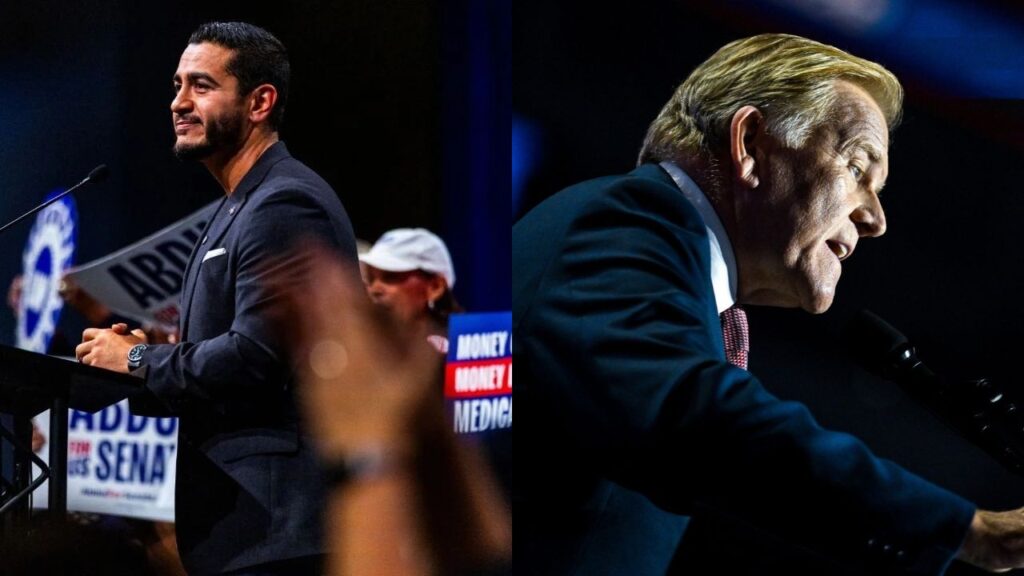
After actively recruiting candidates for Golden’s seat, the official campaign arm of House Democrats threw its weight behind Joe Baldacci, a state senator and former mayor of Bangor. The group argued that his record of “overperformance” in past elections made him the strongest candidate in a difficult district.
In the Maine Legislature, Baldacci supported abortion rights but broke from his party to oppose some gun control measures. Unlike his opponents, he has not called for universal healthcare.
The Democratic group recently claimed that Republicans had secretly worked to help one of Baldacci’s progressive opponents, Matt Dunlap, the state auditor, through the Real Change PAC, a political action committee registered so recently that it has not yet had to disclose its donors.
Real Change PAC has spent more than $500,000 to oppose Baldacci and support Dunlap, according to campaign finance filings, and one of its vendors uses the same Wyoming address as a firm used by another shadowy group with Republican ties, Politico earlier reported.
“Washington Republicans are spending over half a million dollars to attack Joe Baldacci because they’re afraid to face him in November,” Riya Vashi, a spokesperson for the Democratic Congressional Campaign Committee, said in a statement.
On Monday, Trump singled out Dunlap, writing on social media that he believed the Maine Democrat would win the nomination and would be a weak candidate.
Dunlap previously served in the State House and as Maine secretary of state, and he was first elected as the state financial chief in 2021. After he failed to obtain the necessary certification for the job within the mandatory nine-month period, he resigned and was reelected to the post in 2024.
Asked about the outside spending, Dunlap’s campaign accused Baldacci of benefiting from “dark money” and the support of “D.C. insiders.” Project 218, a Democratic super PAC, has spent more than $900,000 to help Baldacci this cycle.
“Matt Dunlap stood on the debate stage and called on the entire field to swear off super PAC support in this primary,” Harry Burke, Dunlap’s campaign manager, told The New York Times in an email. “Every candidate joined him — except Joe Baldacci, who is being propped up by nearly a million dollars from dark money groups and corporate lobbyists because he couldn’t build a campaign of Mainers.”
Kaila Harris, Baldacci’s campaign manager, called the promise not to accept support from super PACs “empty words.”
“His empty rhetoric can’t hide the fact that Republicans who want to protect Trump are backing him,” she wrote. “Democrats who want to flip the House are backing Joe Baldacci.”
The Real Change PAC did not respond to a request for comment.
A third Democratic candidate, Jordan Wood, a liberal activist, has also appeared competitive in the limited polling for the race.
The Democratic nominee will face former Maine Gov. Paul LePage, a Republican backed by Trump, in November. A colorful, polarizing and sometimes controversial figure, LePage ascended to the governorship during the height of the Tea Party movement in 2011, adopting a populist style that has invited comparisons to the Republican president.
“I was Donald Trump before Donald Trump became popular,” LePage said after he endorsed Trump in 2016.
A spokesperson for the campaign arm of House Republicans, Maureen O’Toole, cast all of the Democratic candidates as “far left” and said that “voters will send Paul LePage to Washington in November.”
Maine uses a ranked choice voting system in the primaries. If no candidate wins a majority of votes, the candidate with the fewest votes is eliminated, and those ballots are redistributed to the remaining candidates based on voters’ next-ranked choices.
—
This article originally appeared in The New York Times.
By Bayliss Wagner/John Tully
c. 2026 The New York Times Company