


|
Getting your Trinity Audio player ready...
|
Canada, which says it wants to reduce reliance on U.S. defense firms, on Wednesday announced plans to buy a fleet of early warning planes from Sweden’s Saab rather than a competing option from Boeing.
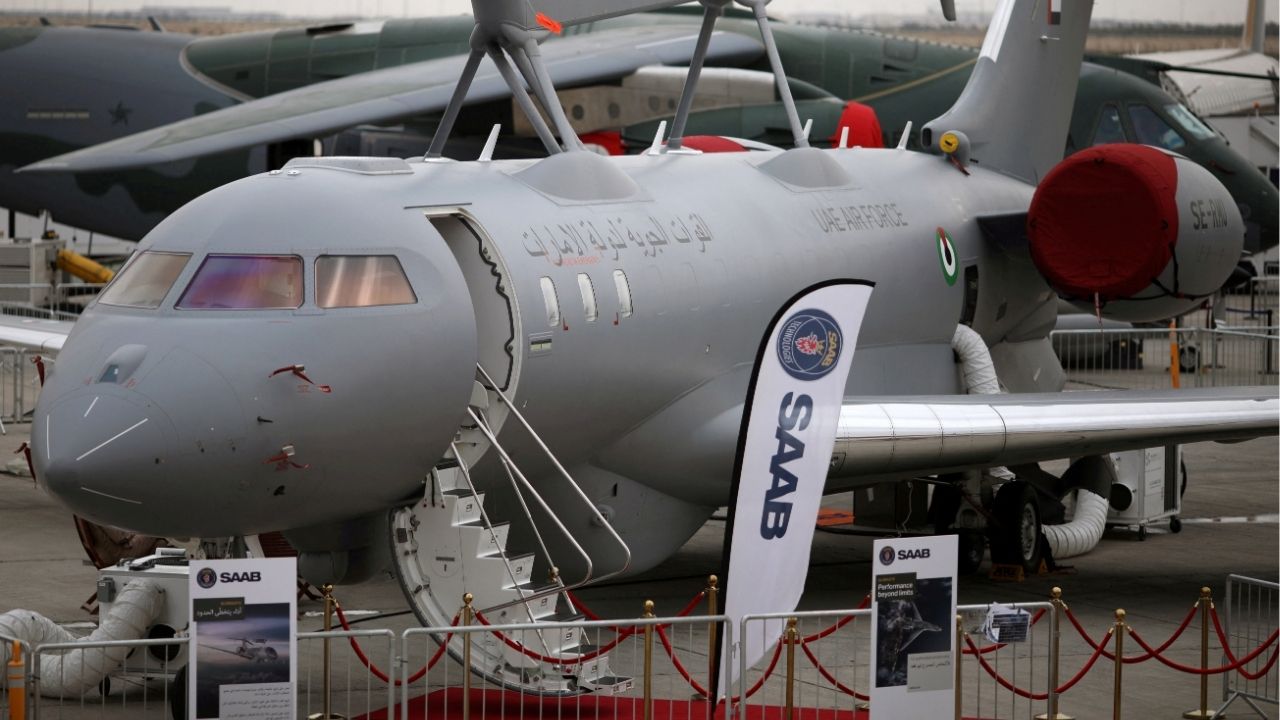
Prime Minister Mark Carney said Canada would opt for Saab’s GlobalEye, which is based on Bombardier’s Global 6500 jet. Boeing’s E-7 Wedgetail plane – which has suffered from delays and cost overruns – had also been in contention.
“With a suite of advanced sensors and mission systems, Saab’s GlobalEye will be a key resource for the Canadian Armed Forces to detect and deter threats across the Arctic,” Carney told a defense conference in Ottawa.

The Prime Minister pledged in March that Canada would take full responsibility for protecting its vast Arctic territory, after relying on decades on a partnership with the U.S. to monitor its more than 4.4 million square km (1.7 million square miles) of land and sea, a territory larger than India.
Carney’s Liberal government last year announced plans to ramp up defense spending. The United States and other allies had complained for years Canada was not meeting long-standing NATO targets on military expenditure; Carney announced in March Canada hit that target of spending 2% of its GDP on defense last year.
In a statement, Saab said it planned to invest in research and development work in Canada as part of any deal.
The future of Boeing’s E-7 plane was put in doubt last year when its biggest customer, the Pentagon, scrapped plans to buy 26 E-7s to replace Cold War-era aircraft, and instead relied on satellites. Under pressure from US lawmakers, Defense Secretary Pete Hegseth told a Congressional subcommittee on May 12 that the Pentagon is pushing to add the plane back into the defense budget.
Although Carney did not give details of the planned fleet size of the Saab GlobalEye planes or the cost of a potential contract, military officials had earlier said they were looking to buy six early warning aircraft.
Philippe Lagasse, associate director of international affairs at Ottawa’s Carleton University, said Canada’s decision to buy the GlobalEye planes was “an important test case for the Carney government’s policy of pivoting away from American military capability.”
He said in a statement that the decision confirms Canada’s relationship with Sweden, a new NATO ally that has also been keen to strengthen its ties to the Canadian military.
Canada has previously said it is eager to work more closely with the Nordic countries in the Arctic on defense and other issues, in a global environment where the U.S. has become a less reliable partner.
“GlobalEye is already creating jobs in Canada, and working with the Canadian supply chain. This decision ties our two nations even closer together,” Swedish Prime Minister Ulf Kristerson said in a social media post.
Saab is also in the running to sell Canada some of its Gripen fighters.
Canada has a deal to buy 88 F-35 jets from Lockheed-Martin but last year, after the United States slapped tariffs on key Canadian imports, Carney asked the military to probe whether it could cut back the order and buy some planes from another manufacturer.
Carney later told reporters Ottawa would make a decision on the fighter fleet in due course and declined to comment when asked whether the military would be operating two jets.
Last week a Pentagon official, speaking after Washington suspended planned biannual defense talks with Canada, said the delay in making a decision on the F-35s showed how Ottawa was prioritizing politics over defense issues.
Still, Lagasse of Carleton University said he expected Canada would ultimately decide to stick with a fleet of F-35 jets rather than splitting the fleet by buying some Saab Gripens.
“If the government was determined to buy Gripens, I would have expected them to make the announcement alongside this (GlobalEye) decision,” he said.
(Additional reporting by Promit Mukherjee and Maria Cheng in Ottawa and Dan Catchpole in SeattleEditing by Nick Zieminski)