

|
Getting your Trinity Audio player ready...
|
In 1988, publisher and editor Michael di Capua saw some sketches of a surprising new story from one of his most popular authors: William Steig, a writer and illustrator known for wobbly lined watercolors and gently biting children’s tales.
“His books were sunny, in a sweet-natured way,” di Capua recalled in an interview. “They made you feel good after reading them.”
Which is why di Capua became uneasy as he examined the rough pages of Steig’s latest effort. It was the story of a pinheaded, pimply faced ogre so repulsive that his body odor could topple trees.

“I was horrified,” said di Capua, who is 87. “I told him it was an aberration. I don’t think I used that word, but that’s what I was thinking.”
At his editor’s urging, Steig put the project aside for a while, only to pick it up again during a brief creative dry spell. Finally di Capua relented, and the finished book hit shelves in the fall of 1990. Its opening line introduced a character who’d soon enchant millions of readers and moviegoers.
“His mother was ugly and his father was ugly,” Steig wrote, “but Shrek was uglier than the two of them put together.”
“Shrek!” follows its grotesque protagonist as he leaves the comforts of his swamp, meets a put-upon donkey and woos an equally hideous princess. Like many of Steig’s children’s books, it is short, sharp and slightly askew.
“A modest achievement,” noted a review in The Washington Post, “but a perfect one.”
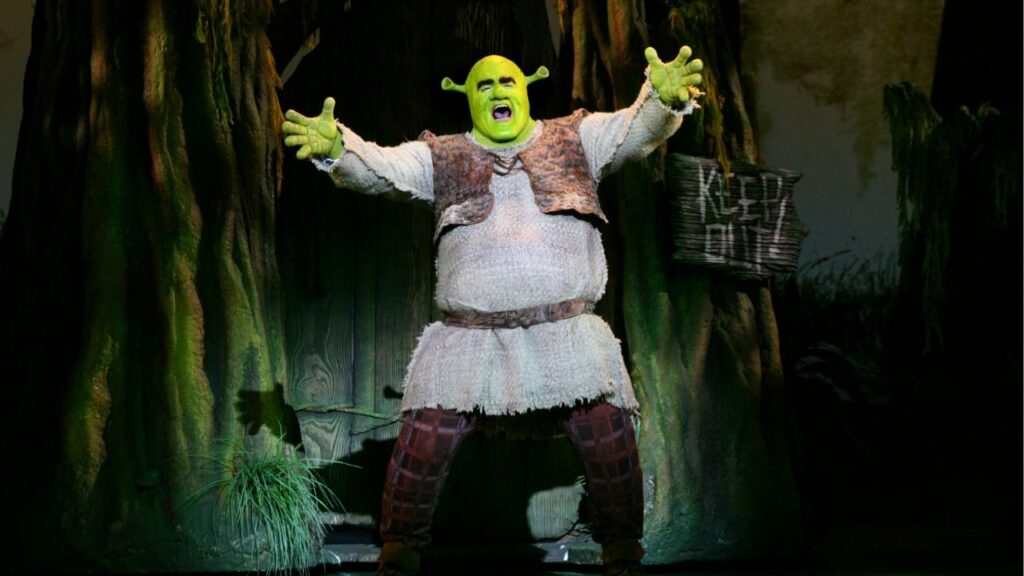
It was likely the last time anyone would associate Steig’s mean, green creation with modesty. In the spring of 2001, a big-screen version of “Shrek!” — minus the exclamation mark and plus actor Mike Myers — arrived in theaters. The film earned nearly $500 million worldwide and launched a franchise that now includes a Tony Award-winning musical and a planned theme park attraction in Texas.
For the last quarter-century, Shrek’s likeness has been adopted, spoofed, transformed and even tattooed by admirers. Online, the character’s expressive face — sometimes menacing, sometimes questioning — has fueled countless GIFs and memes. In real life, revelers across the globe have attended late-night Shrek raves, and performers as distinct as Regis Philbin and Bad Bunny have donned lime-green face paint in homage to the ogre.
Steig died in 2003 at the age of 95. But according to his youngest daughter, Maggie Steig, the writer and illustrator would have been delighted, if a bit baffled, by Shrek’s transformation from unseemly kid-lit hero to multimedia all-star.
“Seeing Bad Bunny show up in Shrek ears on ‘SNL’ would have tickled him,” Steig, 68, said in an interview. “But when it came to tattoos, I think he would have said, ‘They’re putting Shrek on their bodies? Feh!’”
Born in Brooklyn, New York, in 1907 to working-class Polish Jewish immigrant parents, William Steig played water polo and studied art in his youth but dreamed of heading out to sea like Herman Melville. His hopes were dashed when the stock market crashed in 1929, prompting his out-of-work father to ask him to support the family.
“My father was a Socialist,” Steig once said in an interview with children’s literature expert Leonard S. Marcus. “He said, ‘If you work for someone, you’re being exploited. If you’re the boss, you’re the exploiter.’ He said both of these are undesirable positions to be in. So he encouraged the arts.”
Steig began selling his art to publications including The New Yorker, to which he’d ultimately contribute more than 1,000 illustrations. He made his debut in the magazine in 1930 with a cartoon featuring two prisoners commiserating in a cell. (“My youngest is a terror,” explains one. “We can’t do a thing with ’im.”)
Later, he worked on greeting cards, advertising campaigns and even a book with psychoanalyst Wilhelm Reich. Yet Steig was best known for his cartoons, which often featured precocious children, immature adults and a good dose of ennui.
“I don’t think a completely joyous guy would be a cartoonist, because satirizing implies you’re unhappy about something,” Steig once said.
Steig grew tired of commercial gigs by the late 1960s, when he began working on children’s books. Maggie Steig, who grew up spending weekends with her father at his Greenwich Village apartment in Manhattan, recalls him constantly drawing.
“There were always reams of doodles he would be making while he was talking on the kitchen phone,” she said.
When “Shrek!” was published, it earned Steig, who was already a critical darling, another round of favorable reviews. But the book wasn’t a blockbuster. A few years later, the book found its way to film producer John H. Williams, whose two young sons had discovered Steig’s works at their local library. “Shrek!” quickly became their favorite.
Williams optioned Steig’s book, eventually selling it to a newly launched film studio, DreamWorks.
It took more than five years to bring “Shrek” to theaters. The filmmakers, struggling to adapt Steig’s slim story into a feature film, introduced new subplots and supporting characters, including Pinocchio and the Gingerbread Man.
Shrek himself got an on-screen makeover, physically and emotionally. The ogre was redesigned with a rounder head and bigger eyes, and his gruff demeanor was smoothed out — as was the love story that ends both the book and the movie.
The film opened at No. 1 in May 2001, and Steig’s book was suddenly in high demand. (“Our sales are running 400% over normal annual sales,” an associate publisher at Farrar, Straus and Giroux noted at the time.)
Less than a year later, Steig’s name was read before millions of viewers when “Shrek” won the inaugural Academy Award for Best Animated Feature. The ogre even made a brief cameo at the ceremony.
Steig was still working, despite his advanced age and fading health. In the spring of 2003, he released an illustrated memoir, “When Everybody Wore a Hat.” He died less than six months later.
“He was going to the very end,” said Holly McGhee, Steig’s former editor and literary agent. “It wasn’t until he put down his drawing pen that he passed away.”
The author never got to see his off-putting ogre become a pop-cultural phenomenon adored by multiple generations despite, or perhaps because of, his foul nature.
But when “Shrek 2” arrived in May 2004 — the first of several sequels, including one planned for next year — it was dedicated to Steig.
—
This article originally appeared in The New York Times.
By Brian Raftery/Joyce Dopkeen
c. 2026 The New York Times Company