



|
Getting your Trinity Audio player ready...
|
Over the last several decades there’s been a recurring debate in political, academic and media circles over the relatively poor levels of academic achievement among California’s public school students.
In basic skills, such as reading and mathematics, measured on state and federal testing, California kids in general were subpar vis-à-vis state standards and in comparison to other states.
The education establishment — school boards, administrators and unions — repeatedly declared that California’s spending on schools was too low and that achievement would rise if they got more money.

There was some factual basis for the first assertion. Relative to other states, California’s per pupil spending did lag; it was second lowest, just ahead of Utah in 2010, according to Education Week’s calculations.
However, as EdSource, a journalistic website devoted to California schools, notes: “In 2012, threatened with further cuts to education, state voters approved a temporary income tax increase on the wealthiest Californians and renewed it in 2016.”
The surtax currently generates about $10 billion a year, with schools claiming a hefty portion under the state constitution’s school finance mandate. Slowly but surely California school spending increased relative to other states.
This commentary was originally published by CalMatters. Sign up for their newsletters.
California Funding Is $2,000 a Pupil Over National Average
The newest comparison, released recently by the Education Law Center, pegs state spending on California schools in the 2022-23 school year — the latest data available — at $19,894 per pupil, 13th highest in the nation and $2,000 over the national average.
During 2019-20, Gov. Gavin Newsom’s first budget contained $58.8 billion for elementary, middle and high schools, and with local property taxes and federal funds the total was $103 billion, or $17,423 per pupil.
Newsom’s last proposed budget for the 2026-27 fiscal year would spend $88.8 billion in state funds and the total, with local and federal funds, would hit $149.1 billion, or $27,418 per student.
The latter numbers, by the way, exclude $5.6 billion in mandated state aid — or nearly $1,000 per student — that Newsom wants to withhold to help narrow the state budget’s yawning deficit.
By any measure, California’s schools have seen a big increase in financial support in recent years, although quite a few local districts are underwater — Sacramento Unified being a notable example — due to their penchant for overspending revenues no matter how high they are.
The state’s schools have also been seeing a steady erosion of enrollment due to a variety of demographic and economic factors, so the money they get should boost per-pupil resources even more.
Where Are the Learning Improvements?
If more money is the cure for California’s academic ills, why hasn’t a $10,000 (57%) per pupil increase during Newsom’s governorship resulted in an equally dramatic increase in academic achievement?
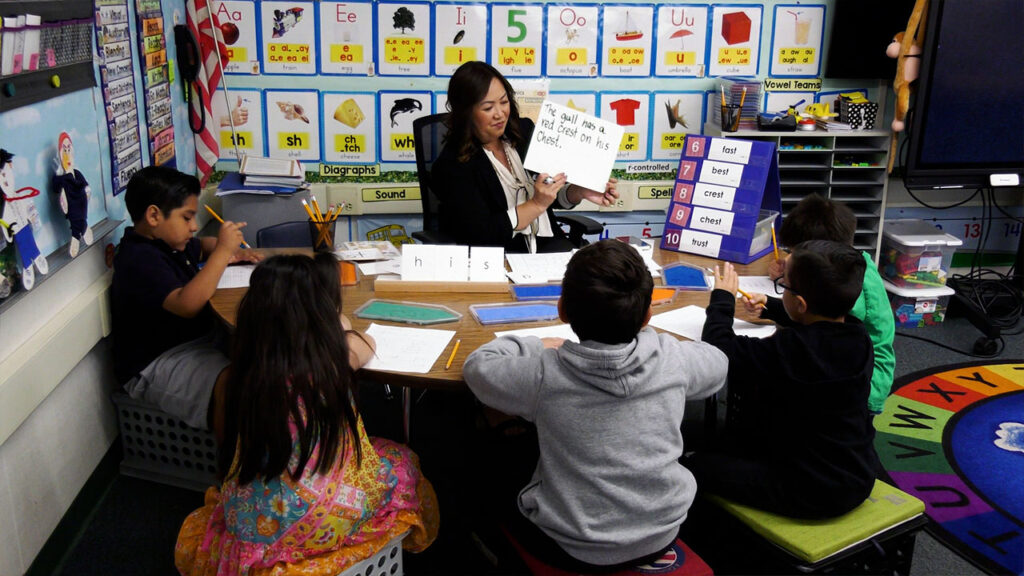
It might be that school officials, such as those in Sacramento Unified, were pressured by their unions into using most of the money for salary increases rather than for qualitative improvements, such as adopting phonics-based tutoring to improve reading.
Or it might be that money is not the critical factor in academic achievement, as the education establishment has insisted.
New York spends the most per pupil in the Education Law Center study — $29,440 per student, or $10,000 more than California. But in the most recent testing by the federal National Assessment of Educational Progress conducted in 2024, just 31% of New York’s fourth graders were proficient in reading, one point above the national average and two points above California’s kids.
Idaho came in last in the Education Law Center’s rankings of per pupil spending at $11,805, but 32% of its fourth graders were proficient, higher than California, New York, and the nation as a whole.
An adequate amount of money is, of course, necessary to support a public school system. But we shouldn’t kid ourselves, or allow politicians and school officials to kid us, that spending more will automatically increase achievement.
This article was originally published on CalMatters and was republished under the Creative Commons Attribution-NonCommercial-NoDerivatives license.