
|
Getting your Trinity Audio player ready...
|
NASHVILLE, Tenn. — Tennessee Republicans on Wednesday proposed a congressional map aimed at diluting the state’s lone majority-Black district, a swift response to last week’s Supreme Court ruling that weakened a landmark voting rights law.
The new map slices Memphis, a majority-Black city, and Shelby County into three districts and likely will give Republicans the ability to flip Tennessee’s lone remaining Democratic seat, which includes the city.
Democratic lawmakers, whose opposition means little under a Republican supermajority in the state’s General Assembly, and Black leaders across Tennessee have compared the effort to carve up the 9th Congressional District with Jim Crow-era voter suppression tactics. They have accused conservatives of a power grab that undermines Black voters in Memphis, who have long favored Democrats.

Republicans, cheered on by President Donald Trump, have rejected those claims. Instead, they have said, they are responding to the Supreme Court ruling, which raised the bar for what constitutes a racial gerrymander under the Voting Rights Act of 1965.
Tennessee joins a series of states that have engaged in tit-for-tat redistricting battles since last summer, when Trump called for Republican-led states to redraw their maps and Texas became the first. Since then, new maps have materialized in half a dozen states controlled by both Republicans and Democrats, with more on the horizon, in the fight for Congress in November’s elections. Tennessee’s new map, if passed, would be the first directly responding to the high court ruling.
Under the map, Shelby County — which includes Memphis — is split into three districts. One district now runs along the state’s western border before extending down to include part of Williamson County, a suburban county just outside Nashville. Two other districts now share part of Shelby County and more rural, conservative communities in Tennessee.
“The Supreme Court has opined that redistricting, like the judicial system, should be colorblind — the decision indicated states like Tennessee can redistrict based on partisan politics,” Speaker Cameron Sexton said in a statement. “Tennessee’s redistricting will reduce the risk of future legal challenges while promoting sound and strategic conservatism.”
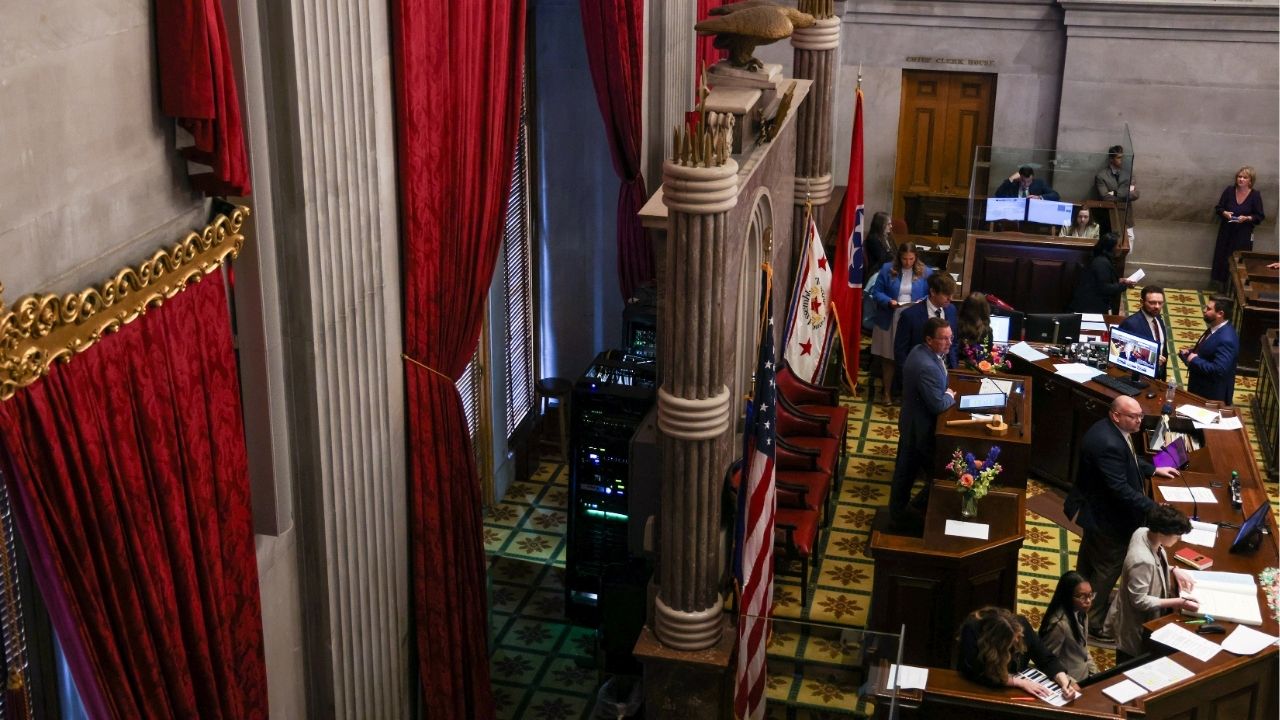
The General Assembly is expected to vote as soon as Thursday.
The Supreme Court struck down a Louisiana congressional map that included two majority-Black districts, arguing that it violated the Constitution by using race as the primary factor in redistricting. The ruling has set off a scramble across Southern states with Republican leadership, all of which have at least one majority-Black district, before the 2026 midterms.
Louisiana last week delayed its House primaries — though thousands of absentee votes had already been cast — to allow its Legislature to draft a new map. The South Carolina legislature is also facing conservative pressure to quickly adopt a new congressional map.
Alabama is barred by court order from adopting a new map until after the 2030 census but is trying to get the order lifted. In anticipation of a favorable ruling, lawmakers convened a special session this week with the goal of allowing the state to delay certain House primaries.
In Florida, debate over a new map that could give Republicans up to four new seats was underway as the Supreme Court ruling became public.
Trump spoke directly to Gov. Bill Lee of Tennessee, a Republican, to press for a new map the day after the ruling, and top Tennessee Republicans have raced to ease the way for rapid passage.
To do so, the legislature must first repeal a state law banning redistricting between census years each decade.
Hundreds of protesters gathered outside the state Capitol on Tuesday to voice opposition to a new map. Once inside, their chants and boos reverberated around the halls of the building. (On Tuesday, the House approved a strict rules package, which bans anyone removed from the gallery or committees for disorderly conduct from returning for the remainder of the session.)
“History will not look back kindly on you when you had an opportunity to do what was right and you chose to do something else,” said state Sen. Raumesh Akbari, D-Memphis, who delivered an emotional plea to Republican colleagues Tuesday.
The 9th Congressional District seat is currently held by Rep. Steve Cohen, a white Democrat who has repeatedly maintained the support of many Black voters since he first won the seat in 2007. He is facing a Black primary challenger, state Rep. Justin J. Pearson; both men joined a rally against the new map Tuesday.
The new map is likely to scramble existing congressional races, including the one between Cohen and Pearson. Under the proposed map, the proposed 9th Congressional District would stretch much farther east along the Tennessee border with Mississippi.
It was not immediately clear whether every Republican would support the map, but given the party’s supermajority, some amount of defection will not matter.
The map also affects Middle Tennessee, where the legislature had already split the Democratic stronghold of Nashville among three Republican-leaning districts. The 5th Congressional District, which is currently held by Rep. Andy Ogles, a Republican, no longer contains parts of Davidson County, which encompasses Nashville.
Should a new map be passed and signed into law, a legal challenge is expected. The primary in Tennessee is currently scheduled for Aug. 6.
—
This article originally appeared in The New York Times.
By Emily Cochrane/Brad J. Vest
c. 2026 The New York Times Company