


|
Getting your Trinity Audio player ready...
|
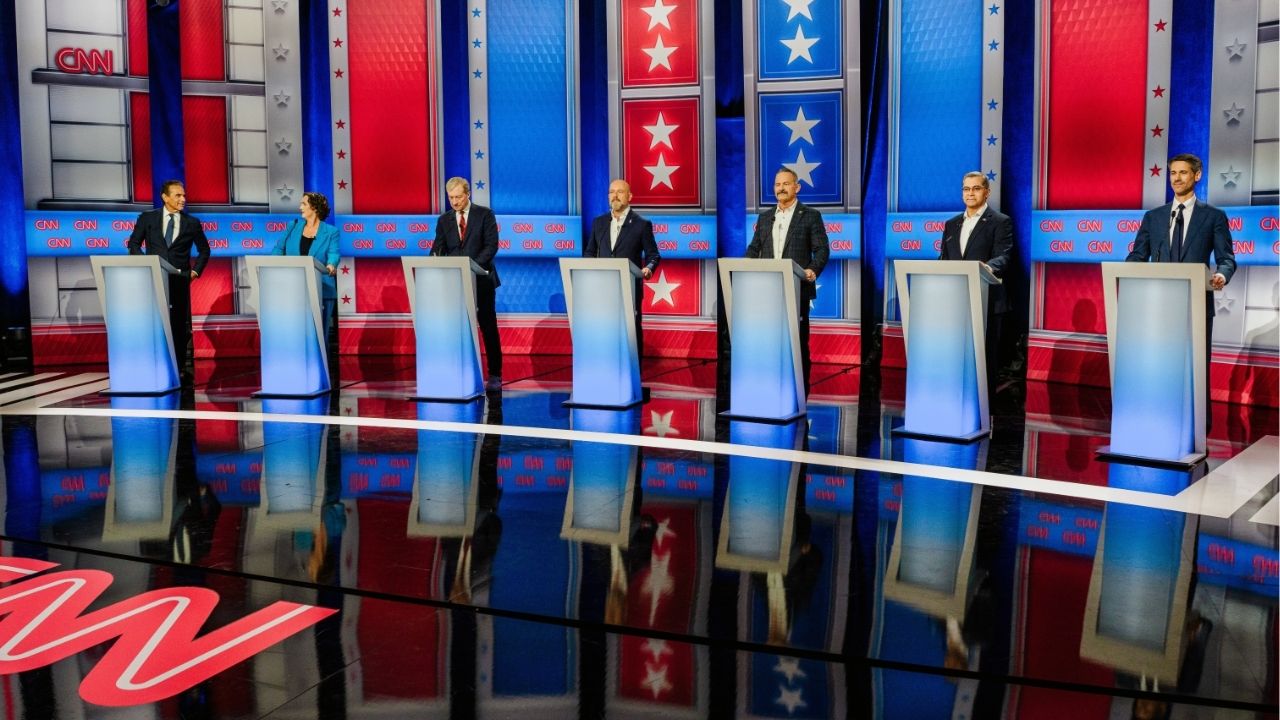
For two hours on national television, seven candidates running for California governor wasted little time attacking one another Tuesday night as they looked for memorable ways to differentiate themselves in the final weeks of the campaign.
The debate at East Los Angeles College in Monterey Park, California, aired on CNN just as California began a month of early voting for the June 2 primary election. The race still has a large field of prominent candidates and has no clear favorite.
All of them are running to succeed Gov. Gavin Newsom, a Democrat who cannot run for reelection because of term limits.

The two Republicans were Steve Hilton, a former Fox News host, and Chad Bianco, the Riverside County sheriff, each of whom seemed intent on criticizing Democrats but showed little interest in attacking one another.
The top-polling Democrats in the debate included Xavier Becerra, a former California attorney general and Cabinet secretary under President Joe Biden; and Tom Steyer, a former hedge fund manager.
Among the other Democrats were Katie Porter, a former member of Congress; Matt Mahan, the mayor of San Jose; and Antonio Villaraigosa, a former mayor of Los Angeles.
In California’s nonpartisan primary, candidates from all parties run on the same ballot, and the two who receive the most votes advance to the November election.
Here are five takeaways from the debate:
Becerra Took Fire From All Sides
After languishing in the polls for months, Becerra has climbed toward the top of the pack ever since Eric Swalwell dropped out of the race.
Democrats and Republicans alike tried to knock him down Tuesday.
Hilton and Villaraigosa questioned Becerra’s role in a criminal case involving two of his top aides, with Hilton saying that his opponent was “mired personally in a corruption scandal.”
The accusation stems from a federal indictment in which Sean McCluskie, Becerra’s former chief of staff, pleaded guilty to a corruption scheme that involved skimming $225,000 from one of Becerra’s campaign accounts. Dana Williamson, who ran Becerra’s campaigns for attorney general, pleaded not guilty; court records suggest that she is in negotiations for a plea agreement.
Becerra said that he had no knowledge of the alleged crimes and no role in the case that rocked the state Capitol. He has not been accused of any crimes.
“If I had been involved, the U.S. attorney would have had me in that indictment,” he said. “I was not involved.”
Mahan went after Becerra over his record as health and human services secretary in the Biden administration, saying “President Biden openly talked about firing him, had to sideline him during COVID because he wasn’t delivering results.”
And Steyer finally took a dig at Becerra onstage after holding back in past debates, accusing Becerra of “being in bed with oil companies.”
Becerra shot back by criticizing the investments Steyer made in fossil fuels through the hedge fund he used to run: “Tom, the last thing we need is someone who makes riches from investing in oil companies and then accuses everyone else of doing the wrong thing.”
Democrats Don’t Like the Billionaire Tax as Much as You Think
It might have seemed counterintuitive, but some of the most progressive Democratic candidates pointed out flaws in a billionaire tax initiative that is expected to qualify for the November ballot.
Porter, asked to explain why she opposes the proposal, said it was “simply not good tax policy.”
Then she counted the ways: It would only tax billionaires once, but the state has ongoing needs for revenue; it would only tax billionaires, but “half billionaires” should pay more, too; and 90% of revenues would go toward healthcare, leaving out other programs.
Steyer said he would vote for the tax if it appears on the November ballot because he believes “billionaires like me should pay more taxes.” But he also said he thinks the proposal is flawed.
“It doesn’t go to education and teachers and students, which is a critical need in the state of California,” Steyer said.
Villaraigosa, a more moderate Democrat, chimed in that the state already relies too heavily on tax revenue from the wealthiest residents.
“That’s why you have feast and famine virtually every year,” he said.
Porter Tried to Turn Her Weaknesses Into Selling Points
“Boys, boys,” Porter interjected as the six men on either side of her argued with, and over, one another. “Enough with the bickering.”
Porter built her reputation as a minivan-driving single mother with a whiteboard — someone whose simple, concise criticisms of big corporations and inequality got her elected in a purple congressional district in Southern California.
But her campaign for governor seemed to have been derailed last year by two videos that went viral: One in which she belittled a television reporter, and another in which she berated an aide for being in the background of her video shot.
On Tuesday night, Porter, the only prominent woman in the race, took that campaign vulnerability head-on, emphasizing her decorum in the debates and asserting that she is better suited for the governor’s office than her male rivals. She said she apologized for mistreating her aide while her opponents had been unable to own up to their mistakes.
“Californians can decide for themselves about my temperament based on what they’ve seen here tonight,” she said. “And if these bullies, these boys bullying and bickering, hasn’t been enough to raise questions about their temperament, I would really challenge that.”
The Attacks Got More Personal
As candidates tried to make an impression on voters, their attacks on one another got more pointed.
At one point during an exchange about immigration enforcement, Villaraigosa called Bianco “a bully,” adding that, he is “an Oath Keeper — we all know that.” Bianco, the sheriff, was once a member of the Oath Keepers, a far-right militia group.
Bianco said he was proud to keep his oaths and suggested that viewers read the group’s mission statement, before saying that he was no longer a member.
Villaraigosa also asked Hilton, “How can you say that Democrats have it wrong when you can’t admit that Donald Trump lost the 2020 election?” Hilton did not address that question and pivoted to blaming Democrats for high gas prices in California.
When Steyer talked about corporations and wealthy Californians paying their fair share of taxes, Becerra quipped about how much of his wealth was parked overseas, untaxed.
“Tom, one of these days, let us know how much money you have in the Cayman Islands, so we can make sure we tax you,” Becerra said. Steyer has denied having money overseas, but his 2024 tax filings show extensive foreign holdings, including in the Cayman Islands.
After Mahan repeatedly cited his work as mayor of San Jose, Becerra fired back at Mahan about the size of his jurisdiction.
“Matt, here’s the thing,” Becerra said. “I’ve been able to balance budgets much larger than your city, San Jose.”
A Single-Payer Discussion Tested Becerra
One of the CNN moderators, Elex Michaelson, said that Becerra appeared to have changed his position on single-payer healthcare in recent weeks and asked if he would push to create such a system as governor.
Becerra didn’t give a straight answer.
Instead, he said he has consistently favored a “Medicare for All” approach and touted his work in Congress and as health and human services secretary to make health insurance available to more Americans through the Affordable Care Act.
Porter saw an opening. She pressed him on the difference between offering insurance to more people through existing plans and the creation of a single-payer system in which everyone is covered by a government-run insurance program.
“Covering everyone with something is not single-payer,” Porter said.
Becerra argued that the name of the insurance didn’t matter, as long as people could see a doctor when needed. But he had given a muddled answer on an issue that has become a litmus test for many progressives.
Both Villaraigosa and Mahan jumped in to say that the discussion was pointless and suggested that their opponents were posturing because the state would never have enough money to pay for single-payer healthcare.
The conversation echoed debates from the 2018 governor’s race, when Newsom supported single-payer in the primary, and Villaraigosa accused him of selling “snake oil” to voters.
After he was elected, Newsom pivoted to a universal access model, expanding state-funded health coverage through existing programs. But the cost of insuring immigrants in the country illegally cost far more than anticipated, and Newsom cut back the coverage last year.
—
This article originally appeared in The New York Times.
By Laurel Rosenhall and Jill Cowan/Gabriela Bhaskar
c. 2026 The New York Times Company