
|
Getting your Trinity Audio player ready...
|
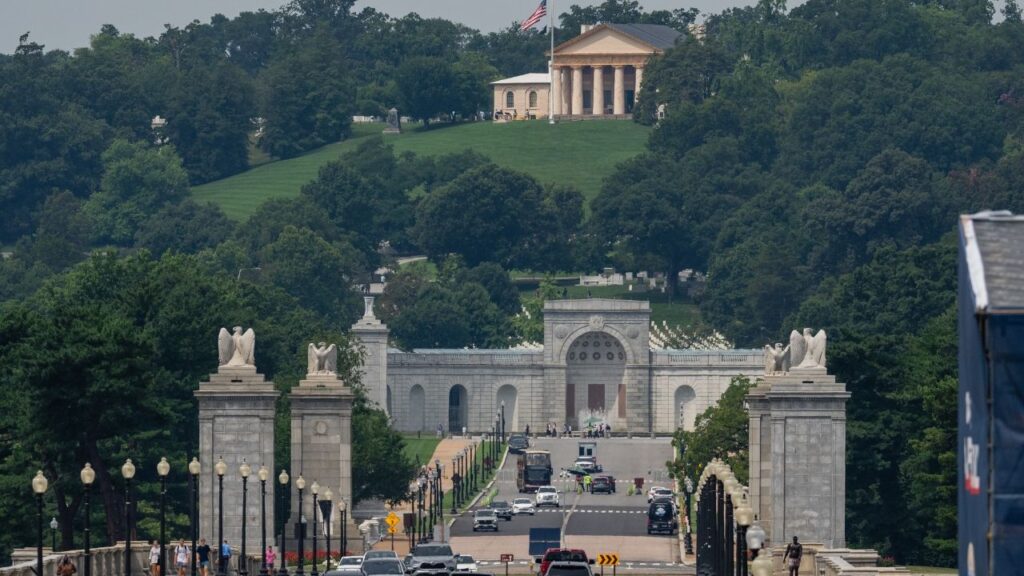
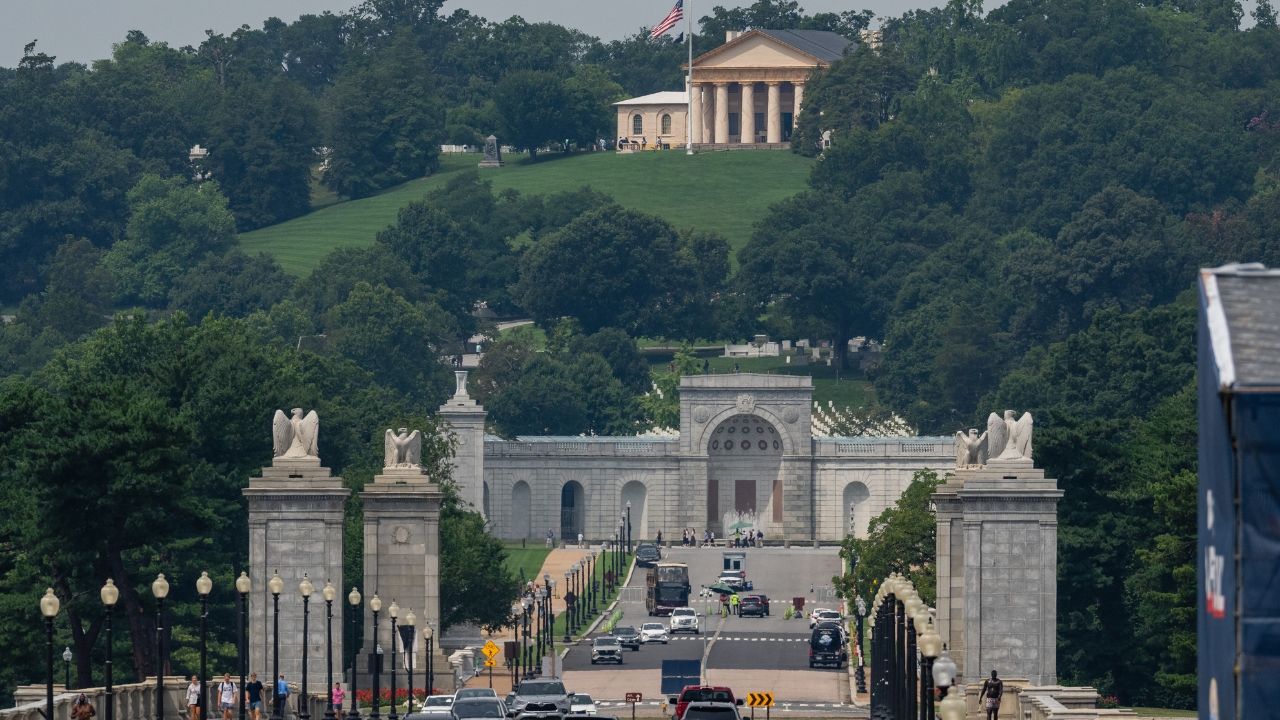
WASHINGTON — President Donald Trump is set to travel to Arlington National Cemetery on Wednesday to lay a wreath in honor of fallen service members, a time-honored presidential tradition on Veterans Day at a site that could be dramatically reshaped by his proposal to build a 250-foot triumphal arch in a traffic circle just outside the cemetery’s main entrance.
Trump’s arch project is being challenged in court by a trio of Vietnam War veterans; Arlington County, Virginia; the state of Virginia; the District of Columbia; and as of Tuesday, members of the Kennedy family, whose relatives’ graves sit at the emotional heart of the cemetery.
A common thread throughout the suits is the contention that the giant arch, which would loom over the nearly 640-acre military cemetery in Virginia, would have a negative effect on it.

The planned site of the arch holds “symbolic significance as the physical and ceremonial connection between Washington, D.C. and Arlington National Cemetery — the final resting place of more than 400,000 active-duty service members, veterans, and their family members,” Virginia and the District of Columbia contended in their joint lawsuit.
“For more than a century, that direct sight line has stood as a testament to the reunification of the nation after the Civil War and a point of reflection for visitors,” Arlington County said in a legal filing.
For months, Trump has vowed to push forward and celebrated the proposed arch as one of his grandest contributions to the city, dwarfing similar triumphal arches around the world. The administration has argued that aesthetic concerns about the area are not enough to win a federal lawsuit, and that various historical proposals for the bridge linking Virginia to Washington at the entrance to the cemetery included proposals for an arch built in the same corridor.
But as plans to break ground have accelerated, government bodies on both sides of the Potomac River have said the idea would bring unwelcome service interruptions to the region — and overshadow the solemn site.
Davis Ingle, a White House spokesperson, said the arch “will serve as a gateway to Arlington National Cemetery for veterans, the families of the fallen and all Americans alike, serving as a visual reminder of the noble sacrifices borne by so many American heroes throughout our 250-year history so we can enjoy our freedoms today.”
The White House also shared a statement from the Interior Department, which said the circle itself would be improved by the project, benefiting traffic flow and pedestrian safety in the long run.
The cemetery hosts around 150 funerals in a typical week, with processions of cars traditionally entering through the main gate.
The arch would sit on an island in the Potomac River at the southwestern boundary of the District of Columbia, just across a 2,100-foot bridge. The bridge was designed to trace a vista to the Lincoln Memorial from the Robert E. Lee Memorial, also known as Arlington House, which sits atop a hill in the cemetery.
All sides agree the arch could be built without closing the cemetery. But the suits argue the national site could be affected in other ways.
Several of the lawsuits anticipate that preliminary excavations for the construction, which could ultimately include paving more than 62,000 square feet, would badly disrupt traffic heading into the cemetery’s main grounds.
In their new suit, nine members of the Kennedy family contend that the arch would also interfere with the intended sightline from the eternal flame at President John F. Kennedy’s grave site, and “permanently cast shadows” over memorials throughout the area.
The board of Arlington County, a five-member legislative body, has said the arch would snarl traffic for tourists and family members visiting the cemetery, not to mention local residents commuting in the area. They have also noted that the county provides emergency services for incidents at Arlington National Cemetery, and the extended construction could impede responders.
“Memorial Circle sits on federal land, but is right next to Arlington, and connects directly to roads the county maintains and that our residents use every day,” a spokesperson for the county said in an email statement.
Citing projections by the National Park Service, Arlington County has said that if Trump’s vision for his arch is successful, visitors to the area could swell by as much as 1,500%. The park service’s assessment found that when the arch is finished, traffic could “approach the upper limit of roadway capacity” in the circle.
The veterans, who include a former Army soldier who later served as the U.S. ambassador to Armenia and a former sailor who went on to serve in Kosovo with the Senior Foreign Service, have noted in court filings that the unobstructed view between the Lincoln Memorial and Arlington House across the river was intended to be “reciprocal.” It echoes the corridor between the Capitol and the White House, as planned by Pierre Charles L’Enfant, the French-born military engineer who designed much of the city.
Trump first proposed his arch last year. He has said the project was conceived to mark the nation’s 250th anniversary, but told reporters it would also be built in his own honor. With plans to rise nearly 100 feet higher than the Arc de Triomphe in Paris and to be topped by golden angels and flames, the arch could take two to three years to build, according to court filings by the government.
The veterans sued in February. They were joined in October by Washington and Virginia, which argued that the arch had been fast-tracked without proper environmental reviews or the approval from Congress necessary to add a soaring monument to the city skyline.
The president’s allies on a federal planning board formally approved construction of the project on Thursday. But minutes later, a federal judge in Washington temporarily blocked work from starting.
Judge Tanya Chutkan, an Obama appointee, has been skeptical that the veterans had legal standing to challenge the project. But she wrote that the District of Columbia and Virginia “face tangible economic harms from the construction of the arch.” She will next consider whether to impose a more lasting block on the project while she weighs the legal challenges.
A federal judge in Virginia will review the concerns raised by Arlington County during a hearing next week.
—
This article originally appeared in The New York Times.
By Zach Montague/Eric Lee
c. 2026 The New York Times Company