

|
Getting your Trinity Audio player ready...
|
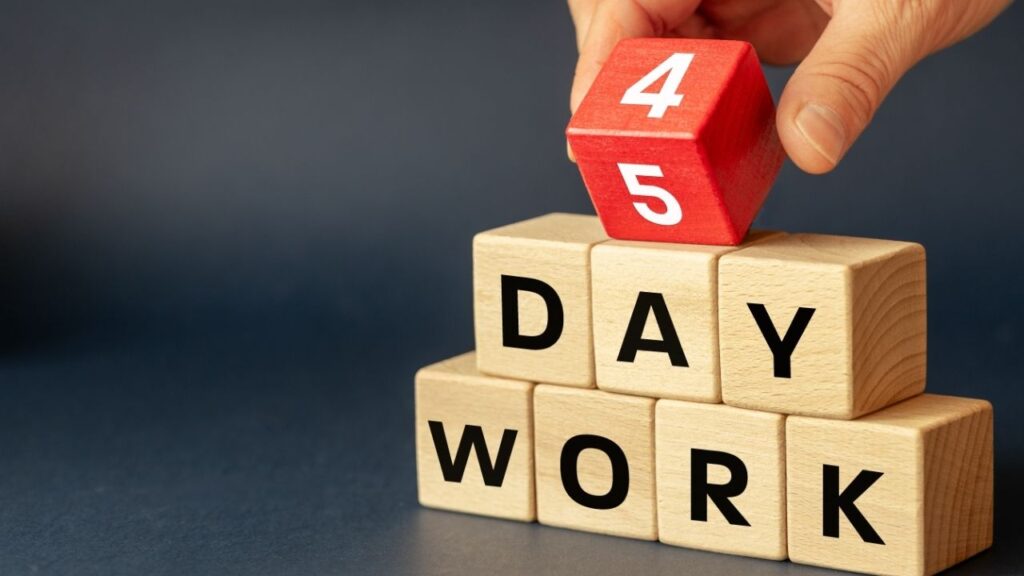
A California congressman is renewing a push to cut the standard American workweek from 40 hours to 32 hours, arguing decades of technological advances and increased worker productivity should translate into more time off or additional overtime pay.
Rep. Mark Takano, D-Riverside, reintroduced the Thirty-Two Hour Workweek Act on Sept. 8, continuing an effort he first launched in 2021.
The proposal would amend the Fair Labor Standards Act of 1938 and gradually lower the threshold at which covered, nonexempt employees become eligible for overtime pay.

Under the bill, the threshold would fall to 38 hours during the first year, beginning no less than 180 days after the legislation became law. It would then decline to 36 hours in the second year, 34 hours in the third year, and 32 hours after the third year.
Employees working beyond the weekly threshold would be entitled to at least 1.5 times their regular rate of pay.
The legislation would also establish federal daily overtime requirements. Employees working more than eight but no more than 12 hours in a day would receive at least 1.5 times their regular rate for those additional hours. Work beyond 12 hours would be paid at no less than double the employee’s regular rate.
Employers would be prohibited from reducing affected employees’ total weekly compensation, regular rate of pay, or benefits because of the shortened workweek.
Takano, Sanders Point to Worker Productivity
Takano and Sen. Bernie Sanders, I-Vt., who is backing the effort in the Senate, argue that federal labor standards have failed to keep pace with major changes in technology and worker productivity.
Takano’s office said American worker productivity has increased 93.2% since 1979 while wages have increased 33.7%, citing Economic Policy Institute data.
Takano said technologies ranging from cellphones and the internet to artificial intelligence have increased productivity while the country’s 40-hour workweek has remained largely unchanged.
“Work has fundamentally changed. It’s time that labor standards caught up,” Takano said.
Sanders said advances in artificial intelligence and robotics make it increasingly important that workers share in the financial benefits generated by new technology.
He said reducing the workweek could give workers and their families more time while reducing stress and improving quality of life.
Labor Groups Back Proposal
The legislation has received endorsements from several major labor organizations, including the AFL-CIO, Service Employees International Union, United Auto Workers, United Food, and Commercial Workers, National Nurses United, and Association of Flight Attendants-CWA.
The International Federation of Professional and Technical Engineers, National Employment Law Project, United Electrical, Radio, and Machine Workers of America, and WorkFour have also endorsed the proposal.
The legislation is the latest attempt to enact a Thirty-Two Hour Workweek Act.
Takano and Sanders have pursued legislation under the same name three times collectively. Takano first introduced the proposal in the House in 2021.
The latest House bill has been referred to the House Committee on Education and Workforce.
—
Connect with Anthony W. Haddad on social media. Got a tip? Send an email.