
|
Getting your Trinity Audio player ready...
|
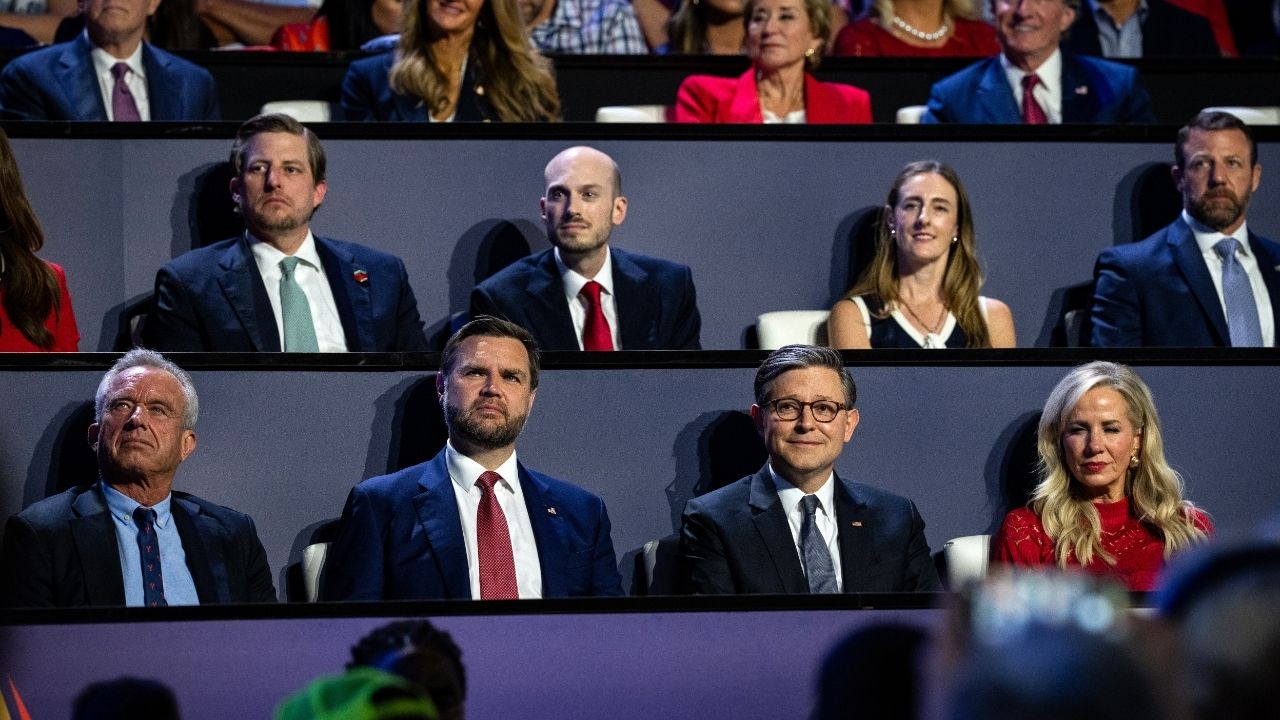
One by one, Republican speakers at President Donald Trump’s midterm convention in Dallas this past week turned to a far-fetched argument with echoes of the Cold War.
House Speaker Mike Johnson of Louisiana claimed, “Next year the communists will be in Congress — that’s what’s so frightening.” Rep. Steve Scalise of Louisiana, the No. 2 House Republican, said implausibly that there had been a “Bolshevik Revolution in the Democrat Party.”
And when Trump, the ringleader of this new Red Scare, took the stage, he returned — again and again and again — to baseless claims that Democrats were running as communists in the midterms.

“It’s going to be a communist country if they win,” he predicted, one of at least 60 times a speaker at the convention mentioned communism or communists.
Although this year’s Democratic primary season brought a surge of left-wing momentum, and a handful of victories by democratic socialists running for Congress in Colorado, Michigan, New York, Pennsylvania and Florida, no credible midterm candidate identifies as a communist. And there is little momentum behind any communist movement in U.S. politics at the federal level.
Still, for months now, Trump and Republicans, staring down a daunting political environment and the potential loss of one or both houses of Congress, have been trying to cast Democrats as communists, deploying a charge that has little overlap with Democrats’ actual platforms.
Republicans have been grasping for a potent attack line as they confront widespread voter discontent with the president’s war with Iran as well as high gasoline and grocery prices. They believe the left-wing congressional nominees have offered an opening to build an argument that Democrats are outside the mainstream.
“Stalin. Mao. Castro. Democrats,” the Republican National Committee wrote on social media last month. “Different leaders, same goal.”
Whether the attacks make a difference in the midterms is still far from clear. Some Democrats have expressed worry that the rise of democratic socialism in their party could play into Republican efforts to cast them as extremists and that constant mentions of communism could blur the lines for some voters. At the same time, Trump’s overheated language could weaken the force of the argument.
Trump and Republicans have pointed to a series of victories by democratic socialists in Democratic primary races — including a suite of June results in deep-blue New York and a stunning Senate upset last month in conservative-leaning Florida — to accuse their opponents of harboring radical beliefs.
Perhaps not since the 1950s or ’60s has an American political party spent so much time talking about communism. In Trump’s telling, communism poses the gravest danger to the country. It is more severe, he says, than World War I, the Japanese raid on Pearl Harbor in 1941 or the Sept. 11 attacks in 2001.
Communists, he said in a bizarre aside at a July rally in Georgia, even want to destroy an American landmark.
“They tried taking Mount Rushmore down — they want to blow it up,” he claimed, without elaborating.
In some ways, far-left leaders have fed the argument. In 2020, Sen. Bernie Sanders of Vermont, a leader of the progressive movement and a self-described democratic socialist, praised elements of the Communist Cuban revolution. And Darializa Avila Chevalier, a democratic socialist who unseated a Democratic congressman in a New York primary in June, once maintained a social-media account that circulated a post suggesting that public libraries should carry more Marxist literature.
Two days after Avila Chevalier and two other self-described democratic socialists swept House primaries in New York, a group of centrist House Democrats signed a letter declaring, “We are capitalist, not socialist.”
Most Americans have unfavorable views of socialism, according to polls. Communism polls much worse. And even as Trump mislabels Democrats as communists, some Democrats have jokingly blurred the lines themselves, referring to the area of New York City where one democratic socialist House candidate won as the “Commie Corridor.”
Jon Fleischman, a former executive director of the California Republican Party, said “your options are limited when the president’s ratings on a lot of key issues, most notably the economy, are underwater.” But he added that describing Democrats as communists was “smart” strategically and would “freak out people.”
Hillary Clinton told Kara Swisher on the “Pivot” podcast that Republican messaging accusing Democrats of being communists would be “very effective” politically. She said Republicans had most likely tested it before making it their central attack.
“People on the left have to be prepared to answer that,” Clinton said.
The deployment of over-the-top warnings about communism has become a staple of Trump’s speeches.
“These are not mere political disagreements like differences over taxes or regulations,” Trump said in a dark speech at Mount Rushmore the weekend of July Fourth, referring to communism more than a dozen times. “Communism is a mortal threat to American liberty. It is the greatest threat to our country, including World I, World War II, Pearl Harbor or even 9/11.”
Republicans have enhanced their standing with Hispanic voters in Florida by linking left-wing American leaders with authoritarian communist governments in Latin America, said former Rep. Carlos Curbelo, R-Fla. But Curbelo was skeptical that the president’s claims of communism would be as potent with other voters.
Rep. Don Bacon, a Republican from a swing Nebraska district who is retiring, said democratic socialists were a “good group to run against.” But he questioned the president’s approach of labeling them as communists.
“When you throw out the labels, people don’t know if it’s true or not,” Bacon said. Trump might be better off highlighting left-wing Democrats’ policy positions or inflammatory past statements, the congressman added: “I would quote these guys.”
Some Democrats say Republicans are embracing a straw-man argument.
Brad Lander, a self-described democratic socialist from New York City who beat a Democratic congressman in a primary in June, said democratic socialists had “in many cases” been the “fiercest opponents of communists.”
“Democratic socialists want an extension of democracy into more parts of working people’s lives,” he said.
Rep. Jamie Raskin, D-Md., said Trump wasn’t qualified to lecture Democrats about communism, pointing to the president’s tendency to embrace President Xi Jinping of China, who leads his country’s Communist Party, and Kim Jong Un, the authoritarian leader of North Korea.
Trump has celebrated his “good relationship” with Kim, saying that they “fell in love” during his first term and that the North Korean leader had sent him “beautiful” letters.
Trump has said he plans to meet again with Kim by the end of the year.
—
This article originally appeared in The New York Times.
By Tim Balk/Haiyun Jiang
c. 2026 The New York Times Company