

|
Getting your Trinity Audio player ready...
|
While city officials said they’ve revised their Southeast Development Area plan to meet the concerns of residents there, as well as other plan opponents, a key element — a detailed financial study — was notably missing at the Fresno Planning Commission hearing Wednesday night.
Despite Fresno planning commissioners Jacqueline Lyday, Linda Calandra, and Gurdeep Shergill saying they needed the financial analysis in order to approve SEDA, the plan passed on a 6-1 vote, with Shergill casting the lone “no” vote.
Other commissioners sided with city planning and development director Jennifer Clark, who said the job of the planning commission does not include financial analysis but rather only land use. Previously, the Fresno City Council had tabled an anticipated economic workshop on the plan.

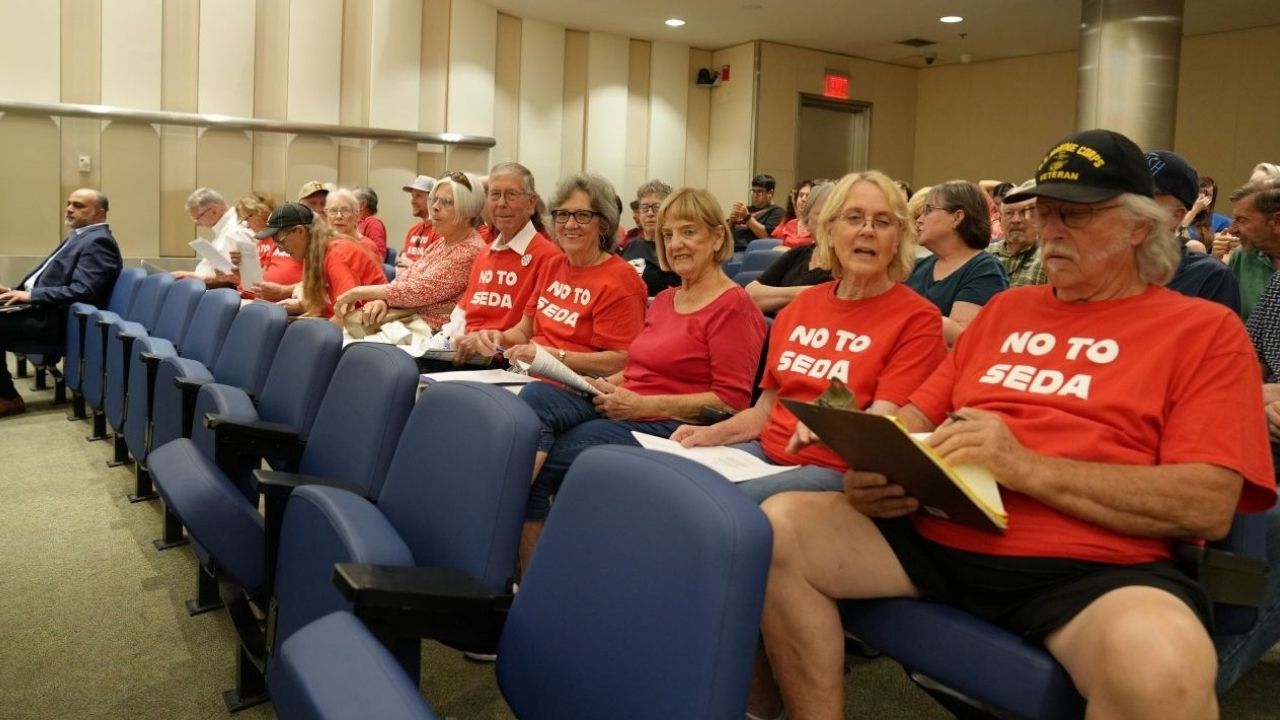
With a meeting attendance matching nearly that of the record-setting SEDA discussion at the city council last December, dozens from the public spoke against the plan, saying the 9,000-acre area would draw development from the city core. In addition, plan critics said the cost to bring necessary infrastructure to the area could impoverish the public treasury.
Residents within the proposed SEDA area said the city’s plan to help finance the transition away from well water to city water lacked needed guarantees and could force residents out of their homes when development comes.
Resident Brett Thompson who lives in what would be SEDA said the city has not answered questions about water certainty, and requirements that South SEDA be self-financed.
“It’s our farms, our tax revenue, our neighborhoods,” said Thompson. “We are not getting honest and transparent planning.”
The plan is expected to go before city council on Thursday, Sept. 3.
Southeast Fresno ‘Underinvested, Neglected’: Weber
In response to objections, Clark said that the city introduced stronger agricultural protections to preserve residents’ way of life. She added that the city’s General Plan mandates that development pay for itself.
Meanwhile a handful of others talked about the need to provide jobs and homes in the area.
With southeast Fresno homeownership rates the lowest in the city, Pete Weber, founder of Fresno Bridge Academy, said residents need good-paying jobs closer to home.
“Southeast Fresno is one of the most underinvested, neglected areas of our city,” Weber told GV Wire. “I get that people want to see more infill, I get that west Fresno wants to see attention paid to them, but we’ve ignored southeast Fresno for way too long.”
Commission chair Kathy Bray, who owns a professional recruiting agency, said she often speaks with people from across the state who come to the area for low home prices. She said the area needs better jobs so people can afford those homes.
“We don’t have an affordability crisis, we have a not-good-enough jobs crisis,” Bray said.
Could Data Centers Go in South SEDA?
The 9,000-acre plan in existence since the early 2000s has been vastly modified as objections and realities arose through the decades.
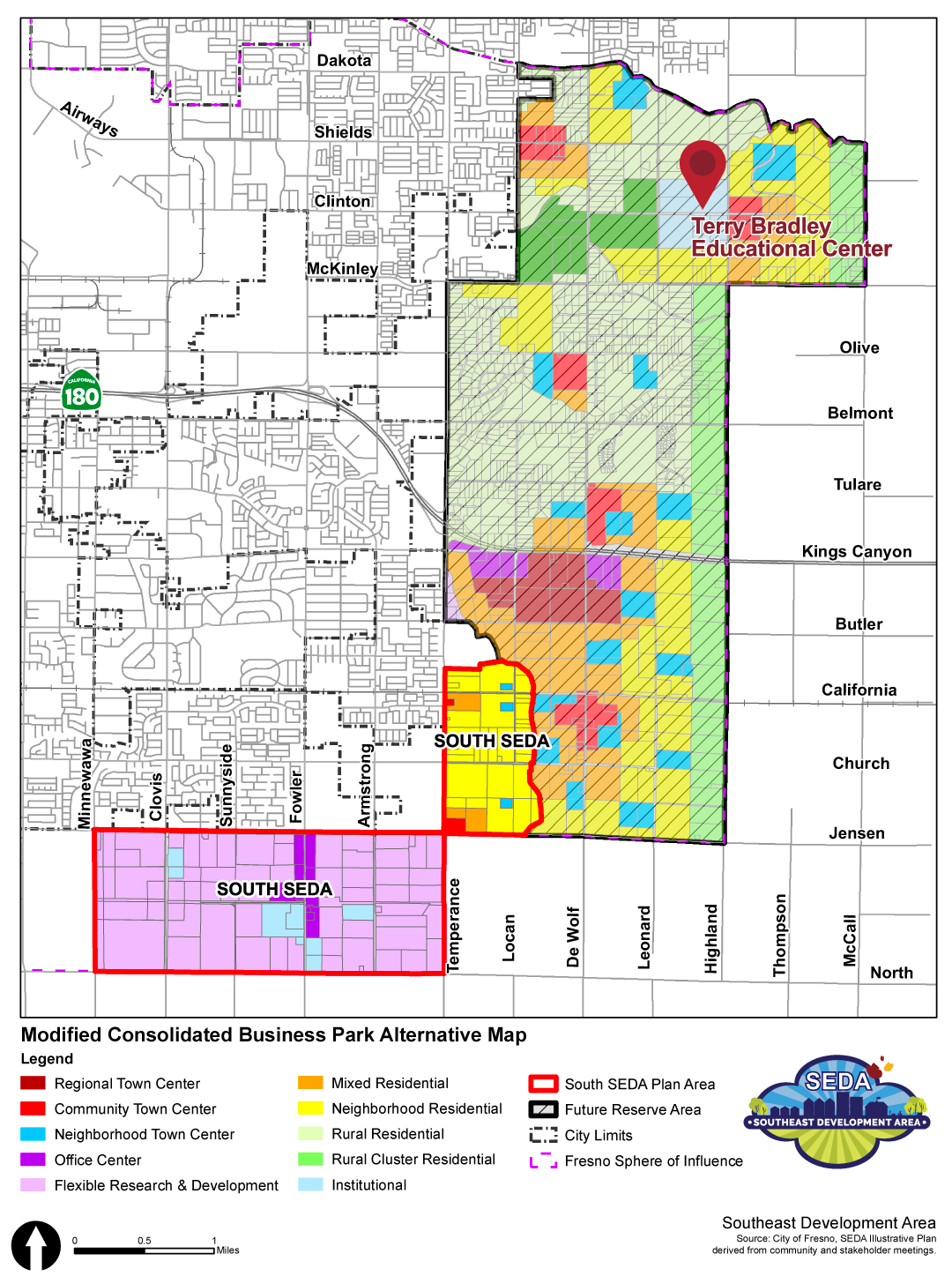
The plan approved by commissioners only allows development within the 2,000-acre portion Dyer has dubbed “South SEDA,” which is nearly all zoned for a new classification known as flexible research and development. An adjacent annex would provide for new homes.
To develop areas outside South SEDA, development thresholds would need to hit 70% and public hearing processes would need to be conducted for each area, Clark said.
Additionally, development would not occur in any part of the area until property owners sell their land to someone looking to develop it. Clark told GV Wire that residents are free to sell to people who want to continue farming.
With far fewer landowners in the area than North or Central SEDA and more available infrastructure, Dyer has long touted the area as a cheaper investment for jobs. What exactly flexible research and development could be has still not been made clear, but the city has used the industrial area east of Ingram Avenue between Nees and Herndon avenues as an example. The area contains typically family-owned, light-industrial operations.
At the meeting, Fresno City Councilmember Miguel Arias said the plan is a way to get data centers into Fresno. In May 2025, Reuters reported data center developers have shown high interest in building in Fresno.
After Arias’ comments raised the eyebrows of attendees and some commissioners alike, Clark said Fresno’s development code doesn’t allow data centers.
Clark clarified to GV Wire after the meeting that rather than a explicit ban, they aren’t allowed in the city because Fresno’s development code doesn’t define or identify data centers.
At least one small data center is in Fresno, however, operated by unWired Broadband.
Water Hookup Requirements Could Bankrupt Property Owners
While ag uses would be protected in perpetuity, one factor that could force property owners off the land is the cost to hook up to water and sewer once it arrives.
Though city water and sewer lines would be years or decades out, if at all, city rules require that once it becomes available, residents have five years to connect and stop using well water.
Some residents have said getting the lines could cost more than $100,000, which they say is as good as kicking them off the land.
In response, the city directed the creation of a Community Benefits Fund to help pay for those connection fees. How that fund is paid for is still unclear.
Resident Elizabeth Sandberg also said that many in the area need to be able to spray pesticides, something not normally allowed in city limits. Other residents wondered how much it would cost to irrigate with city water.
“If you pass this plan and it’s not written down, there no legal obligation to go back and do anything,” Sandberg told GV Wire.
City Adapts Rules to Accommodate Residents’ Concerns
With many residents within SEDA long opposed to development in their area, planning staff have met with and adapted regulations to preserve agriculture in the area.
Closer to the Kings River than western Fresno County, farmland in the area has been considered by many to be among the most fertile on the planet. Residents there also want to maintain their rural way of life.
Sandberg told GV Wire that the city rules drastically limit how many horses per acre she can have. The county allows 16 on a property her size.
To help clear up complications, the city wrote into its rules that any dispute between city and county rules would defer to the county’s looser rules, meaning Sandberg can have the 16 horses allowed.
Additionally, Clark told GV Wire that residents can build new barns or rebuild old ones without any zoning conflicts.
SEDA Objections
Opponents to SEDA brought up three major arguments — how the project will be paid for, where demand for the area will come from, and what the effect on schools and the city’s interior and west side will be.
Central Unified Superintendent Mark Marshall said west Fresno needs more investment.
“We share a common goal with the city — creating vibrant, thriving communities for every student and family across our community,” Marshall said. “To achieve that vision, Central Unified is advocating for long-term development planning, a concentrated investment in our established neighborhoods.”
Fresno Unified Board President Veva Islas said the SEDA plan would lead to further declines in enrollment and not contribute property tax revenue to the area’s largest school district.
Fresno Teachers Association President Manuel Bonilla echoed those sentiments, saying it would cost jobs.
“I know that school closures gets a lot of the headlines, but the harm to our students and our community is long before school closures even happen,” Bonilla said. “It shows up in larger class sizes, it shows up in fewer counselors, it shows up in fewer nurses and eventually it shows up in less teachers via layoffs.”
SEDA Realities
While opponents said that areas within Fresno have gone neglected, with empty buildings and potholes throughout, Commissioner Joseph Giles said the city has been developing both the interior and the west. He brought up ongoing road repairs and Fresno City College’s West Campus. The city earlier this year authorized a $100 million bond for road repair.
Dyer also secured $250 million for infrastructure upgrades in downtown Fresno.
“West Fresno is getting a lot of road work done, they’ve got the new college out there, there’s a lot of upgrades going around everywhere,” Giles said. “To hear that everybody’s being left out, I have a different thought on that.”
Bray and Commissioner Jaime Holt both said others could develop the area if Fresno doesn’t.
On Wednesday, Fresnoland reported that neither Sanger nor Clovis leaders said they want to build in SEDA.
Despite these statements, six years ago Sanger Unified School District completed Sanger West High School at Jensen and Fowler avenues in the heart of South SEDA.
Holt said during her previous tenure as commissioner, she saw Tesoro Viejo, Riverstone, and Millerton New Town get developed.
Bray, however, said with Clovis developing the Terry Bradley Education Center in the area, the writing is on the wall. She said she lived in that area for 40 years and watched development occur.
“In the real world, it’s going to happen,” Bray said. “I see this plan with it being phased out in the Jensen area first as the least awful iteration.”