
|
Getting your Trinity Audio player ready...
|
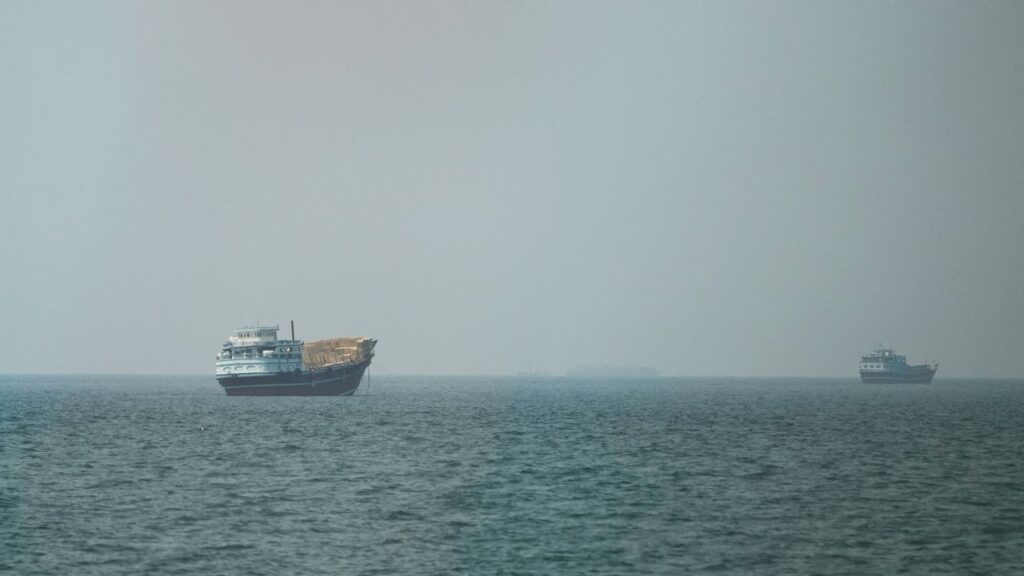
Oil prices rose about 2% to a one-month high on Tuesday after the U.S. reimposed a naval blockade on Iran and as renewed attacks between Washington and Tehran heightened concerns over energy flows through the Strait of Hormuz.
Before the Iran war about 20% of global oil supplies flowed through the strait.
Keeping price gains in check, however, were concerns that those higher energy prices could boost inflation around the world and ultimately reduce economic growth and demand for oil.

Brent futures rose $1.47, or 1.8%, to $84.77 per barrel at 11:36 a.m. EDT (1536 GMT), while U.S. West Texas Intermediate (WTI) crude rose $1.26, or 1.6%, to $79.40.
That put Brent on track for its highest close since June 12 and WTI on track for its highest close since June 15. It also kept Brent in technically overbought territory for a second day in a row for the first time since March.
“The resumption of attacks between the U.S. and Iran is accelerating this week and will likely continue given the additional U.S. bombing overnight that followed reinstatement of a U.S. blockade of the Strait of Hormuz,” analysts at energy advisory firm Ritterbusch and Associates said in a note.
Iran fired missiles at Jordan and Bahrain on Tuesday after the U.S. launched a five-hour attack on Iranian targets, stepping up a battle for control of the Strait of Hormuz.
U.S. forces carried out waves of attacks for the third night in a row after Tehran said it had closed the strait, prompting U.S. President Donald Trump to reinstate a blockade of Iranian shipping.
Trump on Tuesday dropped the idea of charging a 20% fee on all cargo shipped through the Strait of Hormuz, and said he would instead take trade and investment deals with the Gulf states.
Trump also said the Strait of Hormuz was open to all ship traffic except for Iran, causing U.S. crude futures to turn negative briefly. Crude prices, however, climbed higher again after Oman said 18 members of an oil tanker hit near Oman were evacuated.
The worsening attacks have increased doubts that a memorandum of understanding signed last month will lead to a permanent halt in the war, which has disrupted global energy supplies and raised fears of a rise in inflation across the world.
In early July, when it looked like the ceasefire between the U.S. and Iran would hold, futures for Brent and WTI were trading near levels seen before the U.S. and Israel started bombing Iran on February 28.
Inflation and Diesel Worries
U.S. consumer inflation slowed more than expected in June, data showed on Tuesday, but that will probably not rule out an interest rate increase from the Federal Reserve this year, with the conflict in the Middle East still unresolved.
Higher interest rates raise the cost of borrowing for consumers, which can slow economic growth and demand for oil.
In Germany, the two-year government bond yield hit its highest since July 2024 on Tuesday as the Iran conflict stoked fears that higher energy prices could boost inflation and interest rates.
Meanwhile, Ukraine’s military said on Tuesday that it struck two Russian oil refineries in the Bashkortostan and Krasnodar regions overnight. Recent Ukrainian attacks on Russia’s energy infrastructure have caused Moscow to curtail diesel exports, boosting diesel prices around the world.
In the U.S., the rise in diesel futures has boosted the 3-2-1 and diesel crack spreads, which measure refining profit margins, to record highs, according to LSEG data.
US Oil Inventories
The oil market waited for weekly storage reports from the American Petroleum Institute (API) trade group later on Tuesday and the U.S. Energy Information Administration (EIA) on Wednesday.
Analysts estimated energy firms pulled 2.7 million barrels of crude from storage during the week ended July 10.
If correct, that would be the 13th time energy firms pulled crude out of storage in 14 weeks. It compares with a decrease of 3.9 million barrels in the same week last year and an average decline of 1.5 million barrels over the past five years (2021 to 2025). [EIA/S] [API/S]
(Reporting by Scott DiSavino in New York, Anushree Mukherjee and Ishaan Arora in Bengaluru and Emily Chow in Singapore; Editing by Jamie Freed, Susan Fenton and Andrea Ricci )