



|
Getting your Trinity Audio player ready...
|
Governor races in two solidly Republican Midwestern states are surprisingly competitive before the November elections, according to New York Times/Siena polls that found a slim Democratic lead in Iowa and a tie in Ohio.
Voters in those states also expressed high levels of disapproval with President Donald Trump’s performance, and a majority of voters polled said the United States was headed in the wrong direction. Voters’ dyspeptic mood could complicate Republicans’ plans to hold onto the governor’s offices in Ohio and Iowa — as well as onto Senate seats in the states, where races are also close.
Both states have open governor’s races: In Iowa, Gov. Kim Reynolds, a Republican, declined to run for a third full term, and in Ohio, Gov. Mike DeWine, a Republican, is term-limited.

In the last two decades, Ohio and Iowa have shifted from swing states to reliably Republican, with control of the governor’s offices and state legislatures in Republican hands. All six members of Congress in Iowa are Republicans.
The candidates for governor in Iowa are neck-and-neck only weeks after the June 2 primary, when Zach Lahn, a businessperson who has been running a populist campaign critical of agriculture interests, defeated Rep. Randy Feenstra for the Republican nomination. Lahn, who has been called a carpetbagger by Democrats because he has spent significant time in Kansas, where he has a home, is a relative unknown to Iowa voters. But he captured his party’s nomination after promising to address high rates of environmental pollution and cancer in Iowa.
Rob Sand, a Democrat who is the state’s elected auditor, ran unopposed for his party’s nomination and has been campaigning across Iowa for more than a year, making a broad bipartisan pitch for change intended to appeal to both Democratic and Republican voters.
Forty-eight percent of likely voters polled said they would vote for Sand if the race were held today, and 47% of voters said they would chose Mr. Lahn. Five percent of voters declined to answer.
A majority of women polled — 55% — said they supported Sand, while a majority of men — also 55% — said they would vote for Lahn.
In Ohio, the race for governor is tied, according to the polls. Vivek Ramaswamy, the billionaire biotech entrepreneur, capitalized on his celebrity in Trump circles to clear the Republican field last year. Given Ohio’s partisan lean as well as his hefty campaign chest — he has already contributed $25 million of his own money — Ramaswamy had seemed well positioned to win.
But polls have continued to show a close race. The Democratic challenger, Dr. Amy Acton, served as the state’s chief public health official under DeWine. Ramaswamy and groups supporting him have focused their attacks on Acton’s role in the early months of the COVID-19 pandemic.
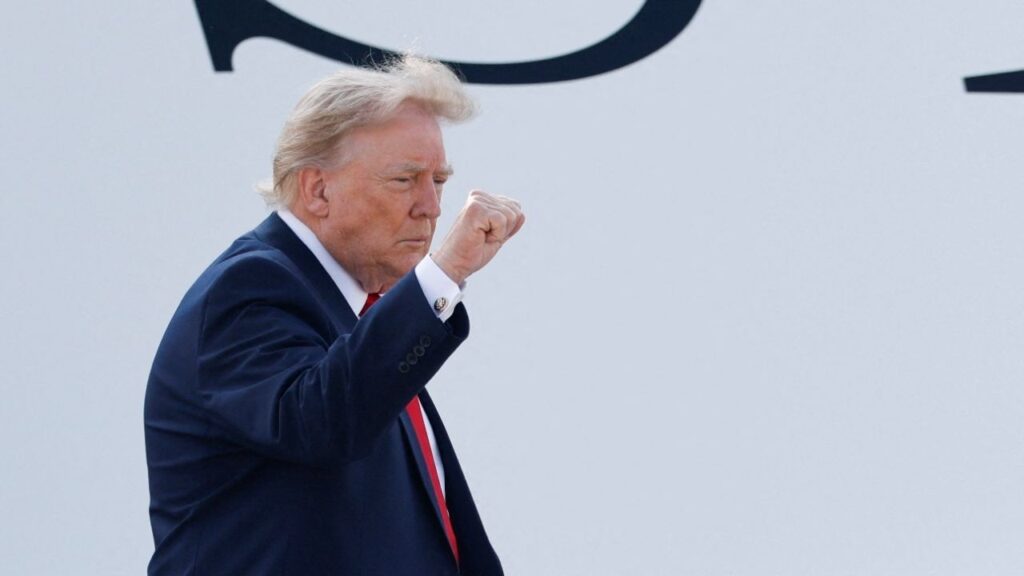
In 2024, Trump won Iowa by 13 percentage points, and Ohio by 11 percentage points. The polls found that a large number of voters in those states were dissatisfied with Trump’s performance in office. In both Iowa and Ohio, 44% of likely voters said they approved of the way Trump was handling his job as president; 54% disapproved.
Nearly two-thirds of voters — 61% in Iowa and 62% in Ohio — said they disapproved of Trump’s handling of the cost of living in their states, including nearly half of voters who strongly disapproved. Many voters said they were upset about the cost of gas and the war in Iran.
Fifty-four percent of Iowa voters said they disapproved of Trump’s handling of the economy, and 53% disapproved of the president’s handling of the tariffs issue.
The top issue that voters in both states said would determine their vote in November is the economy, according to the polls. In Iowa, immigration came second as an issue; in Ohio, control of Congress or support for a particular political party came second.
Cheryl Throwe, 68, a Democrat, lives in a rural county in central Ohio that voted for Trump by 30 points in 2024. People are too fearful to talk openly about politics these days, she said. But she has noticed the Trump signs coming down around her as the costs of healthcare and everything else continue to rise.
“I think people are disturbed enough, and they are suffering enough that it could happen,” she said of a Democratic victory in either of the main Ohio races, for governor and Senate. “But after the last round of voting, I have no faith in humanity anymore.”
Despite Sand’s relative strength in Iowa, some voters said they hoped the governor’s office would remain in Republican hands.
Chuck Craver, 56, a Republican from Ottumwa, said he supported Reynolds’ policies, particularly on education and the state budget, and hoped Lahn would be elected.
“It sounds like he’s going to be fairly conservative, and that’s what we need,” Craver said.
He said the Democratic Party had veered so far to the left that he could not consider voting for a Democrat.
—
This article originally appeared in The New York Times.
By Julie Bosman and Campbell Robertson/Antranik Tavitian
c. 2026 The New York Times Company