
|
Getting your Trinity Audio player ready...
|
NEW YORK — After days of backbiting rancor, New York City Mayor Zohran Mamdani and the speaker of the City Council settled the first budget of their respective tenures, a $126 billion spending plan that resolves yearslong litigation over a rental assistance program whose parabolic cost growth caused widespread alarm.
Mamdani and the council speaker, Julie Menin, Democrats who have often operated as political adversaries, fought until the final hours over how to handle the ballooning costs of the city-funded program that provides rental assistance, known by the ungainly name CityFHEPS.
In reaching an agreement that expands eligibility for the rental vouchers — by establishing a new program to administer them — the two sides agreed to end the litigation, even as the city’s housing crisis continues.

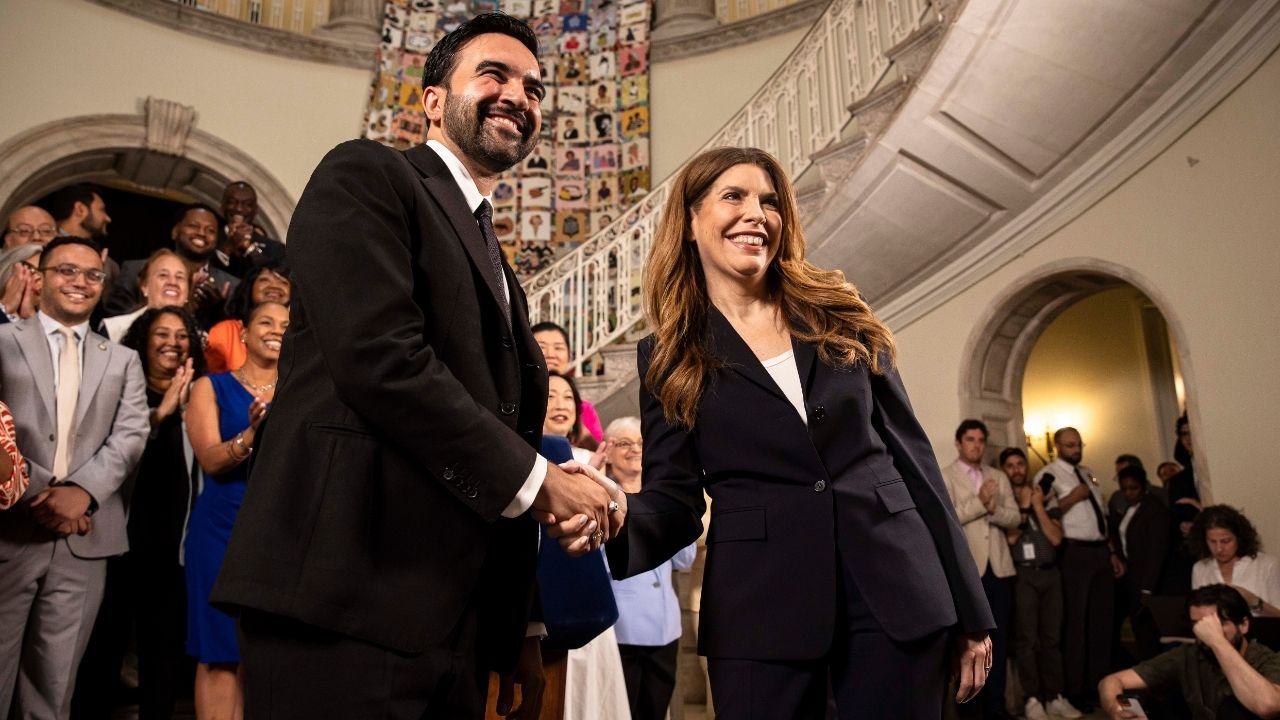
At a news conference Tuesday morning, Mamdani and Menin were all smiles and affectionate handshakes as the mayor declared the budget a reflection of “government excellence” and Menin argued it would “meaningfully tackle the affordability crisis.”
The council must now vote on the deal, which takes effect Wednesday — the statutory day when a new budget must be in place.
“Throughout this process, I have been reminded of the words of the Austrian economist Friedrich Hayek: ‘If socialists understood economics, they wouldn’t be socialists,’” said Mamdani, a democratic socialist. “If these past months have shown us anything, it is that socialists not only understand economics just as well as the capitalists who came before, but that we can solve their years of mismanagement through an embrace of our principles.”
The budget deal also includes money to expand Fair Fares, a discounted transit fare program that was, like the expansion of CityFHEPS, a council priority. Mamdani said he remained committed to finding a way to fund free buses, a core campaign promise.
Menin also won City Hall’s support for an expansion of a program called NYC Kids Rise, a $53 million commitment to put $1,000 into a college savings fund for every public school kindergarten student in the city.
But one controversial element of the budget was eliminated when Mamdani backtracked on his plan for an additional 580 officers to the New York City Police Department, in part to enhance security in the Bronx. The proposal to add police officers was a flip-flop of his campaign stance to freeze the police head count, and his reversal had angered some of Mamdani’s democratic socialist base, which made the rare move of publicly criticizing him over his support.
“Commissioner Tisch and I were able to identify ways to keep the NYPD head count at the originally authorized 35,000 while also meeting all of our crime-fighting needs,” Mamdani said Tuesday, referring to Police Commissioner Jessica Tisch.
The new voucher program is expected to serve an additional 5,600 households, or about 14,000 New Yorkers, according to the mayor’s office. Still, a major crisis persists: Nearly 100,000 New Yorkers remain in city shelters, and close to one-third of them are children. The existing CityFHEPS serves about 67,000 households.
The new program is not an entitlement like the existing one, but it will serve people in homeless shelters as well as rent-regulated tenants facing eviction. Unlike the existing program, this one will not feature work requirements. Some officials worry that the new program may create self-defeating competition between existing renters and homeless shelter tenants for an extremely limited supply of vacant apartments.
Because it is not an entitlement, the new program’s budget is capped.
Council member Pierina Sanchez, a Democrat from the Bronx, led the push for more funding for housing vouchers.
“It’s not exactly where we wanted to end up; we wanted a bigger size of this program to start,” Sanchez said, even as she applauded the new voucher program. She said the new system would expand eligibility for people based on income and added, “We live to fight another day.”
Mamdani had promised on the campaign trail to expand the voucher program far more than he ended up doing Tuesday. Asked about his longer-term plan for dealing with the homelessness crisis, Mamdani pointed to his “comprehensive” efforts to make New York City more affordable, from building more housing to the Fair Fares expansion.
The budget negotiations surrounding the housing vouchers happened in concert with efforts to settle ongoing litigation surrounding the program. In 2023, the City Council voted to expand the program so that it would serve not just those in homeless shelters but also renters facing eviction. Former Mayor Eric Adams proceeded to veto the legislation, citing concerns about the program’s exploding costs.
The council overrode his veto, only for Adams to refuse to enforce the laws. The council sued.
Between 2019 and 2026, the program’s cost has grown to $1.7 billion from $25 million, according to the Citizens Budget Commission.
While the original FHEPS entitlement program was crafted in concert with the state, as the city charter mandates, the expansion was not, according to Legal Aid and a senior city official. The settlement replaces the 2023 laws and affirms that state approval is required for the creation of entitlement programs.
On Tuesday, Andrew Rein, the commission’s president, praised the city’s new housing voucher program, because he argued its costs would escalate in a far less dramatic fashion.
“Ensuring FHEPS is not an entitlement is key to controlling spending growth,” Rein said.
But he issued a broader warning about the spending plan, saying the city “has a huge structural budget problem. Unfortunately, this budget fails to solve it.” The mayor and speaker closed the budget gap “with one-shots, short-term savings and cost shifts to future taxpayers,” Rein added, “leaving the city to face a gaping hole next year and undue stress in the years after.”
—
This article originally appeared in The New York Times.
By Sally Goldenberg and Dana Rubinstein/Dave Sanders
c. 2026 The New York Times Company