
|
Getting your Trinity Audio player ready...
|
RIYADH, Saudi Arabia — Iran and U.S.-allied Oman are moving forward with plans to collect payment for ships transiting the Strait of Hormuz, despite public U.S. objections, according to an Iranian official and four diplomats with knowledge of the matter.
If enacted, the plans would be a significant change from the prewar status in the strategic waterway, underscoring how the U.S.-Israeli decision to attack Iran on Feb. 28 has changed the Middle East in far-reaching and unanticipated ways.
Before the war, the Strait of Hormuz was an international shipping route between Iran and Oman that vessels sailed through free, carrying oil and gas from the Persian Gulf to the rest of the world. During the fighting, Iran effectively blockaded the waterway, an important choke point for global trade, sending energy prices skyrocketing.

Since then, Iranian officials have repeatedly declared their intentions to monetize the strait.
Oman recently delivered a formal proposal to the United States and other Western allies that outlined a plan in which shipping companies would pay service fees to use the strait, according to the Iranian official and a regional diplomat.
A person familiar with the U.S. position confirmed that U.S. negotiators had received the Omani proposal and said they had concerns that they intended to discuss with Omani officials. The officials and diplomats cited in this article all spoke on the condition of anonymity to discuss sensitive diplomacy.
The future of the strait remains a central issue in talks between the United States and Iran to hammer out a lasting peace agreement.
Oman’s proposal is partly modeled on arrangements in the Straits of Malacca and Singapore, an Asian waterway where a private foundation collects voluntary contributions for safe navigation, the regional diplomat said.
Any fees in the Strait of Hormuz would be voluntary, the diplomat said. The Iranian official, however, said the payments would be obligatory.
On Monday, Iran’s deputy foreign minister, Kazem Gharibabadi, said Iran’s priority was to come to an agreement with Oman. But if Oman is unwilling to establish a joint framework for managing the waterway, Iran will move forward on its own, he said, according to remarks carried by Iranian state television.
Oman, a sultanate in the southeastern tip of the Arabian Peninsula, has long cultivated a reputation for neutrality, serving as a mediator between the United States and Iran. The country has found itself engaging in an increasingly difficult balancing act as the war inflames regional tensions.
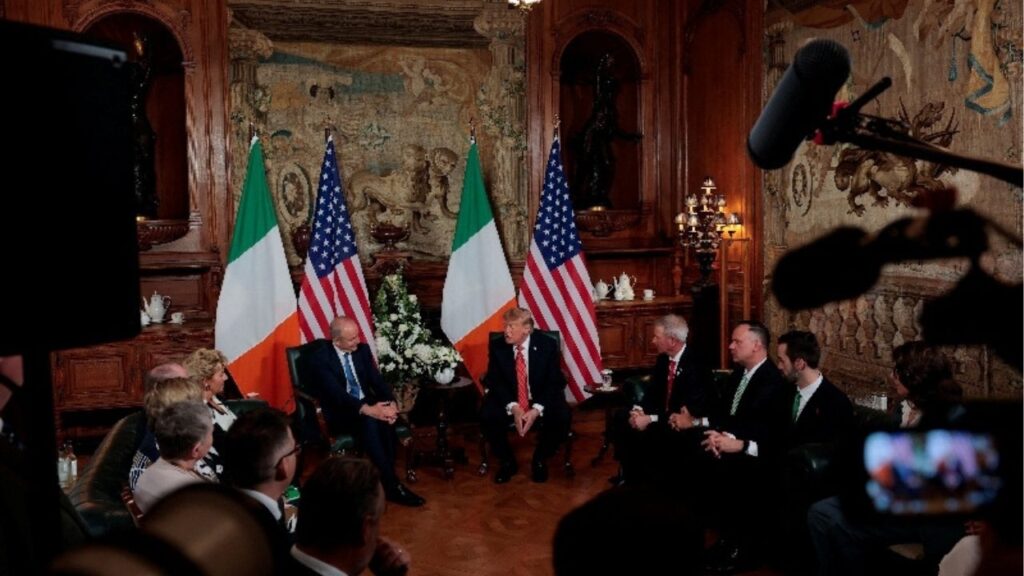
After news initially emerged in May that Oman had discussed partnering with Iran to charge service fees in the strait, President Donald Trump threatened to bomb Oman if it did not “behave just like everybody else.”
As recently as last week, Trump called the idea of collecting tolls or fees for passage through the strait “unacceptable.”
It was not immediately clear whether the Trump administration would be willing to go along with voluntary service fees.
A framework peace agreement signed by the United States and Iran this month, which stopped the war, addressed the Strait of Hormuz, ensuring “the safe passage of commercial vessels with no charge,” but only for a period of 60 days while negotiations to define specifics carried on.
The agreement stipulated that Iran and Oman should start a “dialogue” about what happens in the shipping route after that.
The person familiar with the U.S. position said the U.S. negotiating team valued its partnership with Oman and was confident that they could resolve differences over the Omani proposal at the technical level.
Secretary of State Marco Rubio told reporters in Bahrain last week that the United States would oppose any scenario in which use of the strait was monetized, regardless of whether it was called “a fee or a toll or a donation.”
“We need to get back to what the straits looked like before this conflict,” he said.
But analysts say Iran’s newfound power to disrupt traffic through a waterway is critical leverage that it cannot afford to lose.
Iran’s foreign minister, Abbas Araghchi, said on state television this month that the Strait of Hormuz would not return to its prewar status, when passage was free.
Oman publicly has been more opaque about its plans. The country’s foreign minister, Badr al-Busaidi, has rejected the idea of charging fees to merely transit the strait, saying that would be illegal. But he has drawn a distinction between “transit fees” versus fees for services provided by the countries along the strait.
Al-Busaidi said in an interview Sunday with Monte Carlo Doualiya, an Arabic-language radio station, that the responsibilities for keeping the strait’s waters safe and pollution-free while responding to periodic shipping emergencies “undoubtedly cost money.”
“All we are saying is that perhaps we can benefit from some existing experiences, on a voluntary basis, between the countries concerned with this matter,” he added in the interview.
The Omani proposal is likely to be contentious among other Gulf Arab countries, which rely on the Strait of Hormuz to export oil and gas.
Speaking at an event organized this month by the European Council on Foreign Relations, Saudi Arabia’s foreign minister, Prince Faisal bin Farhan, said the Strait of Hormuz “must return to the status quo before the war.”
“Why should we now, as a result of a conflict, accept some novel arrangement that is going to be imposed on it?” he asked.
—
This article originally appeared in The New York Times.
By Vivian Nereim, Farnaz Fassihi and Erika Solomon/Gabriel V. Cárdenas
c. 2026 The New York Times Company