
|
Getting your Trinity Audio player ready...
|
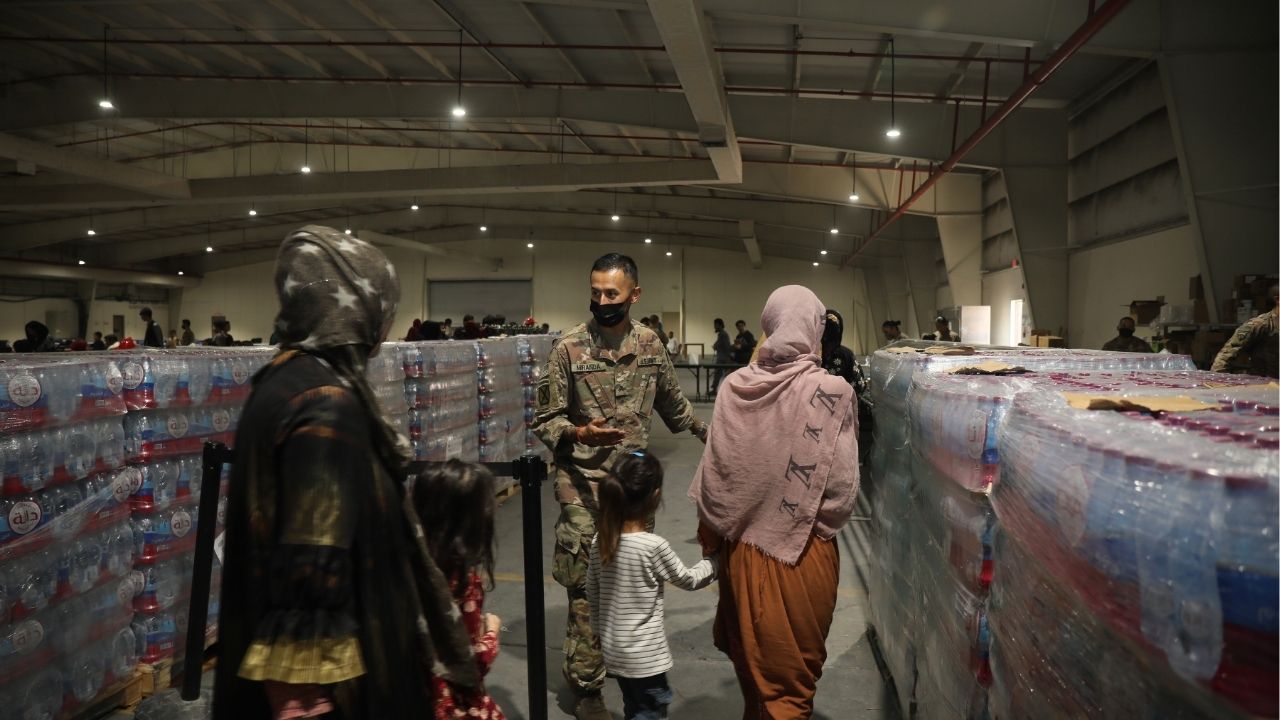
Afghan refugees who once helped U.S. forces and have been stranded for years at a former U.S. military base in Qatar say they are being forced to choose between returning to Taliban-ruled Afghanistan or resettling in a third country that some have never heard of.
The New York Times reported this week that the Trump administration has been in talks with the government of Congo to send as many as 1,100 Afghans to the Central African country.
Camp officials deny that any decision has been made, even as they have, for months, pushed Afghans to return to Afghanistan by offering free airfare and a stipend, according to camp residents and screenshots of messages from camp officials seen by the Times.

Officials at the facility, Camp As Sayliyah in Qatar, told residents Wednesday that no deal had been finalized.
“Please be aware NO third country has been confirmed or officially announced for resettlement,” read a message sent to a WhatsApp group that officials have used to communicate with residents. “The U.S. government continues discussions to identify and secure voluntary resettlement opportunities.”
For months, the Afghans had lived under a cloud, hearing from camp officials and aid workers that they might be relocated to either an African or Asian country.
“Now we are stuck between bad and worse options,” said Arash Pahlavi, a camp resident.
Zabiullah Mujahid, a Taliban government spokesperson, said Afghan authorities would welcome the return of camp residents.
“Now they have realized how much importance the Americans give them and how much value they place on those who worked with them,” Mujahid said.
He did not respond to questions about reports of human rights abuses — including extrajudicial killings, imprisonment and torture — against members of the former Afghan administration and allies of U.S. forces.
If implemented, the relocation would be the latest measure taken by the Trump administration to prevent Afghan refugees who helped U.S. forces in Afghanistan from reaching the United States. In November, the Trump administration froze a special visa program for Afghans and, in January, said it would close the camp in March.
Pahlavi has family in the United States, but his plans to join them fell apart when President Donald Trump suspended a refugee admission program last year.
Since U.S. officials running the camp began offering free plane tickets and stipends late last year, over 200 people have gone back, according to Shawn VanDiver, president of aid group AfghanEvac, who was briefed on the State Department’s plan to relocate camp residents to Congo. Six residents confirmed that dozens of families have left.
Those still at the camp include former interpreters for the U.S. military, Afghan special operations forces and relatives of U.S. service members, many of whom would be at risk of human rights abuses if repatriated.
The U.S. plan adds to a growing list of coercive measures implemented by countries across the world to send Afghan refugees back home. Iran and Pakistan forced nearly 3 million Afghans back home last year. The European Union is in talks with the Taliban government to repatriate Afghans without legal status. A notable exception has been Brazil, which has received hundreds of Afghan refugees since last year.
It is unclear whether the deal with the Congolese government would include some or all of the 1,100 residents. More than half of them are women and children.
Aid workers and U.S. politicians opposing the plan say relocation to Congo would be anything but secure and voluntary. Congo is in the grip of one of the world’s most severe displacement crises and is in conflict with its neighbor, Rwanda.
“The option to be deported to the Taliban or to move to a catastrophic humanitarian crisis in the Democratic Republic of Congo is not a choice,” said Rep. Sydney Kamlager-Dove, D-Calif., who is a member of the House Foreign Affairs Subcommittee that oversees Afghanistan issues.
The State Department and the Congolese government did not respond to a request for comment.
Residents of As Sayliyah went through at least one round of preliminary vetting, according to Jon Finer, a former deputy national security adviser under the Biden administration. Some have had English and driving lessons and taken courses on American culture, residents said.
However, not all had been cleared for U.S. relocation before Trump suspended the program.
Some residents said they would be ready to go back to Afghanistan if Congo were the only other option; others said they would accept resettlement to Congo.
“I will choose Congo over Afghanistan because I don’t feel safe there in Afghanistan,” said Salem, a former Afghan Air Force pilot.
But Zahra, 15, would be unable to go to school or travel long distances without a male companion, under restrictions imposed on women and girls by the Taliban government.
She and Salem spoke on condition that only their first names be used to avoid retaliation if they were sent back to Afghanistan.
“Afghanistan is my homeland — I respect it,” Zahra said. “But I’m not ready to go back.”
—
This article originally appeared in The New York Times.
By Elian Peltier/Sgt. Jimmie Baker
c. 2026 The New York Times Company