


|
Getting your Trinity Audio player ready...
|
Venezuela’s government says 6,509 people died in the back-to-back earthquakes in June. But calculations from multiple sources, including a New York Times analysis of residential buildings and the U.S. Geological Survey, indicate that this is likely a severe undercount.
For years the USGS has used shaking severity, historical data and population distribution to try to estimate deaths after an earthquake. The information is typically more accurate in higher casualty incidents, such as this one, said David Wald, a seismologist at the USGS.
For the Venezuela quakes, the USGS’s median estimate is that 53,000 people died — meaning there is a 50% chance the actual number is higher than that, and a 50% chance it is lower.

The USGS also says there is approximately an 81% chance that the real number of deaths is higher than 10,000.
One obstacle to calculating a reliable death count in Venezuela is the absence of an up-to-date official government census.
To address that problem, the USGS uses a model called LandScan to “age” the most recent census forward in time. The model, developed at Oak Ridge National Laboratory, also uses independent United Nations figures to refine the estimates. LandScan uses dozens of other variables, including land use, roads and proximity to urban areas to estimate where people are likely to be when the ground shakes.
The Venezuelan government did not respond to messages detailing our findings and asking for comment.
A Times analysis of satellite imagery, ground-level footage and building type also casts doubt on the government’s official death toll.
Our examination of public housing in the hardest-hit state, La Guaira, shows that 16 public housing towers collapsed there after the quakes. Each concrete tower had 12 residential floors with eight apartments per floor, according to floor plans obtained by the Times and site observations.
To arrive at an estimated number of residents per apartment, we used a census of one of the complexes taken by its community council, which indicated that an average of 3.4 people lived in each unit. We corroborated this information with former residents and an official government statement, which indicated that around four people lived in each public housing apartment.
This means that roughly 5,200 people lived in the 16 collapsed public housing towers in La Guaira alone.
Of course, all those residents might not have been home at the time of the quakes. But witness accounts and surveillance footage indicate that at least some of the buildings, including several tall towers, collapsed immediately — leaving those who were inside little or no time to escape.
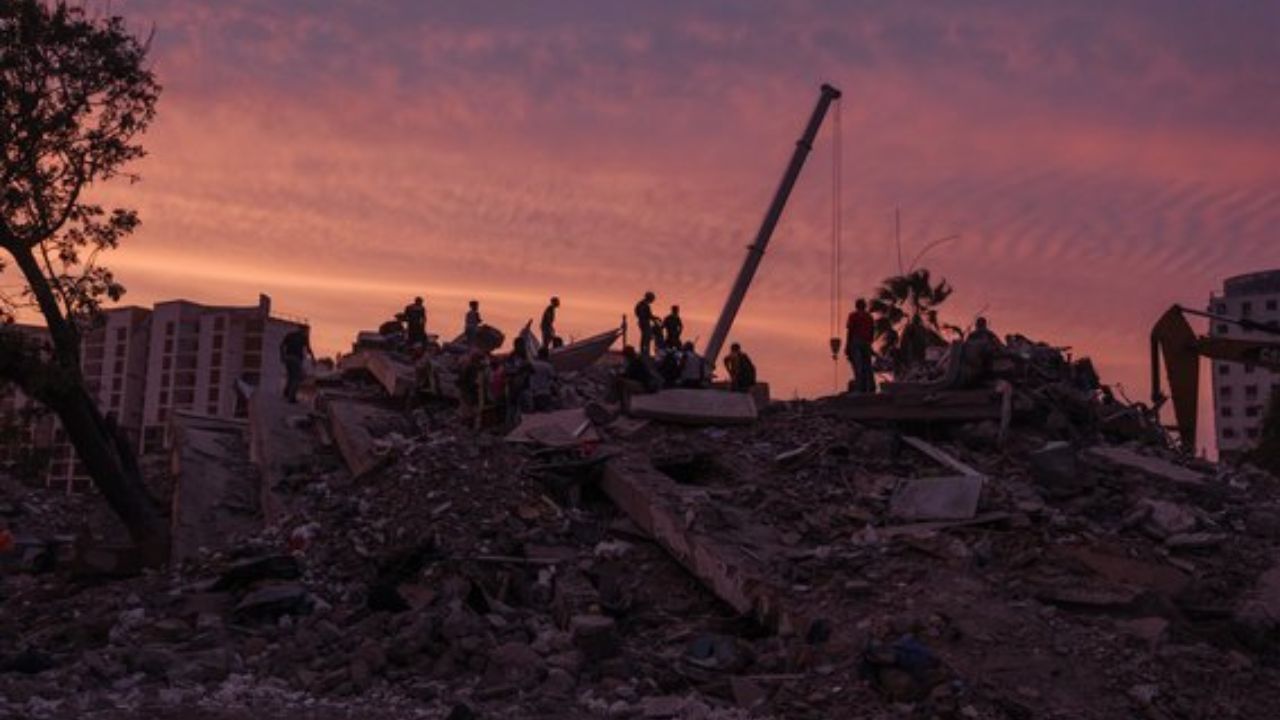
Times reporters on the ground after the quakes witnessed how these towers, called OPPPEs for the government office that built them, became some of the densest pockets of death. Bodies were pulled out of some of the buildings every day for weeks.
But the OPPPE buildings were not the only ones to collapse into piles of rubble.
Nearly 700 structures in all were destroyed, according to an analysis of satellite imagery by Copernicus, the European Union’s earth observation program. Hundreds more were damaged.
While Venezuelan officials have publicized data saying 190 buildings fell completely, a government minister overseeing a commission reviewing the damage, Francisco Garcés, told the Times that the real number is far higher — 656 buildings and 370 homes, all collapsed or partially collapsed.
Officials have also refused to say how many Venezuelans are still missing and presumed dead, a major source of anger for many survivors. But Venezuelans have created their own citizen-led efforts to report and count the missing. On one site, Venezuela Earthquake Disappeared, locals have reported more than 29,000 missing people.
Jorge Bastidas, a Venezuelan programmer who started the site, said some of those names are likely duplicates or are of people who have since been found, despite efforts by his team to remove double listings and to encourage people to report discoveries.
Still, he said, the number is an indication that there are likely thousands of uncounted quake deaths.
A second site from a team doing similar work, Venezuela Reports lists more than 40,000 missing people. That team has also attempted to eliminate duplicate entries.
One challenge to quantifying how many people may have died is that Venezuela has not done a rigorous field census since 2011, according to Robert Rodríguez, a Venezuelan researcher and former election official.
So Rodríguez used recent voter registration numbers to estimate the population in the hardest-hit areas of La Guaira. He tallied the number of registered voters from the seven worst-hit precincts, then added 38% of that number, to account for children, visitors and unregistered voters.
He believes there were 342,000 people present in the hardest-hit part of La Guaira on the day of the quakes.
The Venezuelan government last updated its public count of the dead on Aug. 24, two months after the quakes hit.
Oscar Murillo, who leads a Venezuelan human rights group called Provea, said an accurate number was essential for both healing and accountability purposes.
It would help victims’ families feel seen, he said, and also “provides the information needed to determine whether criminal or civil investigations and sanctions are warranted due to potential deaths that could have been avoided.”
—
This article originally appeared in The New York Times.
By James Glanz, Julie Turkewitz and Helmuth Rosales/Adriana Loureiro Fernandez
c. 2026 The New York Times Company