
|
Getting your Trinity Audio player ready...
|
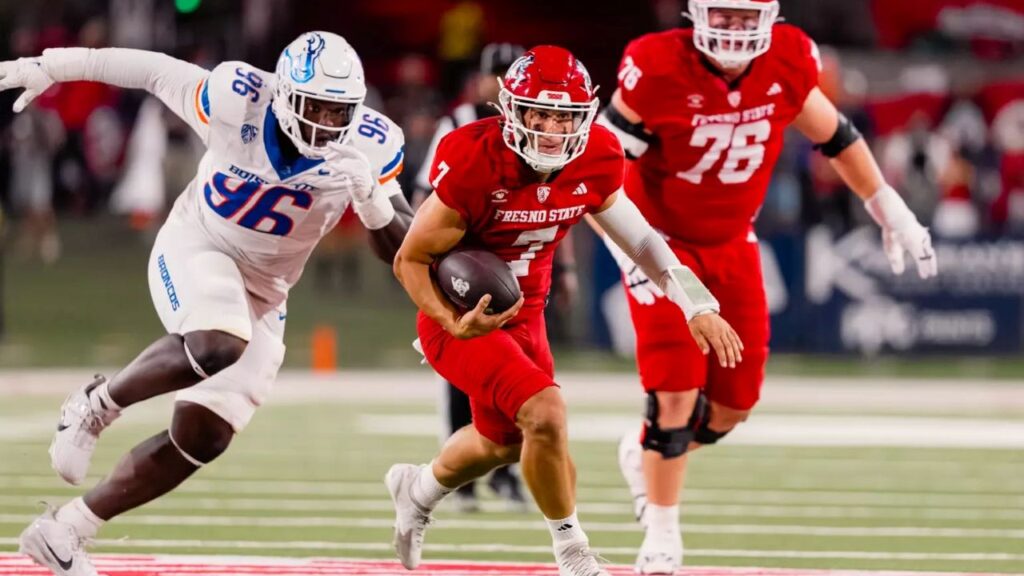
Sens. Cory Booker and Eric Schmitt were both scholarship athletes in college. Now they find themselves on opposite sides of potential landmark legislation the Senate is considering that would impose a sweeping new regulatory framework on collegiate sports.
“While a college student and a player, I saw how unjust the NCAA is,” Booker, the New Jersey Democrat and former Stanford University tight end who is a leading opponent of the bill, said of the governing body of college athletics. “It is a serial monopolist, controlling an industry over $15 billion strong and rapidly growing.”
Schmitt, a Missouri Republican who played baseball and football at Truman State University, is one of the proposal’s most ardent supporters and argues that the legislation is the only way to preserve popular college sports that teach valuable life lessons.

“I had the opportunity to play in college and throughout my life,” Schmitt said on the Senate floor. “When you are on a team, you want to win, and you want to win with your teammates.”
At the moment, Schmitt’s team is winning big after his colleagues gave the measure two strong, bipartisan shows of support last week, moving it toward Senate passage and an uncertain future in the House. More than 70 senators have backed the bill so far, a significant showing in the sharply split chamber, though some may ultimately vote against it if changes are not made.
Schmitt and his allies say the complex legislation is needed to stabilize the unsettled world of college sports. Some top college athletes are paid as much money for use of their name, image and likeness, or NIL, as professional athletes, and can maximize their compensation by transferring schools multiple times. Without new rules, the proponents warn, some sports with less of a following than football could be eliminated as money runs short.
And they contend that Congress is only the institution capable of addressing the myriad issues.
“There is a lot of pent-up demand to try to fix college sports. It is clearly broken,” said Sen. John Thune, R-S.D., the majority leader. “It has been proven over time that nobody else is going to fix it.”
A devotion to sports has always run deep in Congress. Politicians are by nature hypercompetitive and often were athletes in high school and college, celebrating their experiences on the field as particularly formative.
Thune played high school and college basketball, and one of his daughters was a Division I track star. His father was a standout basketball player at the University of Minnesota.
Sen. Shelley Moore Capito, R-W.Va., played tennis at Duke University, and Sen. Kirsten Gillibrand, D-N.Y., played tennis and squash at Dartmouth College. Sen. John Fetterman, D-Pa., played college football.
Sen. Jon Husted, R-Ohio, recounted his own sports journey on the floor during debate on the college sports bill, noting that it was his desire to play football that got him interested in attending college in the first place.
“I ended up playing football at the University of Dayton,” said Husted, who said that he was listed as the team’s seventh running back but stuck with it even when a team manager expressed skepticism that he would ever play. “For me, that resilience paid off because later I ended up having the opportunity to be a starting defensive back, eventually became a national champion and an all-American.”
Even those lawmakers who did not play at a high level are frequently sports junkies. And state universities are an important element of any lawmaker’s portfolio, with ties to donors, boosters and constituents.
Sen. Tommy Tuberville, R-Ala., was the head football coach at Auburn University. Sports success has traditionally been a winning ticket in politics, and big-name athletes and coaches are a staple of Congress, including basketball superstar Bill Bradley, who represented New Jersey in the Senate; NFL great Steve Largent, who served in the House; and Nebraska football coach Tom Osborne, who went on to represent the district where he grew up.
The immense popularity of college sports is one reason the legislation, the Protect College Sports Act, rose to the top of the Senate agenda even though some lawmakers argued that the scarce floor time before the election might be better spent on issues with more impact on reducing costs. But lawmakers know people are generally more invested in college sports than, say, legislation to speed approval of major infrastructure and energy projects.
“We do a lot of things up here that back home people wonder, ‘What are you talking about? What are you doing?’” Schmitt said. “This is a cultural issue. This is something that our folks back home do care about.”
But the legislation, while seemingly headed toward Senate approval, has drawn sharp opposition, led by Booker and other Black lawmakers as well as civil rights and labor groups. They say that while coaches and conferences will prosper under the bill, it will cause college athletes — many of them Black — to lose some of their hard-won leverage by imposing a cap on overall compensation, a limit on transfers and a fixed five-year window for playing.
Booker’s playing days have given him added credibility with his colleagues.
“For Cory, it is personal,” said Gillibrand, who has joined him, about 20 other Democrats and a few Republicans in unsuccessfully trying to slow the measure. “I’m on the side of the athlete.”
The debate has exposed internal rifts in both parties. Sen. Maria Cantwell of Washington, the chief Democratic author of the bill, took to the floor last week to argue that the legislation would ensure the future of college sports and Olympic training.
She noted that it would protect the right to compensation for student-athletes and institute significant other guarantees for scholarships and healthcare. It also would cap agent fees and prohibit professional athletes from returning to college.
“We are not interested in having some 27-year-old pro college player beating up on a 19-year-old who is basically just entering his college academic career,” she said.
Still, while she clashed with Booker over the bill, she acknowledged what he brought to the debate as a former player.
“I do respect his work and passion on this issue,” she said. “I do respect that he was an athlete who had various experiences.”
Citing those experiences, Booker vowed to use his platform to continue battling the legislation.
“I wouldn’t be here,” he said, “if it wasn’t for being a high school all-American who got an unbelievable shot to a full scholarship at Stanford.”
—
This article originally appeared in The New York Times.
By: Carl Hulse/Eric Lee
c.2026 The New York Times Company