




|
Getting your Trinity Audio player ready...
|
Cassandra Michael, the getaway driver convicted of aiding and abetting the murder of 18-year-old Caleb Quick, was sentenced Wednesday to seven years in a secure youth treatment facility.
Fresno County Superior Court Judge Brian Alvarez imposed the maximum term available at Michael’s juvenile disposition hearing, rejecting a defense request for four years and a probation department recommendation of six years. Michael will receive 482 days of credit for time served.
Michael was found guilty of first-degree murder on Aug. 17 following a bench trial before Alvarez.

Caleb was shot outside a McDonald’s near Willow and Nees avenues in Clovis on April 23, 2025, and later died at a hospital. Prosecutors said Michael drove the white Tesla used to transport the shooter before and after the targeted, pre-planned killing.
The defense maintained during the trial that Michael did not know the shooter planned to kill Caleb.
Caleb’s side of the courtroom was packed Wednesday with relatives, friends, and supporters, while fewer people sat on Michael’s side. The hearing became emotional as Caleb’s parents described their son and the life he would never have.
Attorneys Debate Michael’s Rehabilitation
Alvarez began the hearing by reviewing and clarifying portions of Michael’s probation report, including correcting a reference to second-degree murder. Michael was convicted of first-degree murder.
The judge noted that an adult convicted of the same offense would ordinarily face 25 years to life in prison. Because Michael was tried as a juvenile, Alvarez was required to select a baseline term of four to seven years.
The defense requested four years, arguing that Michael has strong prospects for rehabilitation and was not the person who pulled the trigger. Defense attorneys pointed to experts who testified during Michael’s transfer hearing and found that she could be rehabilitated within the juvenile justice system.
The defense also argued that prosecutors did not adequately address Michael’s rehabilitation needs when recommending the maximum term.
Michael declined to address the court.
The probation department maintained its recommendation of six years after changes were made to its report. A probation representative said Michael had been fully compliant.
Prosecutor Kendall Reynolds asked Alvarez to impose seven years, arguing that the maximum term was necessary to address Michael’s developmental and rehabilitative needs and prepare her for an eventual return to the community.
“Not because it is the maximum, because it is necessary,” Reynolds said.
Prosecutors argued that four years would not provide enough time for Michael’s rehabilitation.
Father Remembers His ‘Best Friend’
Before prosecutors completed their argument, Caleb’s father, Stephen Quick, delivered a victim impact statement that began with his son’s birth and the arrival of his first “ginger baby.”
He described Caleb as his “mini me” and recalled the close relationship they shared.
“My heart is broken, my best friend, my gym buddy, my goofball,” he said while describing the loss of his son.
Stephen said he struggled to sleep after the killing, experienced changes in his weight, and stopped making some of the recipes his son enjoyed.
He also described the milestones Caleb would never reach. He said his son dreamed of becoming an engineer and an Air Force pilot and was supposed to begin training several months after his death. Caleb had scored high enough to become a pilot, his father said.
Stephen said his son wanted to name his first son Stephen.
“I looked forward to being a grandpa,” he said.
He showed the court family photographs, including one of Caleb, Stephen, and Caleb’s brother together at Disney World.
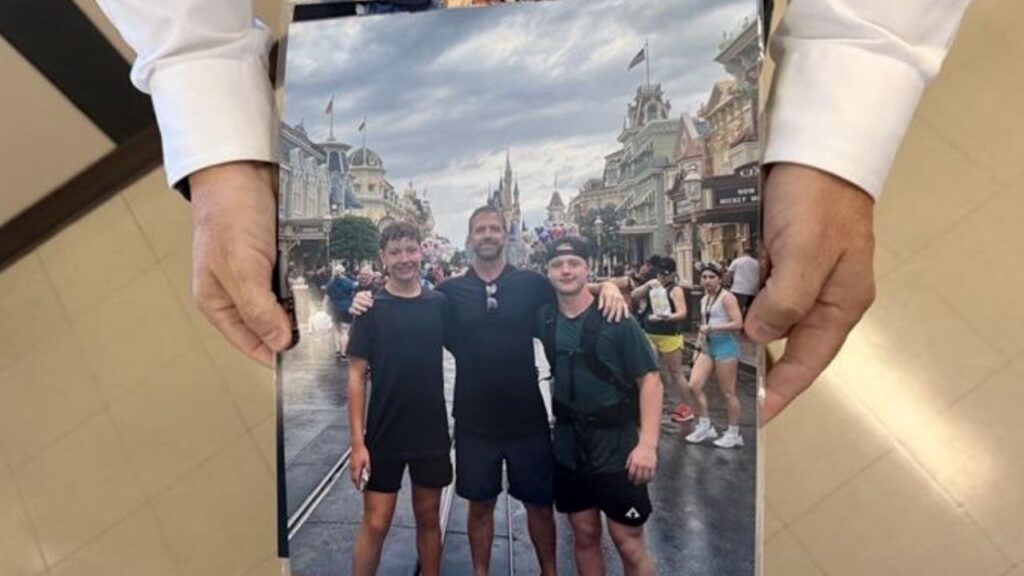
He recalled Caleb’s many friends, his orange Jeep, and his dream of building a ranch in Montana.
He also showed a photograph of Caleb and Michael together with other children on a houseboat.

Stephen said Michael hugged Caleb goodbye on the night he was killed, later saw his body on the ground, and attended prom two weekends after the murder.
“The murder weapon was in a trunk, in a car, at a church,” he said.
Stephen, an outspoken opponent of Proposition 57, argued that the juvenile justice system does not adequately address juveniles who commit heinous crimes. He called Michael a psychopath and asked Alvarez to impose the maximum term.
“I fear for whoever her next victim may be,” he said.
He also asked that his statement be preserved in Michael’s file for consideration during any future probation hearing.
Mother Says Caleb Was ‘the Light of My Life’
Caleb’s mother, Stephanie Bauch, described her son as kind, loving, and a source of light for those around him.
“That life was taken from him,” Bauch said.
She said Caleb was shot in the head and had no opportunity to defend himself.
“I have to live the reality that my firstborn son is gone,” Bauch said.
Bauch said Caleb’s death took away a piece of her and left his brother without the person who had served as his protector.
“We will never know who he will become,” she said. “He was not a case number … he was my son.”
Bauch said no number of years could represent the value of her son’s life or provide what she truly wanted.
“No sentence can give me another conversation with him, no sentence can allow him to grow older,” she said.
She asked Alvarez to impose the maximum term.
“I will carry Caleb with me for the rest of my life,” Bauch said. “He was my firstborn son, he was my protector, he was the light of my life.”
Both of Caleb’s parents became emotional while addressing the court. Michael’s mother also cried during the statements.
Michael’s father was expected to speak on his daughter’s behalf, but the defense ultimately told him, “Let’s not do it.”
Judge Calls Michael Equally Culpable
Before announcing the sentence, Alvarez questioned how Michael could hug Caleb while knowing that he was about to be killed.
“Something is wrong,” Alvarez said.
The judge contrasted Michael’s upbringing with those of minors who enter his courtroom after being neglected, disadvantaged, or mistreated by their parents. Michael did not have that background and instead had significant advantages, he said.
Alvarez said Michael expressed sadness despite knowing she was involved in the plan.
“It is quite concerning for the court,” he said.
The judge found Michael equally culpable with the shooter and described the killing as sophisticated. Although Michael had no criminal history, Alvarez said the gravity of the offense weighed in favor of the maximum term.
“Even though she did not pull the trigger, she started the chain of events,” Alvarez said.
The judge said there was no evidence that Michael suffered from an impairment and found that the killing was neither rash nor spontaneous.
“There is something wrong with her, I do not know what it is,” Alvarez said.
Alvarez then committed Michael to a secure youth treatment facility for seven years.
—
Connect with Anthony W. Haddad on social media. Got a tip? Send an email.













![[hubspot type=form portal=8576119 id=f5235c74-daca-46b2-b841-0fec24b5a509]](https://gvwire.com/wp-content/uploads/2026/09/GVH_LaborDaySavings_300x250_static.jpg)
