
|
Getting your Trinity Audio player ready...
|
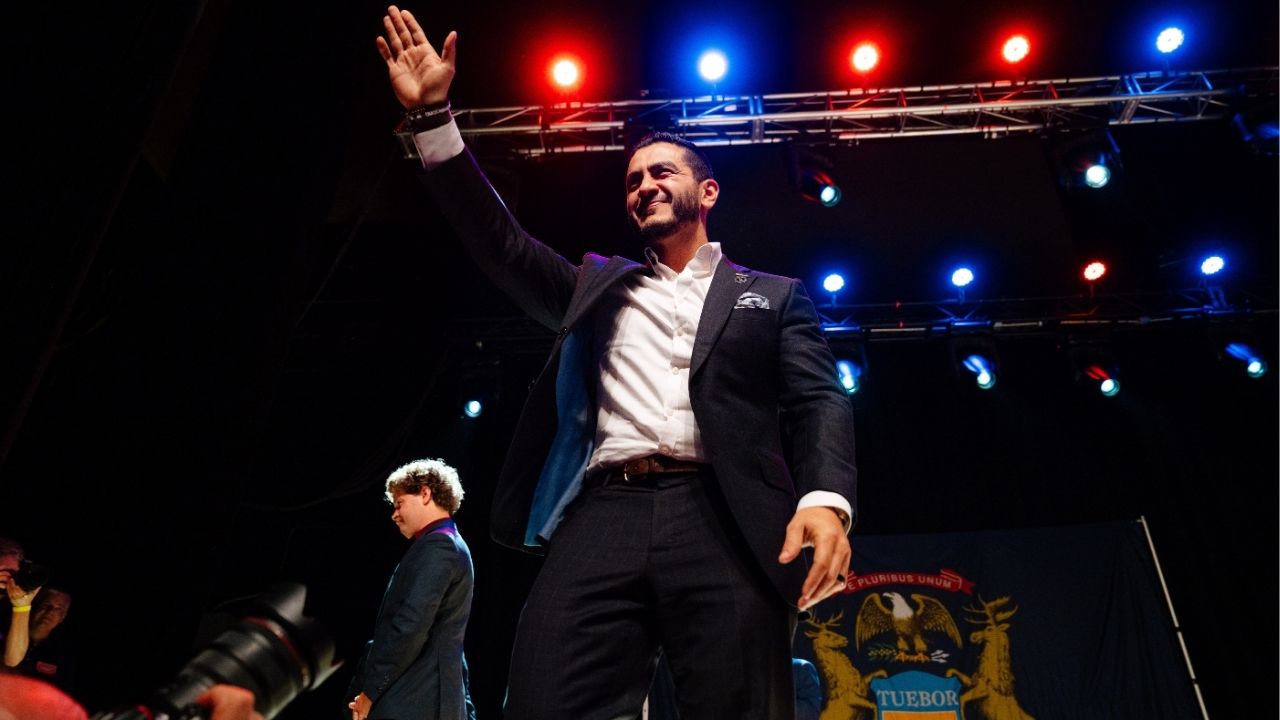
Vice President JD Vance called Abdul El-Sayed, Michigan’s Democratic Senate nominee and an outspoken critic of Israel, “very, very evil” at a campaign rally near Detroit on Monday and accused him of heightening racial and religious divisions.
“I realize that there’s something about Abdul El-Sayed that is very, very evil and on the rise in the United States of America today,” Vance said at the event at a warehouse in Sterling Heights hosted by MAGA Inc., President Donald Trump’s super political action committee.
Vance was in Michigan campaigning for former Rep. Mike Rogers, El-Sayed’s Republican opponent in one of the nation’s most hotly contested Senate races this fall. The vice president’s remarks appeared aimed at stoking tensions between El-Sayed and Michigan’s Jewish community, which the Democrat has been attempting to allay since winning his party’s bitter primary against a pro-Israel opponent in early August.

Over the weekend, El-Sayed, who is Muslim, met with members of the Jewish Democratic Caucus to apologize for a remark he made in March after an assailant drove a truck into a synagogue in West Bloomfield Township, Michigan. The candidate said he regretted saying that “hurt people hurt people,” a comment that some interpreted as too sympathetic to the perpetrator, whose deeds were described by authorities as a “targeted act of violence against the Jewish community.” The man, 41-year-old Ayman Mohamad Ghazali, died in the incident.
Vance’s comments appeared to reflect a strategy of trying to harm El-Sayed’s standing among Jewish voters. The vice president’s one-day trip to Michigan also illustrated the stakes in the race, which many Republicans view as must-win if they are to retain control of the Senate.
In his remarks, Vance praised the rabbi of Temple Israel, the synagogue where the attack occurred, as well as a guard who was injured in a firefight with the attacker. He met with them backstage before the event, a spokesperson for Vance said.
People like El-Sayed “see themselves not as citizens of a common nation fighting for every single person — whether they’re Jewish or Christian, whether they’re white or Black or brown — but see themselves as fighting for one group at the expense of others,” Vance said. “And that is how, ladies and gentlemen, you destroy the United States of America.”
Others in the party have gone further to try to demonize El-Sayed by using anti-Muslim stereotypes. Joe Gruters, chair of the Republican National Committee, told Fox News on Aug. 6 that “Mike Rogers is a guy that would be the first responder going to help the victims of 9/11, and El-Sayed is the guy that would have been friends of the guys flying the plane.”
In addition, the Senate Republicans’ campaign committee referred to El-Sayed by his full name, Abdulrahman Mohamed El-Sayed, in a news release issued in early August that accused him of supporting “terrorist organizations.”
Rogers, meanwhile, has sought to cast his campaign as more friendly to Jewish voters. Last week, he released a list of 344 Jewish Michiganders who had pledged to support his campaign.
El-Sayed called Vance “a sock puppet” and cast his policies as “evil” in a statement responding to the vice president’s remarks.
“Evil is ripping healthcare away from working people in exchange for tax breaks for billionaires,” El-Sayed said Monday. “Evil is making people pay more for groceries and gas while pushing for trade wars and actual war. Evil is dividing people for your own gain. Evil is selling out your morals for a little bit of power.”
Onstage Monday, Vance also took issue with El-Sayed for making remarks about the second lady, Usha Vance.
Last week, El-Sayed mused in a social media post about whether the vice president would take her “back in time to meet Papaw” if he could, referring to Vance’s late grandfather and seeming to imply that he would not have approved of the Vances’ interracial marriage.
“Abdul, keep my wife’s name the hell out of your mouth because she’s way out of your league,” JD Vance said, prompting a roar from supporters.
Usha Vance is of Indian descent. In his first memoir, “Hillbilly Elegy,” JD Vance wrote that it was “one of the great regrets of my life that Mamaw and Papaw never met” her.
It wasn’t El-Sayed’s first mention of Usha Vance. In a podcast episode in April, he accused JD Vance of having made his career by “hating people who are different” and suggested that the couple’s mixed-race children would have to reckon with that fact. He also suggested that Usha Vance, who gave birth to the couple’s fourth child in July, was not physically attracted to her husband.
JD Vance also sought on Monday to tie El-Sayed to past remarks by Hasan Piker, a Twitch streamer and progressive commentator. The vice president described watching El-Sayed “campaign around the state with somebody who said that America deserved 9/11,” a reference to a comment by Piker in 2019 that he has since disavowed.
—
This article originally appeared in The New York Times.
By Bayliss Wagner/Nick Hagen
c. 2026 The New York Times Company