
|
Getting your Trinity Audio player ready...
|
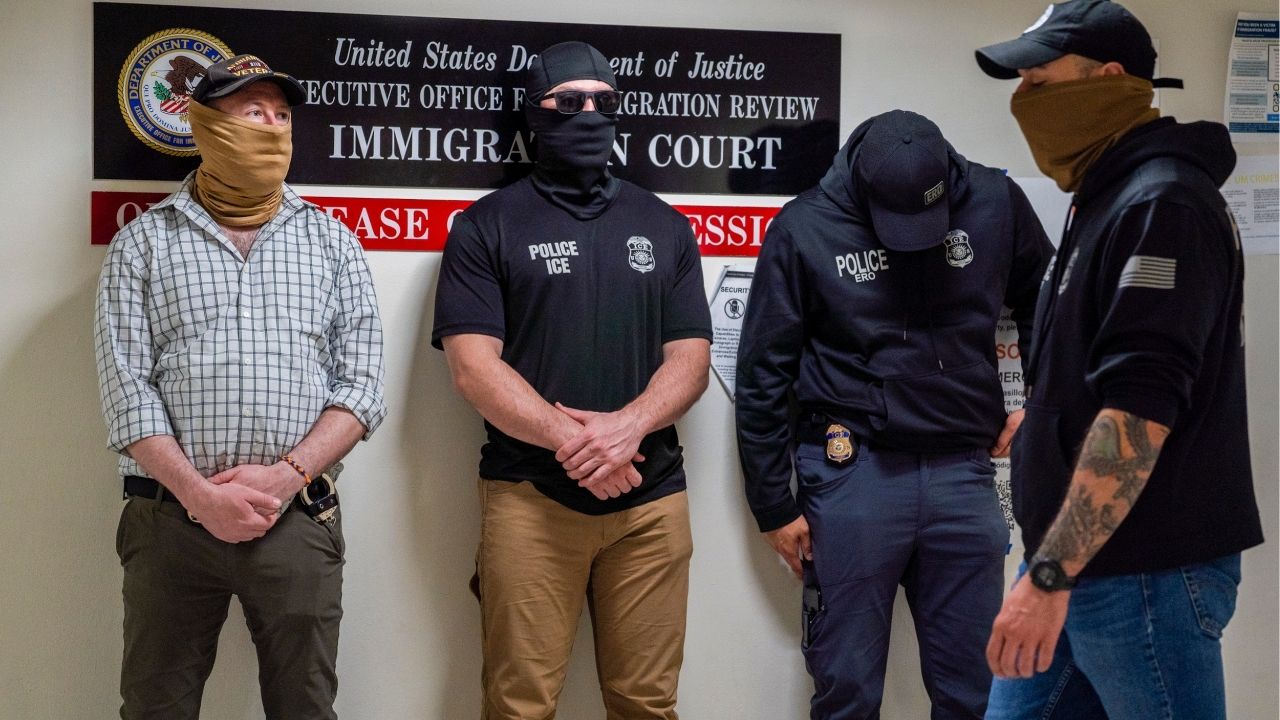
New York’s law prohibiting federal immigration agents from wearing masks and requiring them to display identification was blocked on Monday after a federal judge issued a preliminary injunction halting the ban.
The Department of Justice has vehemently opposed New York’s efforts to rein in U.S. Immigration and Customs Enforcement operations, saying they represent an illegal push to regulate the federal government. In June, the Trump administration sued to block the mandates.
Judge Mae D’Agostino of the Northern District of New York partially granted the Justice Department’s request for a preliminary injunction, saying she expected the federal government to succeed at trial with its argument that the state’s “face covering and identification acts directly regulate federal officers in violation of the Supremacy Clause.”

D’Agostino wrote that New York officials “may be correct that federal immigration officers wearing masks and not displaying viable identification creates certain dangerous situations that the face covering and identification acts remedy.” But she added that “settled law establishes that federal, not state, authorities make the policies that animate the enforcement of federal immigration laws.”
The decision comes less than a month before the state’s broader ban on formal collaboration between local law enforcement and immigration agents goes into effect on Aug. 25. In her ruling, D’Agostino allowed that measure to proceed.
The ruling is nonetheless a victory for the Trump administration, which has argued that ICE agents need to wear masks to protect them from harassment. The administration previously succeeded in having a similar law struck down in California, after a judge said the legislation had improperly discriminated against federal officials.
In a joint statement, Gov. Kathy Hochul and Attorney General Letitia James applauded the judge’s decision to allow the cooperation ban to take effect, saying: “Local law enforcement should be focused on local matters, and New York taxpayers should not have to foot the bill for any collaboration with ICE.”
New York will review all legal options regarding the decision on masks, James and Hochul said, adding that “we stand firm in our belief that masked agents do not make New York safer.”
Hochul, a Democrat seeking reelection this fall, has been increasingly outspoken about her frustration with the Trump administration’s immigration policy, taking particular umbrage at the separation of families and the frequent occurrence of ICE agents covering their faces and name tags to avoid identification.
In November, Hochul will face Bruce Blakeman, the Nassau County executive. Once known as a moderate for his support of abortion rights, Blakeman, a Republican, has become one of the strongest defenders of President Donald Trump’s deportation agenda and the tactics of ICE agents.
Last week, Blakeman stood alongside the parents of Sheridan Gorman, an 18-year-old woman from New York who was killed in Chicago by a Venezuelan man with a criminal record, according to local police officials.
“Our public officials have let them down,” Blakeman said, blaming Gorman’s death on “sanctuary policies promulgated by those who have an agenda that is anti-American, antipublic safety, pro-criminal.”
Echoing Trump, Blakeman portrayed migrants coming to the United States as criminal predators.
“Many of them have come from jails in their own countries,” he said. “They let them out so they could prey on America.”
As county executive, Blakeman has a formal agreement with ICE agents that allows them to round up noncitizens who have been jailed on suspicion of having committed crimes. By allowing ICE into jails, agents had been able to avoid raids on schools, hospitals and daycare centers, Blakeman added.
This type of coordination is banned under the immigration package Hochul signed into law earlier this year, which also bans ICE agents from raiding schools, hospitals and daycare facilities unless they have a judicial warrant.
New Yorkers’ views on ICE and its deportation tactics soured after immigration agents killed two people in Minnesota this winter. Others have since been killed after confrontations with ICE agents, drawing additional scrutiny and spurring the agency to review its approach.
In a March poll from Siena University, 44% of respondents said they supported deporting immigrants living illegally in the United States, down from 49% a month earlier. ICE itself was even less popular, with 62% of respondents opposing the agency’s approach.
—
This article originally appeared in The New York Times.
By Grace Ashford/Madison Swart
c. 2026 The New York Times Company