
|
Getting your Trinity Audio player ready...
|
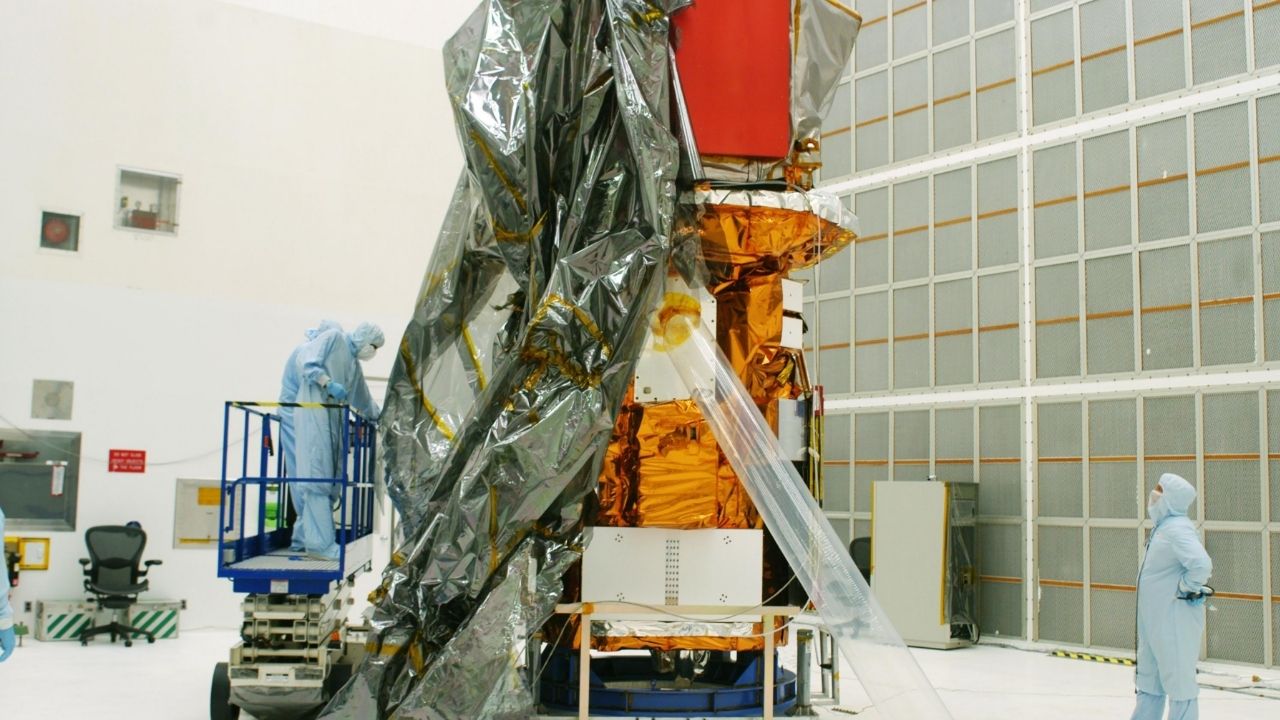
A one-of-a-kind NASA space telescope is about to fall out of the sky.
For more than two decades, the Neil Gehrels Swift Observatory telescope has gazed at the fading afterglows of some of the universe’s most violent explosions.
After launching in 2004, Swift initially circled about 370 miles above Earth’s surface. That far up, there were hardly any air molecules for Swift to run into, but slowly, over time, its orbit descended lower and lower.

It is now at an altitude of about 210 miles, where the air is denser, dragging on the telescope. Within a few months, the friction will pull Swift into the thicker part of the atmosphere and rip it apart.
That is, unless a robotic spacecraft can pull off a daring, never-before-tried rescue: catching Swift and then nudging it back to a higher orbit. That spacecraft launched successfully July 3.
“I am cautiously optimistic,” said Brad Cenko, the principal investigator for the Swift mission.
A small startup company, Katalyst Space Technologies of Flagstaff, Arizona, developed and built the spacecraft, called Link, in about nine months, a breakneck pace compared with typical space missions, which take years to get off the ground.
But to save Swift, the luxury of careful, thorough engineering was not an option. Ghonhee Lee, the CEO of Katalyst, said NASA had laid only two basic requirements: Boost the spacecraft and do not run into it or otherwise damage it.
“That gave us a ton of flexibility in how we designed the program and how we designed the spacecraft,” Lee said.
A replacement for Swift, if NASA decided to build one, would most likely take years and cost hundreds of millions of dollars. Giving a $30 million contract to Katalyst to boost Swift was a smart bet, NASA officials said.
“The risk of us losing Swift — if we hadn’t done this — the odds were 100%,” said Shawn Domagal-Goldman, director of NASA’s astrophysics division. “That’s why, from a financial and management standpoint, this made sense to do.”
He was more emphatic during a later news conference: “No one thought it was going to be possible. No one thought we would get as far as we’ve already gotten today.”
Successfully rescuing Swift could add years of precise gamma-ray burst observations.
Gamma rays are a form of light like radio waves, the visible spectrum of light and X-rays, but they possess the very highest energies. In the 1960s, satellites that were built to monitor nuclear weapon tests unexpectedly discovered flashes of gamma rays popping all around the cosmos.
When another telescope spots a gamma-ray burst, Swift lives up to its name by quickly swiveling toward the newly discovered burst and making detailed measurements of the high-energy light as it fades away.
Those brief torrents of gamma rays tell stories about moments of extreme cosmic violence, like explosions of stars and the collisions of small, ultradense stars known as neutron stars.
NASA originally counted on Swift lasting just two years, and it did not include any contingency plans for boosting the orbit a couple of decades later.
The pace of descent is difficult to predict, because it speeds up and slows down depending on the ebbs and flows of the sun’s 11-year sunspot cycle. When the sun is more active at the peak of the sunspot cycle, it shoots out more intense solar flares that heat the Earth’s atmosphere and puff it outward, increasing the drag on orbiting satellites like Swift.
The most recent peak, at the end of 2024, was stronger than predicted. That greatly sped up Swift’s fall, and NASA suddenly faced the possibility that the telescope might reenter the Earth’s atmosphere sometime this year.
There was not enough time to design from scratch a mission to boost Swift. Instead, NASA scrambled to find three companies, including Katalyst, that had already developed technologies that could be deployed for this rescue attempt.
Lee said he started Katalyst six years ago with the vision of deploying a fleet of space robots to build, repair and refuel satellites and other infrastructure in space.
NASA awarded the rescue mission contract to the company last September.
“I think we were the only ones that were maybe crazy enough to say, ‘Yeah, I think there’s a possibility that we could do this for that budget and that timeline,’” Lee said.
Katalyst was also fortunate in coming across a discounted, leftover rocket. The price tag for many rockets, including SpaceX’s workhorse, Falcon 9, would use up the $30 million that NASA allocated for the entire rescue mission.
The rescue looks as though it will be in time.
This year, Swift stopped observing gamma ray bursts to perform maneuvers needed to slow its fall. If Swift had continued to operate as usual, the telescope might be about 25 miles lower today, Cenko said.
Mission controllers at Katalyst were to spend a week or two after the launch checking that Link’s systems are working properly. Then the spacecraft will take about a month and a half to approach Swift and grab it.
After that, Link will gradually propel Swift upward for two months before releasing it 100 miles higher, enough of a boost for it to remain in orbit for another decade.
—
This article originally appeared in The New York Times.
By Kenneth Chang/NASA
c. 2026 The New York Times Company