
|
Getting your Trinity Audio player ready...
|
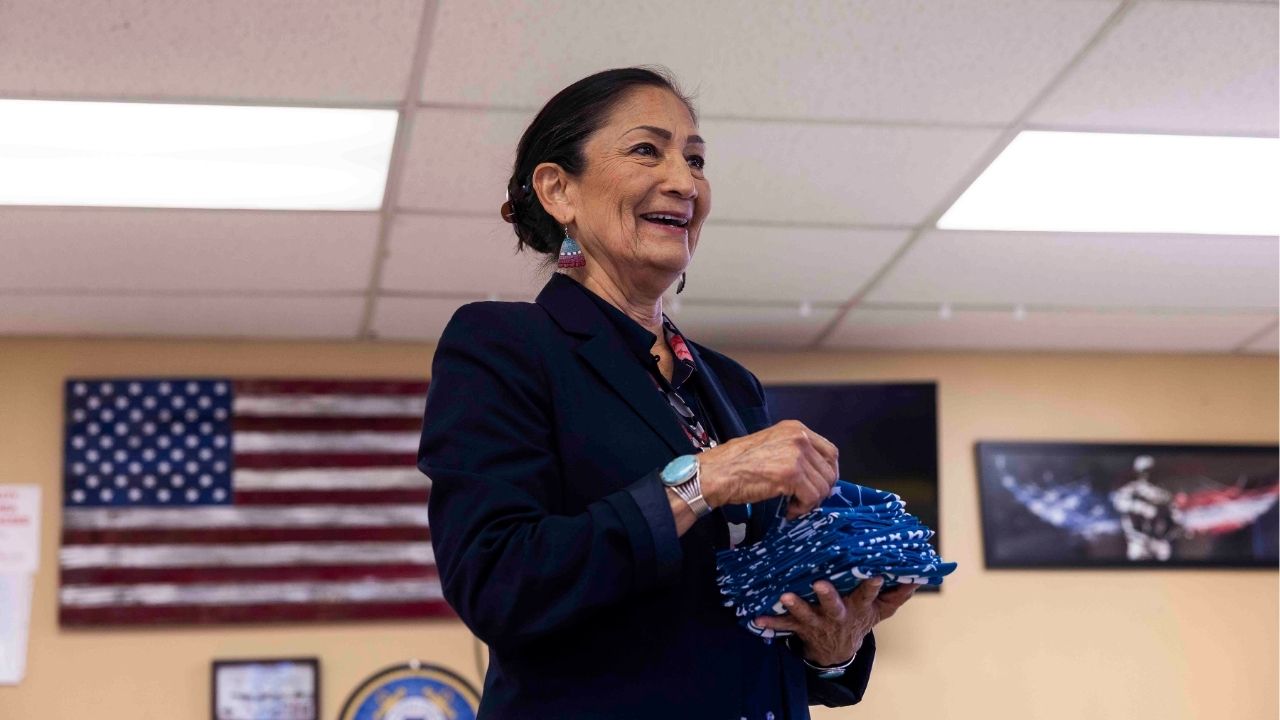
Deb Haaland, a former member of Congress and Interior secretary, won the Democratic nomination for governor of New Mexico on Tuesday, according to The Associated Press, setting her up to make history as the first Native American woman to lead a state.
Haaland defeated Sam Bregman, district attorney of New Mexico’s most populous county and father of baseball all-star Alex Bregman, who ran as a tough-on-crime Democrat and turned the primary campaign into a surprisingly feisty affair.
One of New Mexico’s most prominent politicians, Haaland benefited from robust fundraising, widespread name recognition and the historic nature of her candidacy. In her deep-blue state, where no Republicans hold executive office, Haaland is widely expected to prevail in the November general election.

Haaland launched her campaign in early 2025, less than a month after leaving the Biden administration, and became the immediate front-runner to succeed Gov. Michelle Lujan Grisham, a Democrat who is term-limited.
During the race, Haaland touted her progressive bona fides — she was an early supporter of the Green New Deal and “Medicare for All” — and she leaned on her personal experiences battling addiction and raising children by herself to connect with working-class voters.
Haaland is poised to take charge of New Mexico at a consequential moment. The state is struggling to upgrade one of the nation’s worst performing education systems, while it grapples with high rates of violent crime and childhood poverty. At the same time, the oil-rich state is making millions of dollars off surging gas prices from the war in Iran, giving New Mexico leaders an opportunity to spend the surplus on social programs.
A member of the Laguna Pueblo, Haaland describes herself as a 35th-generation New Mexican and traces her family’s ancestry in the state to the 1200s. She has been a barrier breaker since the moment she entered politics.
In 2015, she became the first Native person to chair a major New Mexico political party. Three years later, Haaland and Sharice Davids of Kansas became the first Native American women elected to Congress. And after her 2021 confirmation, Haaland became the first Native American Cabinet secretary, running a department that once oversaw the repression of Native tribes.
“Representation matters, it matters at the ballot box,” Haaland said in an interview during her primary campaign. “And I have just always felt like Native Americans should be represented by people who care about our issues.”
On the campaign trail, Indigenous New Mexicans, who make up about 12% of the state’s population, were thrilled at the chance to vote for a candidate they felt would intuitively understand their concerns.
“It’s amazing to have someone who is as educated and as experienced as her, who has the lived experience and understands tribal people, tribal communities and tribal perspectives,” said Adam Becenti, a consultant and member of the Navajo Nation, who attended two of Haaland’s events in Gallup, New Mexico.
Haaland also won endorsements from a long list of liberal groups and most of the state’s top elected Democrats, boxing out Bregman, who received support from Albuquerque police officers and a handful of other unions.
Bregman sought to present himself as Haaland’s stylistic opposite, a brash law-and-order Democrat who appeared in campaign ads on horseback wearing a black cowboy hat. He attempted to turn the race into a referendum on toughness — the most important quality, he argued, for standing up to President Donald Trump.
But Haaland also insisted she would push back on Trump’s policies, such as his slashing of food stamps and Medicaid, two programs that New Mexico relies on as much as any state, and his administration’s attempts to privatize public land.
When asked at a forum in Galisteo, a tiny town outside of Santa Fe, how she would protect Chaco Canyon, a sacred Native American site, from administration-backed oil drilling, she replied that she would “sue the pants off Donald Trump.”
New Mexico voters, worried over their state’s most pressing problems, said they want their next governor to do more than face off with the president.
“As Democrats, we’re going to lose if all we do is fight Trump,” said Jose Nieto, a 70-year-old accountant and supporter of Haaland from outside Santa Fe. “You’ve got to actually do something.”
—
This article originally appeared in The New York Times.
By Reis Thebault/Nini Riggio
c. 2026 The New York Times Company