


|
Getting your Trinity Audio player ready...
|
This year, the candidates for California governor were asked at a forum what they were watching on television. Steve Hilton, the Republican who is President Donald Trump’s pick for the job, brought up a British political satire called “The Thick of It.”
“It’s from the producers of ‘Veep,’” he told the crowd, adding that it was “incredibly profane.”
“There’s a character that curses like you’ve never seen before.”

Then he got to his point.
“To my horror, there is a character based on me.”
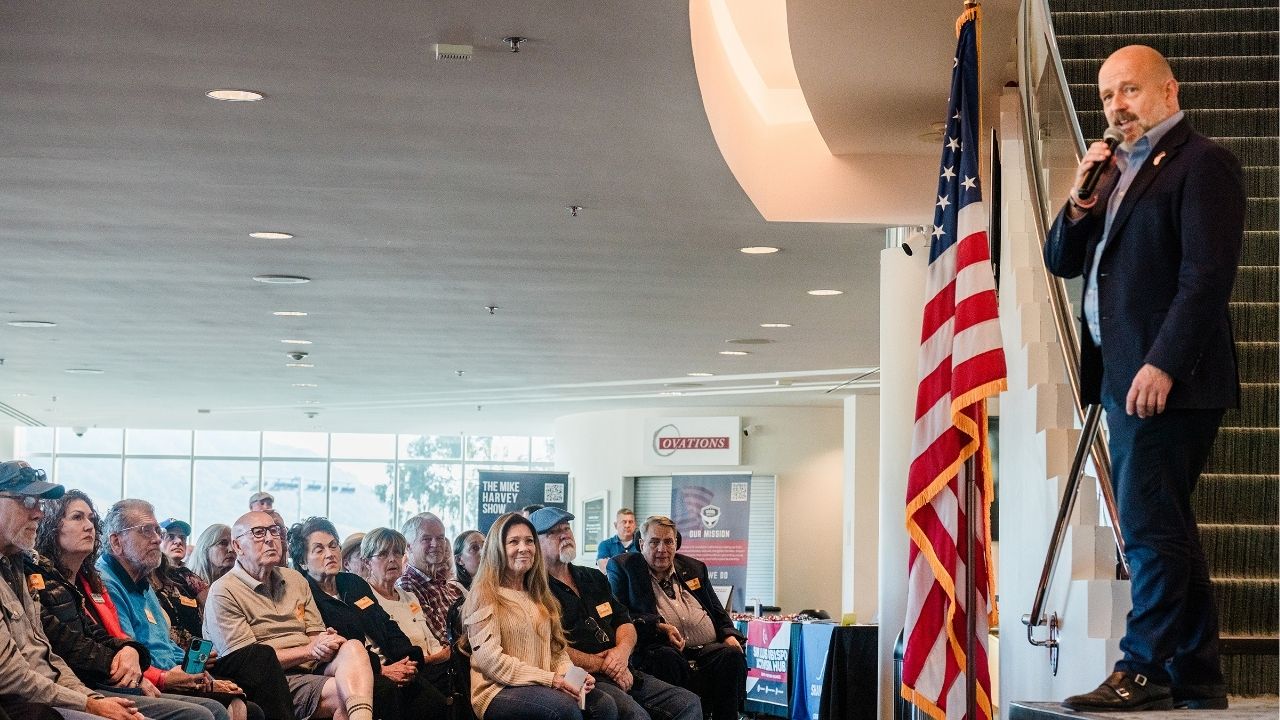
Hilton, 56, is not the typical candidate vying to run one of the bluest states in America. A native of Britain, he served as the headline-grabbing right-hand man of Prime Minister David Cameron before moving to California 14 years ago and becoming a Fox News pundit. Now, he is one of the leading contenders in Tuesday’s primary for California governor. The top two candidates, regardless of party, will advance to November’s general election.
Hilton’s American political renaissance has bemused his former colleagues and rivals in Britain. His alter ego on “The Thick of It,” Stewart Pearson, was portrayed as a clownish figure who tries to push “thought circles” on bewildered Tories and utters pablum like “knowledge is porridge.” The real Hilton became a larger-than-life figure, infamous among colleagues for walking the corridors of Downing Street shoeless and in shorts and proposing idiosyncratic ideas that made headlines, such as using cloud-bursting technology to make Britain sunnier and abolishing maternity leave. (He disputed how both ideas had been previously characterized.)
In 2012, he decided to leave politics and follow his wife, Rachel Whetstone, another Tory strategist, to America. By then, she had embarked on a lucrative career in the tech industry, where she has worked in top communications jobs for Netflix and Google. Hilton settled into a role as a Fox News host. (Rupert Murdoch, the founder of the media empire that includes Fox News, is among his largest donors, as is Google cofounder Sergey Brin, according to campaign finance filings.)
Hilton’s 2024 tax records show that his wife earned $6.7 million. He earned $250,000, though a media production business he set up lost nearly $227,000.
Hilton became a U.S. citizen in 2021 and now sports an American flag pin in the shape of California and wears campaign-trail attire that tends to be business casual, often going tieless in a blazer. In a contest upended by Eric Swalwell’s sudden withdrawal in April, he is promising to make the state “Cal-affordable” by slashing taxes and regulations. He also wants to bring a version of the Trump administration’s Department of Government Efficiency to California.
In an interview, Hilton insisted that a Trump-endorsed candidate can win in California, a notion that even his main Republican rival, Chad Bianco, the sheriff of Riverside County, has doubted.
“To a certain extent, people on the East Coast in particular who look in don’t quite get the level of frustration bordering on rage in California with the conditions here,” Hilton said, adding that “it’s very obvious that the anti-Trump messaging is basically all that the Democrats have in California.”
His campaign hews to more MAGA-friendly fare. He traveled to the state track and field championships to speak out against a transgender athlete’s participation. He wants to make California the “crypto capital of the world” and has close ties to Silicon Valley through his wife, though he himself has said he still uses a flip phone.
He dismissed a proposed billionaire tax as “an insane proposal” that would drive out wealthy Californians, and chided the billionaire in the race, Tom Steyer, for offering qualified support for it. (“I’ve never seen anyone run around so ferociously pandering to every possible interest group,” he said of Steyer, a Democrat.)
Some other billionaires are opening their checkbooks for Hilton. Not only has. Brin donated the maximum amount he could to Hilton, but he has also poured $66 million into Build a Better California, a group that opposes the billionaires’ tax. Other billionaires who have maxed out to the Hilton campaign include Tim Draper, the venture capitalist who proposed splitting California into three states, and Geoff Palmer, a real estate developer whose Los Angeles apartment buildings have been controversial.
Hilton’s parents were Hungarian immigrants to Britain, and along the way the surname Hircsák became Hilton. He was raised in the English coastal city of Brighton by his mother and stepfather. He won a scholarship to Christ’s Hospital School in Horsham, a prestigious institution that funded many less-affluent pupils, and later went on to Oxford University.
He began his career at the research department at Conservative Central Office, working for Cameron, then the head of the political section. By 1992, Hilton was working for Britain’s Conservative Party alongside Cameron and Whetstone, a party strategist, on an election campaign in which the party narrowly defeated the Labour Party. Subsequently, Hilton moved to the advertising company used by the party, Saatchi & Saatchi.
“He quite prided himself, I think, on being slightly eccentric,” said Moray MacLennan, his boss at the time. Hilton was personable and “prodigiously bright and smart,” he said, but “not particularly tolerant of people who weren’t.”
The agency’s mantra was “brutal simplicity of thought.” Before Labour won the 1997 election, Hilton worked on the campaign that featured one ad with the face of the future prime minister, Tony Blair, with demonic eyes superimposed above the legend “New Labour, New Danger.”
With an advertising colleague, Giles Gibbons, Hilton then cofounded a company, Good Business, advising corporations, including McDonald’s and Coca-Cola, on corporate social responsibility.
Then in 2005, Hilton joined Cameron’s successful campaign to become the leader of the Conservative Party before softening the party’s image. In one speech, Cameron called for more understanding of young people, an intervention that became known as “hug a hoodie.” Then, to advertise green credentials, the Conservative leader was photographed hugging a husky on an Arctic trip with Hilton. And the Conservative Party’s symbol, a flaming torch, was replaced with a tree.
Cameron won a general election in 2010 but without a majority, forcing him into a coalition with the centrist Liberal Democrats. Some of that party’s advisers were not impressed.
One of them, Giles Wilkes, said Cameron knew “that of Steve’s 20 ideas, only one of them will be good and the rest will be stupid.” He added, “It was policy by mouth feel. If it sounds good coming out of your mouth and it passes the speech test, or surviving the questions in Parliament test, then it’s good policy.”
But it was Brexit, Britain’s withdrawal from the European Union, that overshadowed Cameron’s tenure. Hilton was for it, and Cameron staked his career against it.
“Before the 2010 election, we had a policy conversation where we discussed making departure from the EU an actual policy commitment,” Hilton said. He argued in favor of it, he said, because he thought it was the right thing to do and also believed the idea had broad appeal beyond the Conservative Party.
He broke with his former boss in 2016, and their relationship never recovered. Hilton, who was the godfather of Cameron’s son Ivan, who died at the age of 6, said he had not had direct contact with Cameron since the Brexit era.
“I think he interpreted it in much more personal terms with a view that if he lost the referendum, that would be the end of his prime ministership, he’d have to resign,” Hilton said. “I didn’t see it that way.”
Hilton is still catching up with his British political legacy and claimed he and his wife were only now watching “The Thick of It.”
“It’s a brilliant show,” he said. “We haven’t quite got to the end.”
Spoiler alert, Hilton. Somebody who looks like you is about to get fired. Or, as they say on the show, “pickled in a think tank.”
—
This article originally appeared in The New York Times.
By Danny Hakim, Stephen Castle and Laurel Rosenhall/Gabriela Bhaskar
c. 2026 The New York Times Company